Showing posts with label Major Arcana. Show all posts
Saturday, November 03, 2018
Home Sweet Home

The ache for home lives in all of us,the safe place where we can go as we are and not be questioned.”~Maya Angelou
I did it! I found a home! It's beautiful and cozy and sweet and happy and it's just the sort of house I imagined for myself. It was built by the seller's grandfather in the 40's. He owned a sawmill that made doors. So he used his "extras" from unclaimed door orders in his own house. No two doors/door-frames are the same size. He used red oak for the floor throughout the house, even in the kitchen. The baseboards and moldings are generous with deep windowsills, stained to match the floors. I have a vestibule (!) with windowed doors. The house has a rather unremarkable exterior, but inside it's an adorable cottage with bright yellow kitchen cabinets that line the length of the large kitchen. We moved in June and couldn't be happier with our new home. At last, I am home.
 | |
| 1JJ Swiss Tarot Created by Stuart Kaplan |AGM-Urania 1970 |
The "Congrats! You did it" card in tarot is The World. As I wrote in "The Spiral World" the World card is about those times on our journey when we overcome
obstacles, complete an objective successfully and feel joy, freedom and a
sense of accomplishment. But with every accomplishment is a new beginning, a new level, a new set of challenges to face. As a homeowner, I am responsible for repairs, improvements, maintenance, insurance, trash pickup, and all that comes with having a home of one's own. There's a learning experience almost weekly here but I'm welcoming even the hard stuff.
 |
| Tarot of Dürer - Created by Giacinto Gaudenzi - Published by Lo Scarabeo |
It begins as this 4 of Wands from the Tarot of Durer, a dream on a
foundation. The woman's expression in this card is hilarious. She's all
"Yeah, yeah, whatever. We've got four poles and a lion skin rug. This is
not a house. Let me close my eyes to try and imagine because this ain't
it." It reminds me of the many houses we toured and tried to envision as
our own but which were inadequate and in need of work beyond our means.
 |
| Housewives Tarot Created by Paul Kepple - Quirk Books |
It ends in 4 of Wands moments like this one from The Housewives Tarot. Moments of bliss like the housewarming party when my family brought laughter and love and blessed my home with appreciation and most of all, their presence. Friends hanging out on the back porch into the night, lit only by a garden torch and the glow of cigarettes. Crockpot buffets, friends sitting at the kitchen table creating their own culinary delights to share, all of us smooshed together on the living room sofa and loveseat. Hauling the extra chairs in from the kitchen so we can all be together in one room. Scooting past laughing people in my kitchen to reach the refrigerator to get someone a beer. It is nothing short of delightful.
Also delightful are the quiet starry skies I find myself drinking in while sitting on my back porch by myself. How starved I had been for outside space while living our apartment life! We didn't have even a balcony there. I'm dotted with mosquito bites but I am undeterred from watching the fireflies dance and rise from the grass in my back yard. As the evenings chill I am to be found wrapped in a quilt on the porch enjoying the outside until inevitably the cold forces me back inside.

Wands stability is unique due to the fire element in the Wands suit. Fire, by nature, must be continuously fed to produce heat, light, energy. Likewise, the stability of a home must be continuously nourished with the ongoing process of home keeping -- everything from maintenance and repairs, decorating and landscaping to entertaining and making memories with friends and family.
Wands symbolize the energetic force behind creativity and bringing things dreamed into being. Our homes are rich with personal investment and expression. One might think a house should be represented by the suit of Pentacles, made of earthly substance such as wood and stone. But houses are more than that. They shelter
us and speak of our identity. They offer warmth and safety, but also
frustration and grief. They serve as a place where we are safe to pursue and express our creativity, devote our energies, and nurture the soul as well as the body. How very Wands-like.
I'll close this happy post with a song that kept me going through the long and arduous search. Enjoy.
Home
Machine Gun Kelly, X Ambassadors, Bebe Rexha
Atlantic Records
from Bright the Album
I'll close this happy post with a song that kept me going through the long and arduous search. Enjoy.
Home
Machine Gun Kelly, X Ambassadors, Bebe Rexha
Atlantic Records
from Bright the Album
Sunday, February 12, 2017
The Spiral World

“Life is a
journey up a spiral staircase; as we grow older we cover the ground we have covered before, only higher up; as we look down the
winding stair below us we measure our progress by the number of places
where we were but no longer are. The journey is both repetitious and
progressive; we go both round and upward.”
―William Butler Yeats
―William Butler Yeats
I love metaphors to a fault. I know when I've traveled too far into metaphor land when my children snap back, "OK, Mom, ok, I get it, I get it." It's like when you've walked along a beach for so long that because the scenery still looks the same you have no idea how far you've gone. Enough with the metaphors. I can never get enough. Tarot, like metaphor, is illustrative language that tells a story and paints a literal picture in order to communicate a vital truth. I love tarot and I love metaphor, so yeah, not going to stop with the metaphors.
I have often heard the metaphor of an onion used to describe an internal process, be it of healing, maturity, or self-discovery. The idea of the onion metaphor is that we continually peel away layers of self to get to the core. The onion metaphor, however, did not line up with what I actually experienced on my personal trek through life. I found that when I overcame a particular personal obstacle or had a breakthrough that allowed me to move on, at some point later I would revisit the same issue. I thought that layer of the onion had been removed. Then a friend of mine shared that she thinks the path is more of a spiral. As we travel the spiral we certainly do revisit the same issues time and again but at a different level. Now that's a picture I can relate to because it mirrors what I have experienced in a more precise way than the onion metaphor.
From the golden ratio and the Fibonacci sequence, the spiral is a constant pattern in the universe. This is a widely observed phenomenon, though scientists have not figured out the "why." Maybe that's better left to philosophers, but the pattern is evident in everything in nature, art, biology, and The Universe itself.


The World card is about those times on our journey when we overcome obstacles, complete an objective successfully and feel joy, freedom and a sense of accomplishment. The wreath that encircles the dancer reminds us of these cycles and that we are never really finished. If you've ever played a video game with "levels" you'll know what I mean when I say this is the "Leveled Up" card. Completing a level is an accomplishment worthy of dancing in celebration, but as any gamer knows the next level will undoubtedly be more challenging and many of the same obstacles you met in the previous level will be presented again but will be more difficult to overcome. However, all along your journey through the levels of the game you have picked up tools and skills and armor to help you in the succeeding levels. In some games, you've also picked up allies who will help you as well.

Wait, these cycles, aren't they what The Wheel of Fortune is about? Yes, but different cycles. The Wheel is most definitely about cycles but they are the typical rotations of life's whims and follies. In other words, fate. While our actions do certainly shape our destinies, we are never free from those events that occur outside of our control that impact our lives. The World, on the other hand, focuses more on how the individual has responded to those and other experiences in order to achieve the successful completion of a goal. The similarities between the two cards doesn't stop there. They each have heavenly beings in each of the four corners. They can be attributed to Christian symbolism of the four evangelists whose books are canonized in the reformed New Testament: Matthew -- a man; Mark -- a lion; Luke -- an ox, and John -- an eagle. These four Evangelists are also represented by the four fixed astrological signs: Leo, Taurus, Aquarius and Scorpio. In The Wheel's imagery they are each busily writing in books whereas in The World they are celebrating the success of the figure in the center. This conveys the message that the Divine was in the seemingly arbitrary events and that heaven was rooting for you all along.
 | |
By Rolf Süssbrich - Own work, CC BY-SA 3.0, https://commons.wikimedia.org/w/index.php?curid=2567511 The four winged creatures that symbolise the Four Evangelists surround Christ in Majesty on the Romanesque tympanum of the Church of St. Trophime in Arles, France. |

Yet another symbol in The World card can be found at the very beginning of the Major Arcana within The Magician. The Magician holds a wand. The figure in The World holds two. This wand is distinct from the suit of Wands in the Minor Arcana. On the table before the Magician, that wand is lying along with symbols of the other suits. So the wand in his right hand with his left hand pointing downward is to symbolize his connection to the Divine and the power to bring forth the adage, "As above, so below." He is, in Waite's tarot, an adept who, unlike the charlatans of previous tarot magicians, seeks to express the Divine within as direct manifestation in his life on earth. The wands in the hands of the woman in The World card are not directly engaged in a concerted effort. She's barely grasping them and they are balanced equally. She's mastered something in her Divine nature and the manifestation is complete. Bravo!

Resting on that laurel wreath is transitory because the next turn of the spiral is right after her last spin on the dance floor. She will find herself back at one, as a Magician, attempting to manifest yet another aspect of the Divine into her earthly existence. No doubt she will go over the same ground previously trod but with a new perspective gained from her last level.
In readings, some situations are readily seen as World events. Graduations, new parenthood, a promotion, an award, etc. I've seen The World show up when someone has been struggling to overcome a broken heart and is a very encouraging indication they are ready, finally, to move on. I've seen it say, "You're above this, don't stoop to their level." and "No need to go through that again, don't reinvent the wheel" (note reference to The Wheel). To a lesser extent this card can be associated with travel, not just a road trip, but more like the kind of travel that requires a passport or visa. However, more often it is a celebratory message that says "Go you!" The question remains, "What's next?"

Saturday, August 03, 2013
When Tarot Says Wait
Of all the hardships a person had to face, none was more punishing than the simple act of waiting.
-Khaled Hosseini, A Thousand Splendid Suns
-Khaled Hosseini, A Thousand Splendid Suns
Tarot is a master of dilemmas. One of the finest uses for tarot is sorting through the angles and what if's and projecting possible outcomes. It's what makes it such a great tool for brainstorming and decision making. So when the advice the cards give is to wait it can be extremely frustrating. We've been waiting, hence the stalemate of the stubborn problem, and we decide to give tarot a go at the situation and even tarot is being stubborn! At first you might think tarot is being obtuse. Like, no shit Sherlock, I already know I'm stuck, give me a freaking answer already!
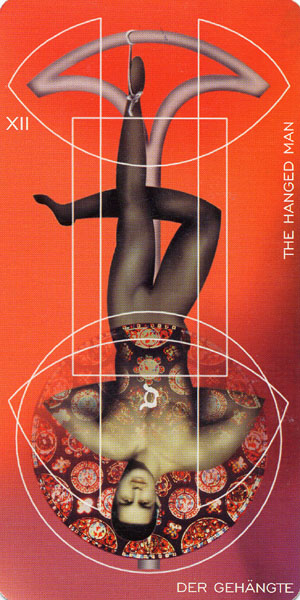
There are several cards in the deck that indicate waiting. The Hanged Man is probably the most obvious as he's got no other option.
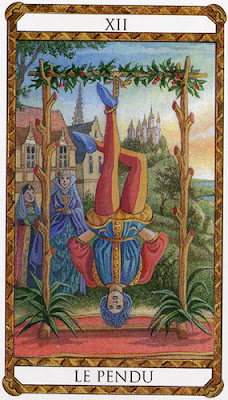
In some ways, as frustrating as any kind of waiting can be, this kind of waiting is one of those "Oh well, may as well make the best of it" kind of times. And with this card you really do make the best of the waiting time and come away from it better off. What's more, you don't have to do much externally. (Well, you can't anyway.) All the good stuff happens internally. Your focus and perspective takes a major shift so when the waiting is over, you're all set to move forward. Getting this card as a signal to wait is a bit easier because you already know if you're caught up like the guy in the card and there's nothing you can do. It's nice to have this acknowledged by a tarot reading so you can accept the situation and get to the internal business rather than struggle against the ropes.
The 4 of Swords is another kind of waiting.

The waiting in this card can be either self-imposed or externally demanded. It indicates a time out either due to illness, imprisonment, a short retreat, even spending time catching up on desperately needed sleep. Like the Hanged Man, it involves gaining perspective, indicated by the swords, as the mental blockade becomes less impenetrable during the time spent in rest. This card advises stepping back and waiting so your mind has an opportunity to settle and in that time you will be better able to go back and deal with the issue. With waiting, time seems suspended and that can be the most frustrating part. Waiting is always less frustrating when we have something to do. But doing isn't always active or physical, it can be mental doing that occupies the time. However, this card says we shouldn't even be doing that. Stop tossing the problem back and forth in your mind for a while. Let it just be and go take care of yourself. Stop obsessing.
And then we have the 2 of Swords:

If ever there was a dilemma card, this one's it. It's not always indicative of indecision. Sometimes it can be a conscious choice to remain neutral in a situation. In terms of waiting, however, this card advises to take that neutral stance until a truth of some kind reveals itself that will undoubtedly break the stalemate. That revelation often comes as the 3 of Swords, an unpleasant truth, but necessary to understand clearly before one knows what to think and do.
Active waiting is another kind, somewhat better to deal with, but still frustrating to get in a reading. The 7 of Pentacles can represent this kind:

In the situation represented by the 7 of Pentacles, you've already put so much time, energy and investment into the situation but you're wondering if you should expend any more. It may be starting to look like it was all a wasted effort and if you continue you may just be throwing good resources after bad. Or maybe when you started you felt more positive about the whole thing but now, you're just not sure it's what you really want. And it's turning out to be a lot more work than you bargained for, too. This card is full of doubt and wishful thinking. Still, there's stuff you can do in the meantime while you're waiting for the situation to ripen. Until something indicates it's time to go in a different direction, you can keep tending to the situation as you have been. I wouldn't invest any more additional resources if you can help it, but just watch and wait to see if things turn out well (or not). This means you'll still be busy, which makes the waiting somewhat more bearable.
Fours in tarot often show stillness, a time of unmoving stability. The 4 of Cups is interesting because cups, emotions, are often anything but still:

Here's the kind of waiting that one does when you're just not feeling it. You had hoped for more and you didn't get it. There's disappointment and feelings of hopelessness. These emotions have a way of dragging you down so you don't even want to keep trying or hoping. Just fuck it, you think, I should just forget it. But you can't. So you wait until something happens to engage your emotions or passions again. Waiting through this card can feel awful, so the advice would be to try not to be so pessimistic and look around you for opportunities you may be missing that would fill your cup again. Take time to just sit with your emotions (or lack of them) and accept that we all go through times like this. I definitely wouldn't make any decisions during this time. Probably unwise. So wait it out.
I really hate the next one, the 8 of Swords:

Stuck. So goddamn stuck. I always get the sense that this woman didn't get into this predicament by herself. While her own thoughts may be keeping her there, she's been hoodwinked and tied up, too. It's as if someone has deceived her and she is now realizing she has been deceived but doesn't know what to do about it and can't find her way out of the deception. The advice here isn't about waiting for rescue, because that isn't going to happen. The waiting in this card is less about standing still any longer, but waiting on your own senses to engage and give you important clues how to release yourself. This woman can use her sense of smell and hearing to gather crucial information. She can smell the sea and hear the waves and know not to move in that direction. She can feel the sand under her feet and take tentative, careful steps across the sand, feeling her way forward. This card can also indicate you've been accepting of your victimization and it's now time to take some control. This card can reveal why you have been waiting but it doesn't exactly advise to keep waiting. It does, however, advise that whatever you decide to do, do carefully and calculatingly.
Usually the 4 of Pentacles is viewed in a rather negative light, as a miserly, greedy, stubborn kind of energy. But in terms of advice and waiting it can mean not these traits but something different:

This is mine and you can't have any. It's telling you to not give any of your stuff, your time, your resources, your attention. Be stubborn and stick to your boundaries. Don't give in. It's not so much about waiting as about taking a stand and refusing to be manipulated or victimized. So if you're wondering what you can do about a situation and this card comes up as advice, don't do anything. Don't give anything. Let them come to you, and even then, don't budge.
While waiting is hard, really hard sometimes, when the advice is clear that waiting is the best course of action, er, non-action, we can at least use the time wisely and productively by following the other clues in the card's advice. If we need to take a break from the situation, do that. Take a long drive, go to a movie, whatever it takes to get away from the anxiousness of waiting. If the card says just keep doing what you've been doing, then do that and try not to stress over what if's. If you're supposed to start taking baby steps, take one. Doesn't matter which one, just move in a direction. If you can't actually do anything, try to see the situation from other perspectives. A change of mind and understanding can actually be the key to getting unstuck. Waiting is always difficult, but with something to do it seems to pass more quickly.
Saturday, April 14, 2012
The Foolish Hero

"The fool doth think he is wise, but the wise man knows himself to be a fool."
William Shakespeare
He's a complicated character, to be sure. He's good and not so hot. In the game of tarocchi, the Fool carries the same points as any of the Trumps which hold the highest point value, but he has a special function. He's the Excuse card which can be laid down in place of any suit when the player doesn't have a card of that suit to play. As such, he's a very good card to have in one's hand. However, at the end of the game, if the score is split even, the side that played the Fool will lose. Not good.
In the olden days when tarot was new, there was already much commentary about fools. The Bible for example, has tons of proverbs and pithy sayings that warn against being one, the most notable verse being Psalms 14, "A fool says in his heart there is no god." It is important to note that the Hebrew word for fool used in that phrase means someone who is morally corrupt. That's important because tarot images of the Fool range from a court jester to a beggar to a mentally disabled person who each have different characteristics and reasons for acting the fool. The Psalms 14 statement appears to be condemning only the ones who, with full mental capacity, knowingly choose evil over good. Fool is used in the New Testament in ways that point out wrong decision making and Jesus had no problem calling out a fool if it illustrated his point. It was considered a very harsh term back then, though, because it inferred the person was hell-bound if they didn't change their ways, and it calls not only their faith but their intelligence into question. And if "fool" wasn't bad enough, he sometimes added to it by calling some extra ignorant people "blind fools." Fools also get a bad rap in the ancient writings of the Greek philosophers, Confucius, and, well, pretty much everyone who tried to explain the difference between right living and wrong living used the fool as an object lesson in what not to do, who not to be. He has been our shining bad example.
But then St. Paul turned the fool around. In his first epistle to the Corinthians, Paul stated that man's wisdom is foolishness to God and where we think we're crafty and wise, God knows we're ignorant. He contended that the message of the Gospel was seen as foolish to those who were smart and educated by society's standards, so to counter their arguments he embraced the fool and said, "We are fools for Christ's sake, but ye are wise in Christ; we are weak, but ye are strong; ye are honourable, but we are despised." (1Cor 4:10) Basically, he was saying that anyone who accepts and promotes the wisdom of man is the real fool because the wisdom of God, which seems foolish to men, is the real deal. Being a fool for one's faith was suddenly better than all the man-made education in the world. It was a pretty clever way to say, "I'm rubber, you're glue, whatever you say bounces off of me and sticks to you." This statement changed the symbolism of the Fool to someone who was only temporarily lost or misguided but could be enlightened. Not only that, but once enlightened would continue to be disdained by conventional society because they just don't get him. Someone who, despite all outside appearances to the contrary, was actually wiser than those who followed the well-trod path of human convention. And now we have our Wise Fool, the bumbling hero who manages to overcome obstacles and challenges, endures trials and tribulations, gets tempted and falls, rises above the consequences, learns from wise teachers, focuses on the goal, succeeds admirably, and finally is rewarded with a crown of glory. The Fool's Journey is the Hero's Journey.

- They are ignorant and so live a happy and carefree life. They are not intelligent enough to worry about tomorrow or regret past decisions, so they lead a blissful existence in the present moment.
- They are not expected to abide by societal conventions, they may say whatever they please, do whatever they wish and are exempt from consequences imposed on them by societal norms and rules.
- Any wisdom a fool possesses is presumed to have come from a supernatural source rather than from normal intelligence or traditional education. They have not earned their wisdom, it was granted to them. It is a gift.
Tarot's Fool has appeared to evolve into the Wise Fool over time, but I think he was always a questionable composite. While our modern philosophies tend to prefer the Wise Fool over the sarcastic Court Fool, the Mentally Challenged Fool, the Morally Corrupt Fool, and the Beggar, we can find all these archetypes in historical representations of the Fool that predate Tarot. The challenge in tarot reading is to discern which face of the Fool is dominant for that particular reading. I've certainly seen the Fool represent the simple, literal message: "You're being foolish, stop that." It has also conveyed the assurance that, while conventional wisdom would disagree, you are wiser than you know, so don't pay any mind to naysayers. It can also convey warnings to watch your step, danger ahead, and don't dismiss the signs. It can tell you the action someone else took was well-intentioned and innocent, even though it may have ended badly. Interpreting the Fool may also be swayed by which type of Fool is depicted in the tarot deck you've chosen for the reading. One that portrays a more traditional Beggar Fool versus one that looks like a Court Jester will render different meanings. The Court Jester was known for "speaking truth to power" in a more humorous and palatable way, whereas the Beggar Fool could bring welcome wisdom from an unlikely source if you would dare to set aside your prejudices and welcome him onto your porch for a spell.

"But methinks I hear the philosophers opposing it and saying 'tis a miserable thing for a man to be foolish, to err, mistake, and know nothing truly. Nay rather, this is to be a man. And why they should call it miserable, I see no reason; forasmuch as we are so born, so bred, so instructed, nay such is the common condition of us all. And nothing can be called miserable that suits with its kind, unless perhaps you'll think a man such because he can neither fly with birds, nor walk on all four with beasts, and is not armed with horns as a bull."
We start off life as innocent fools and continue through life making mistakes, learning from them, and subsequently find out more and more that we don't know. The Fool is Tarot's bumbling hero, and subsequently, that Fool is us. As he meanders among the Arcana, takes chances, asks questions, falls down, gets back up, faces tragedy, triumph, temptation, and trials, we easily identify with his experiences and so identify with and can apply the meanings of the cards to our lives with immediate relevance. Although we do hopefully become more wise as our path progresses, we find, often to our dismay, that we are never immune from our own foolishness no matter how long we have been on our Fool's Journey. Michelangelo said at age eighty-seven, "Ancora Imparo," I am yet learning.
Sunday, January 29, 2012
We Are Woman

I've been a feminist as long as I can remember. Thanks to my mother, who encouraged her daughters to be independent, strong, and socially conscious of sexism, I have, despite my varied intensity on the subject over the course of my life, always had a deep and abiding passion for the social equality of women. I had a brief crush on a boy when I was 12 years old who asked me in all seriousness, "You don't really believe in all that Women's Lib stuff you talk about, do you?"
"Of course I do!" I retorted, "Why would I say that stuff if I didn't believe it?" All of a sudden, he didn't seem that attractive to me anymore. Mom would blast Helen Reddy's song, "I Am Woman" on the stereo and we would sing loudly and pump our fists:

See me standing toe to toe
As I spread my loving arms across the land
But I'm still an embryo
With a long long way to go
Until I make my brother understand
Oh yes I am wise
But it's wisdom born of pain
Yes, I've paid the price
But look how much I gained
If I have to I can face anything
I am strong
I am invincible
I am woman!
Who else but a woman would use the analogy of an embryo? I liked this verse most of all because it spoke of joining together with men to create a more equal society. Because as long as I've been a feminist, I've also loved men. Or maybe I am just fascinated with men as being so different from myself. Regardless, I believe in a society that simply accepts people from the inside out without regarding them as inferior based on physical characteristics.

You can bend but never break me
'cause it only serves to make me
More determined to achieve my final goal
And I come back even stronger
Not a novice any longer
'cause you've deepened the conviction in my soul
While I won't go so far to thank my abuser for it, my experiences with him certainly served to deepen my convictions about equality for women and particularly to work toward freedom from violence in our relationships with men. I went on to work with domestic violence victims and survivors, hosting support groups in my home and creating and maintaining a website for victims.
Even when I was neck-deep in fundamentalist Christianity, I wasn't content with the more conservative interpretations of women's role in society. I would counter those views with what I believed to be the authentic message of Christianity: mutuality. I did the requisite Biblical research and made a sound case, but received the censure of my church's pastor who said I was unfit for service because I believed and espoused that women could and should serve as clergy. In leaving the church, I was freed from the task of having to prove what I believed to be obvious: men and woman are different, yes, but functionally equal. I wondered what men were afraid would happen if they admitted this. I also wondered why they refused to take advantage of the vast resources of half the population. Just as my pastor relegated me to organizing women's tea parties rather than Bible studies, many men seem content to ignore the treasure-trove of creative insight and intelligence in their counterparts. What does it benefit them to do this?
In the long run, Women's Liberation will of course free men -- but in the short run it's going to COST men a lot of privilege, which no one gives up willingly or easily. ~Robin Morgan

It really chaps my ass that women have had to fight for what should be naturally acknowledged as true. The Greeks were very much into dualistic philosophies and they acknowledged that both masculine and the feminine traits were to be found in everyone. The problem was these characteristics were ascribed value judgments and those deemed "feminine" were seen as less appealing and needing suppression. But here's the problem with dualism: it neglects the whole. The Sanskrit word Tantra transliterates as the weft and warp (duality) of the weave (nonduality), the directions of the threads that create cloth. If one of these dualistic pairs did not exist, neither would the cloth. Equality doesn't exclude the differences or polarities, it includes them, accepts them, and weaves them together to make a whole -- whole person, whole society. Suppression or devaluing one side of the duality makes for a very unbalanced, weak "whole," or rather, something that is not whole.

We've begun to raise daughters more like sons... but few have the courage to raise our sons more like our daughters. ~Gloria Steinem
The Empress is the archetypal "mother" but not all can identify with that. Instead of viewing her as a noun, try instead to view her as a verb. In a commentary written by feminist Gloria Steinem, she explains:
"Think about it: As a noun, mother not only excludes half the human race, but is also limited by fertility and age and intention...Another funny thing about archetypes and dualities is that they aren't really meant to describe actual men and women, but only traits and characteristics, with no value judgment placed upon whether these characteristics and traits are better or worse. They simply are. Men express "mothering" naturally and as easily, and many women really suck at it. The mistake is made when we assume that feminine archetypes belong to women and masculine archetypes belong to men. They don't, they are meant to be balanced within each of us and therefore balancing our societies.
As a noun, mother may be good or bad, willing or unwilling, on welfare or rich, worshiped or blamed, dominating or nurturing, accidental or chosen.
Perhaps that’s why the noun mother is so easily taken over by profanity; or by war, as in “the Mother of All Bombs;” or by war-makers who honor Hero Mothers for birthing soldiers.
But when mother is a verb—as in to mother, to be mothered—then the best of human possibilities come into our imaginations.
To mother is to care about the welfare of another person as much as one’s own.
To mother depends on empathy and thoughtfulness, noticing and caring.
To mother is the only paradigm in which the strong and the weak are perfectly matched in mutual interest." ( Mother As A Verb by Gloria Steinem)
Patriarchy is the result of too strong an emphasis on the masculine part of the duality, too much value given to that particular warp of the cloth. While it has its benefits, such as strength, survival, profit-making, and logic, it is lopsided on its own. Technology and business are examples of masculine archetypal structure and energy and while extremely beneficial, when they ignore the feminine elements they become destructive and ultimately self-destructive. Only when feminine archetypal energy is integrated into these institutions will they thrive in balance with nature and with our own long-term survival.

To me, feminism isn't about who's better or who screwed everything up. It's not about forcing men to shoulder the blame for everything wrong with the world, even though, come on guys, you've made the lion's share of decisions for quite some time now, so take responsibility. It's about awareness and what the hippies used to call "consciousness raising." What does it really take for people, both men and women, to realize we need balance?
Sunday, October 30, 2011
Honoring Death


The practice of taking over existing cultural holidays and "Christianizing" them is something the Church has done practically since its inception. In a well-known speech to the Athenians in the 1st century, the Apostle Paul declares the deity they called "Agnostos Theos," or unknown god, was actually the Hebrew god, whose name was too holy to say. (Acts 17:22-31) There was a temple in Athens dedicated to this god, but it wasn't viewed so much as a deity itself but as a way the Greeks could cover their spiritual hindquarters in case there was a god that existed that they didn't know about and didn't want to inadvertently insult. Paul, being an educated scholar, used his understanding of the Greek culture and literature to sway his listeners to a different spiritual concept, but also using one that was already embedded in the culture. Conversion to Christianity, in Paul's experience, came as a dramatic "Aha!" moment in which he was struck blind for a time. When he could see again, it was as if he saw everything in creation in a new light with a new perspective. Therefore, the effort to convert others to Christianity involved, at least early in the history of the movement, persuading them to see their existing world through the lens of a Christian perspective. That Sun God you worship? That's the Son of God. The death and rebirth you witness each year on the earth? That symbolizes Christ's death and resurrection, and so on and so forth. It wasn't until the Church became a civil authority with the conversion of the Roman Emperor Constantine that it had the official power to not only persuade but demand certain feasts and festivals honor Christian concepts rather than pagan. Constantine himself was Roman and did not cease to be Roman after his conversion. Rather, he credited his successes to the Christian High God but continued to honor the Roman deities as well. In fact, he instructed that Christians and non-Christians alike were to observe the venerable day of the sun. This edict would lead to the transforming of the pagan holiday of Yule into Christmas, but Constantine was happy with it as it was.


Meanwhile, as we don our costumes, attend parties and trick-or-treat, we are participating in an amazing cross-cultural, cross-spiritual event, whether we recognize it or not. We're paying homage to Death and, by extension, to Life. We're facing our fears, whistling in the dark, and honoring our ancestors who have all had to face the same ultimate end. We all participate in the dance macabre.
Monday, October 17, 2011
Occupy Justice

So often we think the power lies "out there" and it's all a matter of what other people and forces do that affect us, but we're the ones that create and shape our world. Justice always seems like an "other" type of force, something outside of us that decides for or against us. Thing is, we are the ones that set Justice in motion. Even if one views her as a kind of karmic balancer, rather than an internal virtue, then she is still profoundly influenced by our actions: past, present, and future. St. Thomas Aquinas defined justice as the constant and perpetual will to render to everyone his due. Injustice, then, occurs when a person or group receives either less or more than what is due to them. The problem, as Lennon observed, is in the lack of awareness that most people possess, either because of apathy or ignorance. People who are educated, informed, and aware of injustice react to it, almost instinctively, and seek to set things to right again. The only way a small, albeit powerful, group could have succeeded in tipping the scales so profoundly in their favor and against the majority without Justice intervening is because the majority wasn't looking or they thought Justice is something done by others and not something they themselves produce by their own decisions and actions.
 |
| Ancient Minchiate Etruria by Pietro Alligo, Lo Scarabeo 1996 |
It is in justice that the ordering of society is centered. ~Aristotle
Among the opponents of the recent protests are those who think the people who are protesting are just pissed off that other people are wealthy and have made something of themselves and that the protests are nothing more than folks with a bad case of sour grapes. What I see instead is the awakening of many people to the reality that we, both individually and collectively, wield Justice's sword. While it is true that Justice represents the decisions made by the "powers that be," what is often overlooked is that we are the creators of those offices, those powers, and it isn't by divine right that those in power maintain their positions. It is all of human artifice and design and therefore can be balanced only by human influence.
Because Justice is a Major Arcana card in the tarot deck, the idea that its power is "fated" or "destined" and is somehow outside of one's control comes into play in many tarot readings. It isn't entirely untrue, that interpretation. As a society, we do vest power in our legal institutions to decide for us, on our behalf. Therefore, when we find ourselves in a situation in which our "fate" must be decided by they who are granted those powers, we can feel quite powerless in the court of Justice. And while our power may be limited in its influence in that moment, we are not powerless. Sometimes Justice rules in our favor and sometimes she doesn't, but nevertheless when Justice is served we know it. It's when we see the scales of Justice totally off kilter that something within rises up, attempts to seize the sword from her hand and start hacking away at whatever resides on the weighty side, and yes, that is our right and duty. It is at Justice's invitation and and plea that we act upon that inner sense of hers inside of us that ultimately determines her final decree.
The problem with human justice is that it is limited by our perceptions. All the checks and balances placed within the system can be circumvented and corrupted by the very people who rely on it to serve them. There is a well-known story in the Gospel of John called the "Pericope de Adultera" about Jesus and the woman taken in adultery. The governing authorities brought a woman who had been caught "in the very act" (ahem) of adultery to Jesus for dispensing of justice. The story illustrates something very important about not only Justice, but who should, and more importantly, who should not wield her sword. Adultery was a capital offense in ancient Jewish society and the sentence was to be carried out by stoning the offender. When the officials brought the woman to be judged, the crowd gathered with stones in their hands in order to, they thought and believed, exact justice. All too often, this is how most of us respond to the call to justice. We follow what we have been taught and so believe to be right. Our inner scales are already weighted with our customs, our upbringing, our cultural mores. With one sentence, Jesus strips the blindfold off Justice by saying, "He who is without sin, cast the first stone." The statement blatantly reveals that not one of us is unbiased, impartial, nor unstained with personal opinion that renders the human being incapable and indeed unworthy of passing such a serious judgement upon another.
All we can do is strive to balance the scales, but we must do so in the understanding that our perceptions are probably skewed and that perfect human justice is probably unattainable. No social movement will ultimately "fix things." However, that should never stop us from trying. The next time Justice appears in a reading, consider where balance ought to be restored and how one might contribute to that effort. If it indicates you are in the position to "render judgement" then consider carefully that you, too, carry the human flaw of bias. If you are the defendant in Justice's court, don't lose heart or feel powerless, but seek to understand your own influence in the events. In human affairs, Justice is something we all work to achieve, but never quite possess.
Sunday, August 28, 2011
The Star's Hope
 |
| Classic Tarot by Carlo DellaRocca Published by Lo Scarabeo 2000 |
 |
The generic description of the card features "a goddess"...wait, which goddess? And do they call her a goddess because she is both beautiful and naked or because she represents a particular goddess myth? Choosing to go with the latter, I researched goddesses associated with either stars or water. I found Inanna, Sumerian goddess of rebirth. Hold up. Rebirth? Wouldn't that be better associated with Judgement? Maybe, but there's a lot more. Others have seen the similarities to Inanna and the tarot Star card, too, and what they are seeing is more than rebirth but alignment with a myth that is only a part, but an important part, of Inanna's legend. Typically, images of Inanna show her either richly dressed or naked. In the story, "Inanna's Descent to the Underworld," which is most useful for the Star imagery, she is stripped of her clothing. Also, for a time during that journey, nature "dies" with Inanna and nothing would grow. It was only when she returned to earth that things began blooming and growing again, hence her fertility goddess role and the watering of the earth. Also, her symbol all over Mesopotamia is the 8-pointed star.
Maybe I should tell the story. Essentially, Inanna needed to visit her sister Ereshkigal who rules the Underworld. She heard her sister's baneful moaning and felt compelled to see her. Any trek to the Underworld risks death, so she garbed herself accordingly: with her crown on her head, lapis lazuli around her neck, a golden bracelet, and a royal robe on her body and a breastplate. She also took a lapis measuring rod and line. When she was announced at the gate, her sister became more agitated and only allowed each of the gates to be opened a crack and Inanna had to remove her garments and ornaments in order to squeeze through each one. She arrived at her destination naked and vulnerable. The judges of the Underworld ruled against her and her sister killed her. She became a rotting corpse and was hung from a hook on the wall.
Her companion outside the gates waited three days and then went seeking help from various Gods and finally Enki,God of Wisdom and Water who had originally blessed Inanna prior to her descent, came to his aid. He created two creatures and gave them the food and water of life to take to Inanna. They snuck into the Underworld and found Ereshkigal in a very distressed state, moaning and crying. Whatever agony she named, they would speak it back to her. Finally she stopped and blessed the creatures and promised to give them whatever they asked. They asked for Inanna's corpse, of course. As part of the deal of reviving her, though, she had to choose another person to go in her place. She ended up choosing her husband because while she was gone, he had gone about his life as if nothing had happened. Though she loved him very much it was clear he didn't love her the same.
Carl Jung, pioneer psychoanalyst who worked extensively with archetypes and myth in his practice and writings wrote some commentary on the Inanna's Descent myth. I found this commentary to be so very enlightening with respect to the Star imagery. The commentary focuses on the Inanna story as it illustrates a journey of deep depression. His commentary, even more than the myth itself, speaks to why this card doesn't always feel so "happy" or "good." It represents the afterwards, the time following a very rigorous examination of one's shadow self, a time of deep darkness and depression. It's as if there is a pause between the Tower and the Star, a time spent in the Underworld groaning, moaning, and dying, a time of utter hopelessness. We don't see this in tarot as it happens in the nether realms, but it is important to understand the cause of the hope the Star implies. The article states: "The solution to depression lies not in great intellectual power, nor in great emotional power. It comes from Wisdom, which encompasses all of the psychological functions." Ah! The missing virtue in tarot! Prudence! The hope she has comes from Wisdom, and from knowing that whatever depths she has visited can be overcome with Wisdom. She has also discarded her former garments for she has learned their value is little compared to the experience of facing her shadow self and integrating it into her being and becoming whole.
Being a veteran of my own treks to the Underworld, I know intimately the cost of depression. Upon my return, I was not happy-go-lucky but I did acquire hope. In the depths, I could not see what there was to look towards. In my ascent, I had hope that things would get better, I would get better. The Star is that time, when you have integrated something rather dark, tragic, painful and costly into your being and, surviving that after having already survived the Tower experience that preceded it, your skin still raw and wet from rebirth, your psyche still wounded and painful to the touch, you spend some time tending to that which you could not when you were "away." Inanna's earth would not grow, so she is watering it to revive its life. The water would not flow, so she is pouring her tears into the stream. It is a time of reclamation, without which we could not move on. You may have to cut ties with people who, as you found out when you were gone, didn't really give a crap about you, like Inanna's husband. You start the process of pruning the overgrowth. This isn't an easy time, but it is a hopeful time. It's a time when others may expect you to be back to "your old self." How do you tell them your old self has died, never to return? Besides, it will be a while before the process of reclamation is done, before you get where you're appointed to go. But it will never be as it was before. You are changed. Your direction will likely change. This is a card of work and healing and growth and yes, rebirth.
Now I understand why it unsettles me so. I know this work. There is a reason stars only shine at night and why the Moon follows this one in tarot progression. It's like that poem by Robert Frost, "Stopping By Woods on a Snowy Evening."
Whose woods these are I think I know.
His house is in the village, though;
He will not see me stopping here
To watch his woods fill up with snow.
My little horse must think it queer
To stop without a farmhouse near
Between the woods and frozen lake
The darkest evening of the year.
He gives his harness bells a shake
To ask if there's some mistake.
The only other sound's the sweep
Of easy wind and downy flake.
The woods are lovely, dark and deep,
But I have promises to keep,
And miles to go before I sleep,
And miles to go before I sleep.
Subscribe to:
Posts
(
Atom
)