Saturday, January 05, 2013
The Decision Analyzer

Many tarot readings are prompted by being faced with a tough decision, one in which your mind and your heart or gut are conflicted and giving you opposing opinions. Upon seeing those boots on Amazon my desire for them leaped and did cartwheels. My mind, upon seeing the $398 price tag immediately chided, "Are you insane?" So my heart started persuading, "But they're FRYE, which means they are very well made and they will last forEVER and they're a classic equestrian boot that NEVER goes out of style and they're WORTH it!" To which my mind replied, "You're an idiot."

Of course, I don't need to do a tarot reading on whether to buy the boots, but there are many opportunities in life that may require a bit more deliberation. Using tarot intelligently for decision making can be extremely helpful, but I don't suggest using a Yes or No type of spread for that. I mean, you could, but it's not particularly empowering and it would probably be faster to flip a coin. Here's a more insightful spread that will help examine the competing arguments inside you. It's called the Decision Analyzer (click on the image to enlarge):
 |
| DruidCraft Tarot by Stephanie Carr-Gomm & Philip Carr-Gomm & Will Worthington Published by Connections 2005 |
In this example, a career opportunity is in the analyzer. The mind thinks it's a wonderful opportunity as the Sun shows what the person is thinking. Maybe it's something the person has dreamed of doing since they were a child. However, the heart isn't so sure. The 5 of Swords indicates there are some gut reservations. There's something about the offer this person isn't fully on board with. Maybe they don't trust the person offering it or the company seems shady. Or maybe it's just a nagging unease coming from some other emotional source that is causing the "bad feeling." It's important, though, to listen carefully to one's intuitive or gut feelings, so this is vital information. What this person wants, the 10 of Pentacles, shows they want long term financial security and stability. The offer may be lucrative and the potential income may be tempting the mind to ignore what the emotional instincts are warning. What they should do, the 4 of Swords, is not act on this immediately but take some time out to think carefully and consider all aspects of the offer and situation. In this example, the action advice is inaction, don't jump on this opportunity just yet. The correct decision will become clear in a short time.
So have at it and let me know how this spread works out for you.
Wednesday, June 27, 2007
Double Celtic Cross
 (click to enlarge)
You begin by laying out the Celtic Cross in the usual manner. I've numbered them on the picture in the order I lay them out, but if you are used to laying them out in a different order, by all means stick with your usual way. Then, you continue laying out a second "layer" of cards around the spread starting again at number one and doubling up through the last card, excepting the crossing card.
The cards are read as pairs, interacting with each other. The second layer isn't necessarily clarifying the first, though it can, but the cards are to be read together, sharing information between them in each position. Once you have the pairs sorted out, you can then see how they interact with each other positionally and the spread is then read in the same way you would read a regular CC spread.
I've used this spread a lot and have found it to be very useful for me, but if reading card pairs or the addition of that second layer of cards is just too much information for you, then this isn't the spread for you. If you are comfortable with the Celtic Cross, then this might offer you a bit of an enjoyable challenge.
Saturday, November 18, 2006
What Do I Do?
 Which way do I go? Tarot is such a great tool for decision making. This is not to say we allow the cards to decide for us. As I've said before, in this post for example, I don't view tarot readings as edict. What a reading can show us are potentials, possibilities, best and worst case scenarios. If things continue to unfold in the direction they are moving, what is the most likely course of events? I wouldn't entrust my future to a pack of 78 cards thrown in a random pattern, would you? Just because I've learned to trust the cards to show me certain marvelous truths and bring clarity to a situation does not mean I think they can be trusted implicitly. Primarily this is because the reliability of the cards often depends on the reader, and we know all readers, being human, are fallible.
Funny things happen when you ask the cards for direction. I've gotten such answers as, "wait and see" and "it's too soon to tell" and even, "find the answer within yourself." Once, when asking for what I should do the cards clearly showed two directions, one the path of following my heart and the other, my mind. The outcomes of both were positive and nonthreatening. The obvious answer was that it was my choice. Often, getting answers from tarot is like sitting with a therapist who keeps asking, "How does that make you feel?" and "What do you think about that?" I admit it can sometimes be frustrating because you just want to be told the answer, not coaxed to find it within yourself. That's too much work.
The Seven of Pentacles is one of those cards that advises a wait-and-see approach. The image on the Rider-Waite-Smith card is one of a farmer leaning on his hoe, considering the produce he has wrought from the earth, and wondering...what? What could he be thinking? Sevens in tarot are "dreamer" cards and often speak of the fantasies, visions, and plans we cook up alone. It's a mystical, spiritual number and a solitary one as well. Given the suit, pentacles, he is likely to be thinking more along the lines of a practical nature, considering the actual product, his material gains and losses, financial reward versus deficit. He's probably considering, too, the physical effort involved in the endeavor. How comfortable is he? What will yield the most security? I imagine him thinking whether or not he wants to continue expending physical and financial resources to this crop or maybe he might be better off doing something else. However, the produce on the vines is not yet ripe. He won't really be able to know whether or not he will be successful in this endeavor for some time. What if mold, disease, or insect infestation attack the crop? What if it doesn't rain? Then again, what if, out of this crop he is able to sell enough to expand his farm and grow and sell even more? But what if he's sick of farming? What if he's only doing it because its a family farm and he really doesn't enjoy it, he'd rather be an artist or a doctor or anything else but a farmer? I know a man who took over his father's plumbing business but really doesn't like being a plumber at all. He has a college degree and would rather be doing something else, but he has a family to support and the plumbing business brings in the primary income. Feeling stuck is part of this card, too. It might show someone who started a business, a project, or a way of life that they, midstream, find unsatisfying but can't just switch gears now. They know they need to wait and see it through, but it's hard when you find yourself daydreaming at work about what you could be doing instead.
One of my favorite decision spreads examines the probable results of two options, gives a likely outcome for each, and gives an advice card about something you should know. It looks like this:
 I really like this spread because it allows the reader to examine the various potential results of two different courses of action. The last card which gives you additional insight often holds the key to which choice is the most sensible as it causes the reader to ponder an additional dynamic. In this example spread, without even knowing the question asked, one can readily see that while Option B might offer some initial, feel-good experience via the 9 of Cups, its overall outcome is the 9 of Swords -- ouch! What the Querant needs to know is the Queen of Pentacles: a nurturing woman that looks to practical needs and often advises taking care of oneself in a holistic way. The outcome of Option A clearly shows a supportive, loving environment or experience and healing via the Star and 9 of Wands. Just looking at these cards would indicate Option A being the better choice because even while insight and wisdom may be gained with Option B via the Ace of Swords and the Hermit, the end result brings about guilt, worry, depression or some other mental torment which really seems unnecessary given that there's an alternative option.
As you see, even with a spread such as this one, tarot isn't giving definites but possibilities. It asks you to examine those possibilities and come to your own conclusions and make your own decision in light of what you discover. Whether you read your own cards or have them read for you, this approach is much more productive. A reader that simply doles out finite answers from the cards leaves little room for an empowering interaction between the Querant and the cards, an interaction which yields so much more potential than just being told what will happen. We are not victims at the hands of capricious Fate and this oracle is best used when we coax our own best answers out of our own wealth of wisdom inside. You are your own best expert on your own life and experiences. Don't hand that over to the cards or anyone else.
Universal Waite Tarot Copyright 1991 US Games Systems
Friday, October 13, 2006
The Celtic Cross Storymaker v.3.0
 When I began reading tarot, I learned, as many tarot newbies do, to use the Celtic Cross spread. It's a 10-card spread that has been a staple of tarot reading at least since Arthur Waite published it, but he claimed it had been used among tarot readers long before he brought it to the masses. The spread is fairly general, but useful, and gives a lot of information, even some you may not need. A lot of people have difficulty with the Celtic Cross Spread. Some say it has too many cards, others say it's too general and doesn't answer the questions specifically enough. I understand those objections and there's no reason to use the spread if you can't seem to get it to work for you. However, I've found a way to read it that helps me, and maybe you, too.
The Celtic Cross Spread is like a story. It has literary elements like a protagonist, antagonist, conflict, climax, and denouement. It also reveals hidden forces at work, for better or for worse, and gives advice to the protagonist on how best to complete his mission. Tarot is story-telling with pictures and this spread lends itself quite well to that method of reading.
The first two cards are the actual cross, while the next four cards are the circle around the cross. The staff up the side is puzzling to many as it is disconnected from the circular cross and some of the positions seems to repeat the ones in the circular cross. There are many, many variations on this spread and different orders of positions as well. I have included a diagram here of the Celtic Cross but actually, I lay the cards down in a slightly different order than pictured here. It doesn't really matter, but it's best to choose an order and stick with it, embedding it in your subconscious so your readings will be more clear to you.
Some readers will use a Significator as well, underneath the first card. In Waite's version this makes sense, as you'll see, given his position designations. A Significator can be chosen by the Querant from the entire deck or from the court cards. It represents the card they see themselves as in their current situation. Or, you may decide to choose a Significator at random which can tell you what may really be going on under the surface with the Querant. Others don't use a Significator at all and just proceed
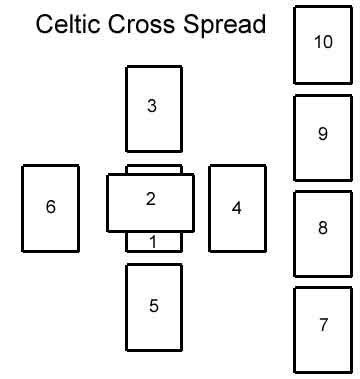 with the spread without it. If we view this spread as telling a story, this card represents the protagonist of the story. The main character. Our noble hero: The Querant.
The first position card is laid just over the Significator, if used, and is called, "What covers you." If you want, you can say that in a spooky voice. This is the main issue at hand. This can show the main focus of the Querant, the main issue or challenge in front of him/her, their strongest feeling or attitude, or even how they have been or desire to approach the situation. Basically, I see this card as saying, "Ok, here's the situation from your point of view." In the story of this spread, this is the protagonist's dilemma or situation facing her. This is the basic issue around which the plot is centered.
The second position card is laid sideways over the first card. This one is called, "What crosses you." This card indicates the obstacles or that which opposes the Querant. In story terms, this is the antagonist. An antagonist can be another person, an external force, or something within the protagonist that brings conflict our hero must overcome.
Using the diagram above, the third position card is laid above the center cross and this is called, "What is above you." There are various ideas about what that means, but generally speaking this is the intended goal of the Querant. It is a potential outcome if she is able to successfully navigate the challenges and if others cooperate as well. The other cards will show if this goal is realistic or not under the current circumstances. So, in story terms, this is the dream of the hero, the intention of his mission, where he has set his sights to end up.
The fourth position card is laid to the right of the cross and is called, "This is before you." This card shows what the very next action in the Querant's situation is likely to be. It will either give advice or simply show what's coming next. It's also called the Immediate Future position and it foreshadows the coming events in the story. It is also the beginning of the action of the story.
The fifth position card is laid below the cross and is called, "This is beneath you" and will give the backstory about how this situation came about. It's like a flashback in a novel, filling in the missing information about a key feature of the more distant past that brought about the present circumstances. It can also indicate a strong character trait that the Querant has that has gotten them thus far and may remind her that she can get through the current problems in a similar way. It, of course, depends on the card and your interpretation to understand what exactly it is referring to.
The sixth position card is laid to the left of the cross and is called, "This is behind you." Rather than being the foundational issue, as in position five, this position tells the reader what has just happened immediately prior to this situation that is even still currently impacting it, but which is passing now as event unfold. This is backstory, too, but because we are able to see dynamics still present, it's current as well. This is action as well, but it's as if we walked in on the scene already in progress.
This portion of the Celtic Cross gives a good idea all by itself about what is going on and where it is likely to go. But our hero has other influences and the challenge is still before her. So, on to the staff.
The seventh position card is laid to the bottom right of the spread and it indicates the Querants present attitude, feelings, and actions. It should be taken as advice, in that if a card comes up indicating a negative attitude or approach, the reader may point that out as being disadvantageous to the accomplishment of the goal the Querant seeks in the third position card. Also, if her approach has been positive, that can be affirmed as well. This is the hero's action plan.
The eighth position card is laid directly above the seventh and it indicates the Querant's environment, the forces and other people who are impacting the events and the way they may be impacting them -- their actions, their opinions, advice, etc. If, say, the Tower appears here, this could show an event out of the Querant's control that will impact the situation and change things for her quite dramatically. If a court or other "people card" is in this position, this would indicate another person who plays a direct role in shaping the events. They could be helping or harming, depending on the situation. Good information for our hero to know.
The ninth position card is laid, again, above the last and it indicates the Querant's hopes and fears concerning the outcome. Other versions use this position as "something the Querant should know." In either case, it sheds more light on what will be the necessary approach, given all the other cards information thus far. It's the final conflict, and if it be her own hopes and fears, it is the protagonist's own inner struggle which brings about the climax as she resolves this conflict within herself and ....
The tenth position card above the ninth indicates the Outcome. This card shows what will likely happen if the story plays out as described in the sequence of cards already shown. Sometimes a card that isn't welcome shows up here, so sometimes one needs to look carefully at the other cards to determine where something might be going badly. It's possible the end result is simply outside of our hero's control and the story becomes rather a tragedy, riveting but sad. Other times there are clues to attitudes we can change, behaviors to adopt and new things to try. The outcome is not written in stone. All the other cards are there to tell our hero what she needs to know to make her OWN outcome, if she can. She can re-write the story at will, and that is one of the best qualities of a tarot reading: that it provides information, ideas, and clues to help us write our own life's stories as we go along.
Wednesday, August 09, 2006
It's Only A Matter of Time, Part II
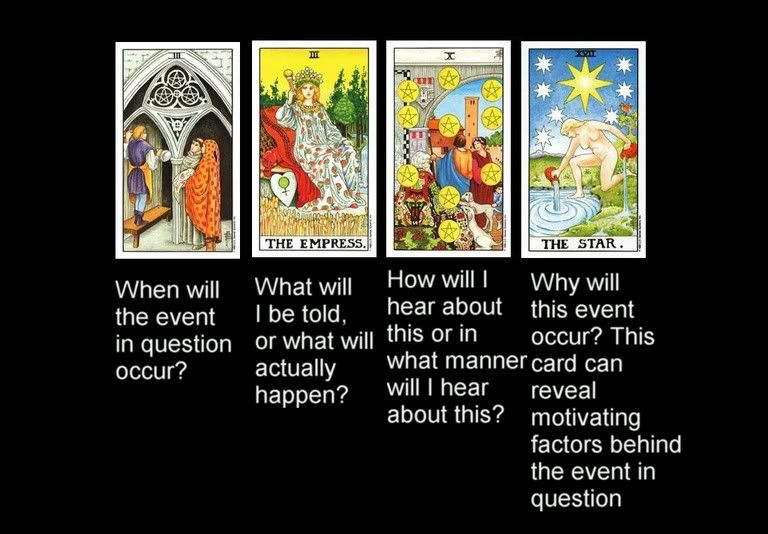
The question for this reading was from a man who wanted to know when he and his wife would conceive their first child, or, put more simply, "When will I hear that my wife is knocked up?"
The first position: When will the event in question occur? Three of Pentacles. Ok...there are several ways you could approach this. First, you could simply read the card and suggest that he will hear of his wife's pregnancy when he gets a raise at work, or when he is at work, maybe in the middle of a meeting. While this gives the querant clues, it doesn't tell him what he really wants to know. He goes to work almost every day, which day will this occur? So let's look first at the number. Three. Does this mean in three hours? Three days? At three o'clock? Well, consider the suit. Pentacles. In my own system, pentacles are the slowest suit and often represent months. They are round, cyclical, and so they tell me that she will likely go through three more menstrual cycles before she will conceive. Also, I place Pentacles in the fall season, so three months from now will put the event in November, autumn, rather than saying the third month, which would be March, the springtime. So, I would say that he will likely hear about his wife's pregnancy while he's at work in about 3 months time.
The second position: What will I be told, or what will actually happen? The Empress. Honey, I'm preggers! The Empress is the Mother of all Mothers, so here tarot is being very in-your-face blunt. In many decks The Empress is shown as pregnant, even, so hi, there's your answer. Enough said.
The third position: How will I be told about this or in what manner will I be told? Ten of Pentacles. This card is all about family ties and wealth. It's about achieving a material goal that allows you to be able to share the wealth, the inheritance, your resources, your self. Once again, I see tarot is being very direct, as this card can also indicate marriage. How he will hear about this is a very tangible message (pentacles are usually something quite tangible that you can see, hear, touch) from his family, particularly his marriage partner. She may purchase something, a card, send flowers, balloons, a teddy bear, something to that effect, and send them to his workplace to announce her pregnancy.
Fourth and final position: Why will this event occur? This card can reveal motivating factors behind this event. The Star. Lovely. This baby has been planned and hoped for for quite some time. They are still in that hopeful place, because the Star indicates the coming event is still a way's off. Three months by my lights. The Star also bodes well for any wished for, hoped for event, it is a wonderful omen, a delightful outcome. The time it takes before the event happens is spent healing and preparing. The card also indicates woman-stuff, fluids, cycles, and this man's wife has been paying a lot of attention to her rhythms and cycles in order to conceive. This attention will continue and will be key in the conception of their child.
Isn't this a great spread? Thanks to Chloe. She rocks.
Tuesday, August 08, 2006
It's Only A Matter of Time
 It's only natural. We want to know "When?" You're waiting on that call, that answer, your life feels in limbo until you hear about that job, that decision. Will the house sell? When? Will they accept my proposal? When? Will he call? When? When will I know so I can make my decision? We really hate being held captive by someone else's actions or decisions. It makes us feel a loss of control in our lives and if there's something human beings have a really hard time with, it's lack of control in their own environment. So we turn to the cards for clues and we hope they can tell us something, anything, about when an event we've been waiting for is likely to occur. However, the cards aren't imprinted with times and dates on them. They speak in symbols and analogies and time, being a manmade construct, is a rather limited box to try and shove allegorical symbols into. Predicting when something will happen with tarot is not impossible, but it's difficult, and there isn't one, particular way to do it.
 First, you need to be really fluent in the language your deck "speaks." The conversations between you must be relatively easy, free-flowing, and reciprocal. This alone takes a while to develop. You should know what your deck means when certain elements present themselves. Do wands represent fire to you or air? Once you have determined the elemental associations with each suit, and understood the individual card meanings (for the most part) you might then be ready to experiment with timing.
The easiest method is to build the timeframe into the question itself. You ask the question in this way: "In the next week, what must I be focusing on in order to get my manuscript published?" That way, you've limited the timeframe to one week's time and any future or outcome cards in the spread will be predetermined to fit in that timeframe. Cheater. Actually, that's a great way to be very specific with your question, and the more specific you are with your question, the more specific an answer you will get. So that's one way. However, it occasionally leads to asking tarot again and again the same question only with different timeframes. How about in two weeks? Three? A month? If anything will get you chasing your tail in circles, asking the same question multiple times in a row will. You're asking for a headache.
There are many and varied methods tarot readers use to determine timing, but what I've found is that they're all dependent on that reader's own relationship and associations with the cards. For example, is fire or air faster to you? Since fire is associated with light (the sun), I view wands as the fastest suit. Swords is slightly slower, as a moving breeze. Cups I associate with water, hence a bit slower than air, like water moving in a stream. Pentacles represent earth which moves very slowly. So these elemental associations with the suits give me clues as to the speed of the event in question. Another clue comes from the numbers on the cards. One (the Magician) and Aces are very quick, almost instantaneous. However, with the Aces, one has to consider the element of the suit as well, as an Ace of Wands will be much faster occurring than the Ace of Pentacles. Fours, on the other hand, the number of The Emperor, are rather static and solid, not going anywhere anytime soon, stubborn almost. So even a Four of Wands, while not as rooted as a Four of Pentacles, is very easygoing and will wait a while. Yet another clue comes from whether the card is a Major or Minor Arcana. The Majors, being "destiny" cards, meaning events that have a major impact on your life, seem to indicate something already in the works. It's going to happen. However, the actual meanings associated with the card must come into play here as well. Temperance, for example, though a Major, takes a while to find just the right mixture between things, and is indicative of patience. We wouldn't need patience if the thing we want to happen comes quickly, so this card says it's going to take a while. It will happen, but not so fast.
Suits can also be associated with seasons. Again, different readers have different associations, and some of these systems are based on the astrological associations of the cards (which is a whole realm in itself!). One of the problems with this system is, again, different people have different astrological associations to different cards. So if you use this system, find one set of associations and stick with it. The key seems to be getting one system embedded into your subconscious so your interaction with the cards bring up those associations more naturally. For me, personally, Swords (air) represent winter, Cups (water) represent spring, Wands (fire) represent summer, and Pentacles (earth) represent autumn.
The numbers on the cards can indicate the number of days, weeks, or months. Or the number of the month, such as 9 being the ninth month, or September. The tricky part is figuring that out. Some people associate pentacles with months, so the Nine of Pentacles then would mean either in 9 months or September. Also, readers sometimes simply pick up cues from the images on the cards themselves, noticing whether the scene in question looks like it's occurring in summer or winter or on a particular holiday.
Combining all these clues and systems and tossing in a healthy dose of intuition and knowing your particular deck's idiosyncrasies based on many, many readings and grasping at something so intangible as the sands of Time itself, you still may find you can only come up with a general sense to answer that elusive question: "When?" In my next post, I'll share a wonderful spread a friend of mine developed that is designed specifically to answer that question, but we've found even after using this spread extensively, you still need to figure out your own system and even then it's pretty trial-and-error. There have been times it's been so eerily accurate that it's made us marvel, but other times she and I will bemoan, "Why did Tarot lie? Why does it lie like that?"
Saturday, July 29, 2006
Like a Bad Penny
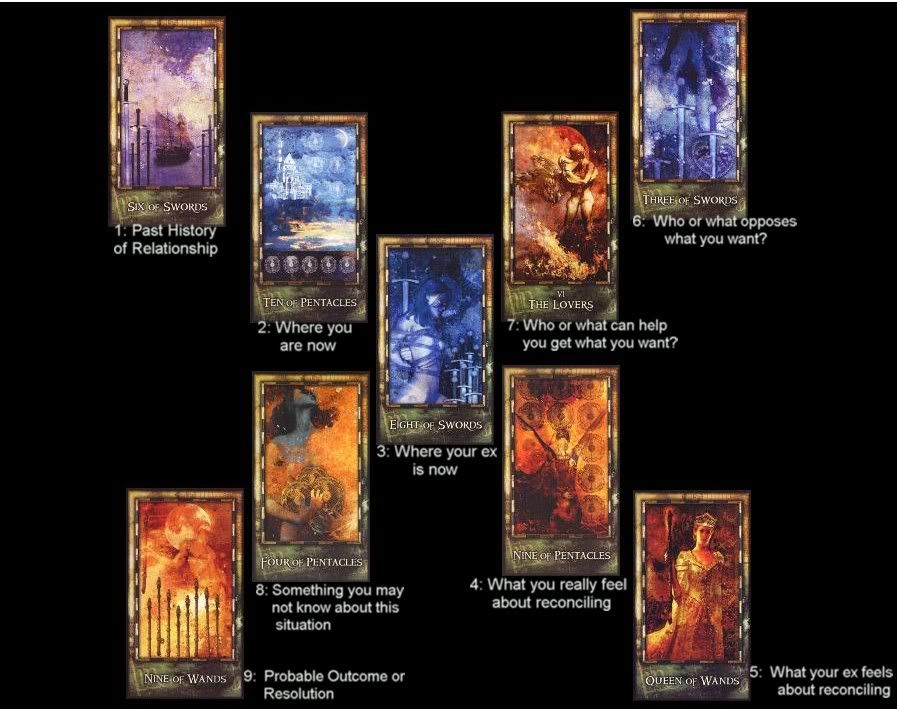
1. The Past History of the Relationship: Six of Swords. Here a ship sails through and past the six swords, leaving them behind, storm clouds appear to be breaking in the distance. From this card it appears the relationship was quite stormy, many harsh words were said on both sides, both people had drawn their lines in the sand, took and held to their positions and the only solution was for one or the other to leave. The six of swords is often a "break up card" in relationship readings as it depicts someone leaving for calmer seas, brighter shores. Sometimes it can indicate a couple getting through a difficult period in their relationship and moving past it, but as this is an ex-relationship reading, it makes sense that this card is depicting what brought the relationship to an end. Given the suit is swords, it appears they had trouble communicating on the same wave length and were opposed to one another's way of thinking as well as speaking.
2. Where you are now. Ten of Pentacles. This is a crucial card in this spread because it tells you about yourself and gives you a piece of what you need to make a more informed decision.
Here we see a very peaceful scene, a large castle-like mansion by a calm sea. The crescent moon illuminates the watery image, telling me that this person has reached that place of peace and security aimed for in the first card, the six of swords. I'm inclined to say that this person was the one who initiated the break-up and has since found a place of inner wealth, peace, and satisfaction in their life. As the ten of pentacles also indicates the wealth of tradition, family and inheritance, this person may have even gone on to marry another and begin a family. If not, it simply means they are quite secure where they are now.
3. Where your ex is now. Eight of Swords. Oy. They're not doing so well. They appear to be stuck as a result of their previous thoughts and actions and now find themselves unable to move in any direction. They could be caught in a bad relationship in which they desperately want freedom from and are looking to you as a way out. They could be overridden with guilt in how they treated you and are looking for the release of your forgiveness. In any case, they are painfully bound up in their own mind and are looking to you for help in removing those bonds.
4. What you really feel about reconciling. Nine of Pentacles. This is another crucial position in this spread, telling you more about yourself. The tendency in these situations is to focus on the ex, to wonder why they called, to try and figure out their intentions but it's very important to instead focus on you and your true feelings about them and what you want to do next. Here is a woman, arms up in freedom and victory, the image of a lion (Strength) superimposed on her torso tells me she is confident and strong in herself. The nine pentacles surrounding her show that she is materially comfortable, self-sufficient, and really doesn't need anyone to complete her or make her whole. I'm thinking the person represented by this card isn't too keen on reconciling with this ex and would rather remain her own person, independent and free.
5. What your ex feels about reconciling. Queen of Wands. This is what is called a "Court Card" in tarot. There are four in each suit: Pages (or Princesses, Knaves, or Fante); Knights (or Princes, though in the Thoth deck Knights are Kings, but Crowley's deck is another ball of wax altogether anyway); Queens (or Regina); and Kings (or Re). These cards are stereotypes of people with the qualities of their suits. I'll go more in depth about courts in another post soon, but for now I'll just say that Queens represent the element of water (emotions, intuition) combined with the element of their suit, in this case wands which, in my way of elemental associations, is fire. Queens are also the means by which plans become implemented, they delegate to others as well as accomplish things themselves. They are actively in charge of things. The Queen of Wands is a passionate, active sort of woman whose emotions tend to guide her actions and passions. She's fairly unstoppable when she is focused on a task that she is passionate about and has a tendency toward the flashy and dramatic. When a Court comes up in a position such as this one, describing how someone may feel, it's helpful to ask yourself, "How would the Queen of Wands feel?" This becomes easier once you get to know these personalities of tarot. The ex in this case probably feels very passionate about reconciling and is eager to see it happen. They would be looking for ways to act on that idea and make it happen in a rather outward, gregarious fashion. The fact that a Queen came up here tells me this person's emotion are key to understanding their actions and how they act is dependent upon those emotions. Watch what this person does as well as what they say, but their actions will tell you how they feel.
6. Who or What Opposes What You Want? Three of Swords. I read this position with the assumption that reconciliation is what is "wanted" or at least supposing it's wanted. It could simply be what is opposing the reconciliation. A figure grieving with hands over their face, three swords, one of which has cracked open a heart. Ouch. This hurt is what is standing in the way. It took a lot of mental processing to deal with the pain of the relationship and the breakup itself, too, so it may not be possible to put that behind either one of you and start anew. It seems there were some hurtful things said that have not been addressed and may still hurt as you look back upon them. While you would like to get past this, you are unsure whether it is possible for you to do so.
7. Who or What Can Help You? The Lovers. This is a Major Arcana and as such, in relationship spreads particularly, signifies a really BIG relationship in your life. This is IT, the One, the connection you've longed to feel and finally realize with this other person. This is the one you know you want to "forsake all others" for and commit to long term. The Lovers represents a major decision of the heart. In this position, though, it serves as advice. It's saying this is what would need to be done in order for this reconciliation to happen. You would need to ask yourself how deep are your feelings for this person? Are they truly the One you have sought and wanted? Is this the person to whom you could or would commit yourself to, sacrifice for, love forever? This is a big decision, and if you find yourself answering yes to those kinds of questions, then yes, reconciliation may be possible, at least on your end. This kind of commitment could help you work through the Three of Swords that oppose you to get past the pain. But if you're really not feeling like you can or want to give it your all, this reconciliation is probably not a good idea.
8. Something You May Not Know. Four of Pentacles. This card shows a figure clutching four pentacles and the body language indicates they are not entertaining anyone else's opinion about what they should do with those pentacles. This person is not engaging on any level with anyone and seems intent on holding on to those pentacles no matter what. This is the person who does not share well or at all. This card may be indicating a lack of willingness to be open or to share one's resources with another. In a relationship it can indicate a clingy, needy person who can be possessive and selfish. Is this about you or is this pointing to something you need to know about the ex? Maybe only the person this reading is for can answer that question. How willing are you really to share what you have with another? If you are willing, then maybe the other person isn't. This position highlights a potential place of difficulty should you decide to reconcile.
9. Probably Outcome or Resolution. Nine of Wands. This card features a man behind eight wands, holding a ninth wand away from his body. He's naked and vulnerable, but he's protected by the fence of eight wands before him. This is not someone ready to engage in the closeness and intimacy of a committed relationship, but rather someone who is still naked and vulnerable behind his walls. He's not prepared yet to engage in pursuit of his passions, the wand he holds as a reminder, but not as a tool or a weapon. My conclusion for this reading is that while the ex is eager to reconcile, the person for whom the reading was done is full of doubts and pain and feels too vulnerable yet to start things up again. They had reached a place of peace and comfort without the ex and has serious reservations about giving up their hard won independence and freedom. While the idea is inviting on some level, the main question needing to be asked is can you or do you want to commit to this person fully? This card seems to indicate you need more time to heal before you are ready to take this, or maybe any serious relationship on.
This reading, done in this way, allows the seeker to ask themselves pertinant questions they may not have been asking themselves or reflecting on deeply enough. Shifting the focus back on to what they want rather than what the wayward ex may want is tremendously helpful in that it grounds the person in their own feelings, needs, and desires. Only they can decide, ultimately, whether to pursue this reconciliation or not, but this type of reading gives them more to go on with which to make that decision.
And just so you know, because I know you were wondering, no, this was not an actual reading for anyone. I simply pulled the cards for the spread at random without thinking of anyone's situation in particular. But if the shoe fits anyone here, go ahead and wear it. You never know, synchronicity and all, if there was a greater purpose to your reading this right now.


