Showing posts with label Reading. Show all posts
Sunday, June 19, 2016
Is It Worth It?

When we find ourselves on a particular path that we've devoted a great deal of time and energy to, and the future being what it is, always uncertain, tarot can provide some valuable feedback that we can use to decide "is it worth it?" In fact, there is a specific tarot card for just this dilemma, the 7 of Pentacles:
 | ||
| Cosmic Tarot by Norbert LoscheUS Games 1986 |
This card represents those moments in a project, a relationship, or any goal process where we begin to have second thoughts after already having started. We may have even seen some progress, some reward or at least the promise of it, but we're starting to tire of the work involved. We may not see enough progress for the amount of energy we've put in. Seven is a dreamer's number, full of what if's, possibilities, fantasies, and hopes. Pentacles represent the earth, the solid ground under our feet, things we can touch and own and give and take. It's not always about money, but it can be. Depending on the goal, a certain relationship for example, it could mean a physical reality coming to be such as moving in together or some other show of commitment that you can see and touch, not mere words or promises. Here is that moment where we are weighing the pros and cons of continuing forward with our plans and efforts. This can be harder than starting something because when one has already invested time, energy, and financial resources, it can be extremely difficult to change course.
Other cards in a reading can give important feedback for us to use when making this decision. The reading itself cannot and should not make your decision for you. Only you can do that. In reading for someone in this situation, even if the other cards show some unpleasant experiences, I always communicate that sometimes we have to get to that really tough place before we know for sure what to do. Or the cards may indicate a struggle to come before a success. So we have to be careful not to jump to conclusions based on seemingly "negative" cards surrounding this dilemma. For example, we might see this sequence:


Other cards in a reading can give important feedback for us to use when making this decision. The reading itself cannot and should not make your decision for you. Only you can do that. In reading for someone in this situation, even if the other cards show some unpleasant experiences, I always communicate that sometimes we have to get to that really tough place before we know for sure what to do. Or the cards may indicate a struggle to come before a success. So we have to be careful not to jump to conclusions based on seemingly "negative" cards surrounding this dilemma. For example, we might see this sequence:
 |
| Original Rider Waite Smith |
It appears there may be a tangible setback and a time of material change and struggle, missed opportunities for success or assistance, leading to some disappointment, loss, and regret, but then followed by a period of recovery and healing with clear signs you are now on the way to your goal. In this case, I would say don't give up when the going gets tough. You will come through to the other side having learned important lessons and with a clearer vision of where you are going, even though you will not have reached your goal, you will see what you are supposed to do. This still doesn't say whether the person will ultimately choose to continue or abandon the current project, but it lays out the likely progression which leads to knowing what to do.

In other readings there may be a very clear message to dramatically change direction. For example we might see something like this:
 |
| DruidCraft Tarot © 2004 by Philip and Stephanie Carr- |
The 10 of Swords tells us it's done, there's no more that can be accomplished in the way you have been approaching things. The 8 of Cups shows an abandoning of a way of being that has become emotionally draining, unsatisfying, or stale. The Ace of Pentacles shows a new opportunity that has much more promise. So in this scenario I would urge my client to consider other options and to critically evaluate their current situation for signs that letting go and moving on would be the right choice for them.

This kind of objective feedback is extraordinarily helpful to one in the middle of a quandary over that assessment of whether something truly is worth seeing through or not. We're often given generic cheerleading advise to keep pushing, never give up, anything that's worth doing is worth giving your all, but sometimes that advice may not work for the specific situation you're dealing with. We also have to take into consideration our own patterns. Do we tend to start things and not finish, or only go halfway and give up? Or do we have a history of holding on to something long past its expiry date? Maybe it's time to change that.
Saturday, January 30, 2016
It's Not About You

"Be careful not to practice your righteousness in front of others to be
seen by them. If you do, you will have no reward from your Father in
heaven."
-- Jesus, Matthew 6:1
When we are doing something that is intended to help someone else the most important thing to remember is that it's not about you. If you respond to that statement, "Well, of course it isn't, silly, I know that." I'm telling you it's harder than you think. Our ego is strong. And smart. And cunning. And it will sneak in self-congratulatory shit when you're not looking.
I read a really thoughtful article the other day on the dilemma of "Good White People" in the fight against racism. The comment section was full of irony, full of "good white people" making it about themselves and then noticing they made it all about themselves and trying to figure out how not to do that. It's hard. The main idea is that no one should feel the need to be congratulated for being a decent human being. You just be one as a matter of course. There are ways to bring important things to the attention of others without also saying, "Look at what a great person I am!" Sometimes we do this with good intention, but it still reeks.
I saw this today: Spiritual Molestation in Chik-Fil-A which I feel really nailed how I have always felt about people doing this sort of thing in public. What made this worse was the underlying coercion of food under condition of prayer. We might say, "What's the big deal? Even if you don't believe, prayer never hurt anyone." True. But to say that one will only help IF the recipient will oblige you is not giving, it's a negotiation. This kind of negotiation is sometimes appropriate but when we are holding something as crucial to life as food as a bargaining tool, we need to be very careful. If the manager of this restaurant really wanted to help this guy he had several options, none of which included making a display of his own faith for others to applaud. He could have asked the guy to meet him around back and take out the trash in exchange for the meal. He might have been able to offer him a job if he showed up every day to take the trash out (and get fed). The manager could have prayed for him silently without drawing attention to himself. I understand God can hear silent prayers.
I also saw this today on why this woman stopped "being a Voluntourist," that is, stopped going on aid missions to third world countries and started coordinating aid efforts that didn't involve her actually being there. The part about the workers coming behind them and tearing down their shoddily laid bricks and relaying them properly (and safely) in the night so the volunteers wouldn't know really brought the point home that these programs are too often set up in a way to be more about the volunteers feeling good about themselves than about the people they are trying to help.
Those who read tarot for others have that "helping others" gene. We truly want to facilitate growth in others and support them in their struggles. That's often the foundational impulse behind what we do. Like any other helping profession it can attract narcissists who get off on various twists of gaining attention, power, and ego stroking, but most of us just want to help. However, even the genuinely motivated ones among us can fall into the "About Me" trap. When we focus on whether or not we did it right, had the right answer, or found the correct interpretation. When we worry too much about the feedback from our clients. When we promote ourselves as super intuitive or act like our readings aren't wrong, the client just isn't in a place to accept the truth. Stop it. It's not about you. Yes, you are the one the client is looking to, but you know better. It's not you, it's them. It's their issue, their struggle, their dilemma, their questions. You're helping only if you understand this and take yourself out of it. The dialogue is between themselves and their understanding of the cards you have done your best to translate for them. You are the interpreter. The conversation is not about you. This subtle but important shift in focus will make such a huge difference in the impact of your readings. By impact I don't mean "accuracy," although that will likely be perceived as such, but by the real and actual help provided by the reading.
All this stuff about helping in a certain way gave me such food for thought because I find myself in a situation now where the last thing I want to do is bring attention to myself for doing something "good" when really, I feel that it's the only human option. My sister was diagnosed with leukemia in 2014. Chemotherapy put her in remission for almost a year. Then she relapsed. The next step is a bone marrow stem cell transplant. Of her three siblings tested, I am the match. In all honesty, I wasn't thrilled with the news and felt like an asshole for not being thrilled. It's not like giving blood, it's a much bigger deal. And the hospital where this will be done is 1000 miles away. There will be missed work, FMLA paperwork, travel time and costs, hotel costs -- all of which our mother is generously financing because it's not covered by my sister's health insurance. Not to mention the procedure itself will require me to be injected with a drug originally meant for cancer patients that disrupts my own bone marrow and causing bone pain for several days and having to sit immobile for six hours or more to have the stem cells harvested. So yeah, it's not nothing. But it really IS nothing when compared to what my sister has endured and will have to endure as the recipient of the transplant. Cancer has turned her life and the lives of her husband and children totally upside down and inside out in ways I'm sure no one but they understand. She recently started a GoFundMe drive in an effort to defray the monster costs of all of this. In my attempts to get the word out to others to hopefully increase donations, I have mentioned my participation in this effort as her donor, but I have tried not to make it about me. Because it's not. Even though it is a little, ultimately it's not. And I know people are just being kind and supportive when they laud me for the act of donating, and I thank them genuinely, but I cringe a bit at the comments that I am "being an angel" or that I am "so awesome." Thank you, and I mean that, but no, I'm not. I don't really see any other option except to be a shitty human being that would deny her the best chance she has to live. And to be honest, I felt weird about posting the GoFundMe thing because I didn't want to bring attention to my part in this but it seemed the best way to get donations for my sister.
I've been taking a break from reading tarot for others until the transplant is over. Just because it's not about me doesn't erase me from the equation. I must still be aware of my own needs else I become useless to others. Making it not about you doesn't mean nothing is about you. You are about you and you need to take care of you. Always remember the flight attendant adage -- "Place your own oxygen mask on first before assisting others."
Sunday, March 22, 2015
Lazy Tarot
 |
“I choose a lazy person to do a hard job. Because a lazy person will find an easy way to do it.”
~Bill Gates
- Cleanse decks
- Use a classic Significator
- Use astrological associations
- Use Kaballah associations
- Do anything about "energies" (no smudging here)
- Use Reversals
- Look at the "Shadow Card"
- Ruminate on a reading
I'm not an astrologer and feel that trying to learn a whole 'nother vast metaphysical art to overlay tarot is just too much work. If I wanted to learn astrology, I would, and maybe someday I will, but not today. Kabballah, same. I've tried using various stones and crystals and noticed nothing different, so whatever floats your boat is fine, no rocks in my boat. I don't "ground" myself other than one deep
I don't turn the cards physically upside down to read "reversals," I generally get a sense by the position, the cards next to/around it, and the question asked whether the card's meaning is "reversed." I forget to look at the bottom card in the deck, so the Shadow Card remains in the shadows. Sometimes other tarot readers have said they will leave a reading out on a table for days to think about it, ruminate over it, journal it to go back to later. I don't. I have journaled specific readings but I always forgot to go back to them, so what was the point?

I do:
- Shuffle, a lot
- Use a Sort of Significator
- Use symbolism: colors, numbers, elemental, suits, objects, etc.
- Use history
- Pay attention to patterns
- Listen to random observations my mind blurts out
- Use common sense
Most of the readings I do include a card that speaks to what the client is thinking, feeling, and/or how they are approaching the issue at hand. This is a Sort of Significator, and I use it because it gives very useful information for the client to use when formulating a plan of action. They can see whether their approach is helpful or not based on what the reading reveals about the other factors and influences.
For me, symbolism is absolutely key in interpreting tarot. Symbols are the language of all humans in all of history. Language itself is symbolism and vice versa. Connected to this is my understanding of history, culture, and the human experience. I notice patterns in the cards. Numbers, suits, colors that appear repeatedly or in a progression or order mean something. Sometimes my mind will say something really random, like an idiom or lyrics from a song and I've learned these random phrases are hugely significant to the reading. I always use them. There was a time I ignored them and was routinely surprised when the client gave feedback that included that exact phrase! When I started speaking them I found my client's feedback often confirmed that phrase played a key role in the situation.
Finally, I use common sense. When the Lovers card appears in a reading that has nothing whatsoever to do with romance, I do not imply the client will fall in love in the middle of updating her resume. While it is possible she may meet a charming person at a job fair, it just isn't sensible to talk romance when she's trying to find out her best option to advance her career. Not ruling it out, just saying, keep on topic.
The practice of tarot reading is so unique to each reader. What works well for one is cumbersome for another. I have been known to spend untold hours researching symbolism and cultural history in my pursuit to understand tarot card meanings. Many readers would shake their head and say, "Ain't nobody got time for that!" But I love it. I love the research and the richness of history and how people lived in times before, how that relates to the images we see now, the connections, the gaps, all of it. Others feel and experience a very tangible difference when using cleansing rituals or objects. Some can't help but see the astrological or Kabbalistic connections and feel they would be remiss if they didn't include them. Whatever you do or don't do in your reading process matters only to you.
But seriously, lazy is good. Keeping what works efficiently and either re-working or tossing out what doesn't makes sense in everything we do. Time and effort are both valuable resources. Be lazy and enjoy what you do.

Sunday, October 05, 2014
Doctor Google & Tarot
 | |
| Image by MaricorMaricar Studio....... |
I've been really out of sorts for a few months. This blog and many other things have taken a back seat to some sudden onset health issues I've been dealing with. It has been stressful but I'm finally taking action and I'm finally starting to feel more like myself again.
It started in June, more or less. I'd had a pinched nerve in my upper back a few years ago and it went away on its own. It took six weeks but when it was gone, it was gone. Until a few months ago. This time it didn't go away. Instead, after four weeks it changed. It became much sharper and sent more than a dull ache down my right arm. Shocks of nerve pain were constantly traveling up into my neck, down my arm and to my fingers. Walking hurt. Working hurt. Cooking hurt. Cleaning hurt. Driving hurt. I lived on anti-inflammatory meds and rest.
I delayed going to the doctor because insurance. I have it, but it's not affordable. High Deductible Plan with only $500 in my Health Savings Account. I know that nerves cannot be seen on lower cost x-rays and that I would need a pricey MRI. I didn't know what kinds of medications I would need to pay for out of pocket. I also have to pay for non-preventive doctor visits out of pocket and I also have another pressing health issue I must see a doctor for which will likely lead to more imaging tests and lab work that, again, I must pay for out of pocket. My pocket is not that deep. My rent is being raised $50 a month starting next month and I still don't know how that will be adjusted for in my no-wiggle-room budget. In addition to the pain and ongoing symptoms and concern for my health, I was also very concerned about my finances.

And then of course, there's Doctor Google. I was pretty sure I was dying of cancer by the time I had researched my symptoms. Possibly three or four types of cancer. And maybe a rare genetic disorder, I'm not sure.

Driven by pain and worry I scheduled my appointments and said fuck it to the finances. About a week before my appointment, the pain subsided a lot. The nerve shocks still occur when triggered, but the unrelenting pain is gone. Sweet relief! The doctor prescribed prednisone which gave me
 |
Hartwig HKD Creative Commons License
|
This is why I don't read tarot for health issues: Anxiety. I may have pulled a few cards for my situation over the last few months but the swords cards always made me think I was going to have surgery and the pentacles cards made me think I would have to pay a lot of money. I pulled one before my visit to the neurosurgeon and it was the King of Swords, which cracked me up because that's a surgeon card if there ever was one. It was like tarot saying, "Just go see the doctor." Which is probably what I'll tell you if you ask me for a health reading.
 |
| Pamela A. tarot |
I will read about how you can make the most productive use of your time while you are dealing with health issues. I will ask tarot for advice how you can focus on self-care. But the advice will be general to your health issue and specific to you. I will not attempt to, nor should I, diagnose your issue. We may discover, for example, that stress is contributing to your issue, but stress will not be the issue. If the Death card appears, I will tell you that something will end, hopefully your health issue, and you will need to adjust to something new in the way of living life after that -- and we'll draw a card to see how to navigate that. I will not tell you that Death means death in a health related tarot reading. I will not give you a prognosis because how foolish and irresponsible would that be? The last thing anyone needs is a reading that echoes Doctor Google. I will interpret the cards in light of what you can do today, tomorrow, in your present and immediate future to aid in your recovery and wholeness and this is often how tarot readings work anyway. It approaches your situation from a holistic view.

There really are very, very few things I won't read tarot about. Sometimes I will tell a client that the proposed reading is a waste of their time and money and allow them to reconsider, but I will usually read on whatever my clients ask. They know their pressing questions far better than I. Health issues, both physical and mental, are different because they usually need the attention of a professional trained in that discipline. I am a tarot professional not a health professional and that is where the line is drawn. Besides, more often than not when health issues have played a part in the reading the cards recommend seeing a physician or mental health professional. I often see Kings, Queens, Hierophants, and Hermits in those readings. Kings and Queens often represent professionals, Hierophants often symbolize established institutions such as traditional medicine, and Hermits can be counselors and therapists. So if you ask me about a worrisome health issue I will tell you to see a doctor and we'll read about how to cope in the meantime.
As for me, I'm firing Doctor Google and seeing real ones.
Monday, May 12, 2014
The Tarot Bones
I've said it before and I'll say it again: Tarot cards do not mean anything and everything you think they might mean. There is a foundational framework of symbolism that has been collectively accepted and agreed upon by human culture over space, time, and history.
There seems to be a certain hesitancy in social tarot groups to tell someone they goofed,they got it wrong, they missed something when they state their take on a particular card. While there is a whole wide area of wiggle room within the confines of that framework, there is a framework. They are the bones of tarot over which everything else rests, is connected to, grows and moves. If you remove the bones you are left with a blob of inert, gloopy stuff that doesn't hold together very well.

So don't tell me the Ace of Swords is about passion without logic, or that the 2 of Cups is about taking a gym class with a friend. No. Just no. While the Ace does contain energetic passion and the 2 is about duality and togetherness, the suit characteristics were mixed up. Wrong.
The problem arises when someone has the cajons to say, "Hey, I don't think that's quite accurate," and are met with predictable nonsense about how tarot card meanings are not "set in stone" and can mean anything to anybody and we all see things differently but equally valid. Nope. If your interpretation isn't tied by even the finest thread to the bones of tarot, your interpretation is invalid.

The bones of the Minor Arcana are the suit and the number or member of court. That isn't too hard or restrictive. Hard, cold steel of the Swords does not equate to illogical, firey passion of a burning brand (Wand) but to precise facts. Flowing liquid in Cups cannot be held in one's hand like a Pentacle. These are the basics and the basis of tarot interpretation and just make sense.
HOWEVER --- (disclaimer time) --- There are people who read cards in just this formless, boneless way and they read beautifully. I am not negating this style of divination. The cool thing about this style is one doesn't even need a tarot deck. Any image or collection of images will work. Oracle decks are wonderfully suited for this sort of reading. There are no rules, there is no framework, one simply allows intuition to guide and bubble up meaningful connections and phrases and ideas and so forth. It's a tremendously useful way to strengthen one's intuition and learn to trust it and hone it.
But if you're setting about reading tarot then read tarot and don't try and serve up some oracular mishmash and claim it's because the meanings are not "set in stone" and "that's the beauty of tarot." Yes, there are some meanings set in stone and no, pulling something contradictory to those foundational meanings is not beautiful, it's tripe. See, if a singular tarot card can mean anything to anyone then there is no way you can teach what you know about tarot. Because you don't know anything until you are faced with a question and a card that has changed its meaning based on the situation. You can certainly coach others to use this same talent, to draw meaning from images relevant to the client's situation, but you aren't teaching tarot. You are helping them develop their intuitive skill. Different.

If one does not assign meaning to any particular card, suit, number, court, etc. then fine, but that's not tarot reading. That's divining with a tarot deck, and there's nothing wrong with that, but I'm drawing this line for reasons of clarity because I'm tired, so tired, of the argument among tarot readers that the cards can mean anything to anyone at any time. I think maybe we confuse our intuitive flashes with reading tarot because they happen often while reading tarot. Those flashes are cool and often strikingly accurate but they don't change the foundational meaning of the card for the next reading. The bones are the starting point and the body that each reader fleshes out from the bones to the outer layer of skin will fluctuate and change depending on the conditions, but the bones don't change. Your understanding of them will deepen as you learn, but they will always be what they are and placed where they belong or the tarot reading will not run, walk, or move.
Sometimes we'll get stumped on a card because what we know about a situation (the flesh) or what we are getting intuitively (also flesh) does not appear to fit well over the bones. Good tarot readers don't discard the bones because the flesh doesn't seem to fit. A good tarot reader digs deeper to see how the flesh connects, finds the sinews, ligaments and muscle fibers that latch to the bone.
Get digging. Find the connective tissue. That's tarot reading.
There seems to be a certain hesitancy in social tarot groups to tell someone they goofed,

So don't tell me the Ace of Swords is about passion without logic, or that the 2 of Cups is about taking a gym class with a friend. No. Just no. While the Ace does contain energetic passion and the 2 is about duality and togetherness, the suit characteristics were mixed up. Wrong.
The problem arises when someone has the cajons to say, "Hey, I don't think that's quite accurate," and are met with predictable nonsense about how tarot card meanings are not "set in stone" and can mean anything to anybody and we all see things differently but equally valid. Nope. If your interpretation isn't tied by even the finest thread to the bones of tarot, your interpretation is invalid.

The bones of the Minor Arcana are the suit and the number or member of court. That isn't too hard or restrictive. Hard, cold steel of the Swords does not equate to illogical, firey passion of a burning brand (Wand) but to precise facts. Flowing liquid in Cups cannot be held in one's hand like a Pentacle. These are the basics and the basis of tarot interpretation and just make sense.
HOWEVER --- (disclaimer time) --- There are people who read cards in just this formless, boneless way and they read beautifully. I am not negating this style of divination. The cool thing about this style is one doesn't even need a tarot deck. Any image or collection of images will work. Oracle decks are wonderfully suited for this sort of reading. There are no rules, there is no framework, one simply allows intuition to guide and bubble up meaningful connections and phrases and ideas and so forth. It's a tremendously useful way to strengthen one's intuition and learn to trust it and hone it.
But if you're setting about reading tarot then read tarot and don't try and serve up some oracular mishmash and claim it's because the meanings are not "set in stone" and "that's the beauty of tarot." Yes, there are some meanings set in stone and no, pulling something contradictory to those foundational meanings is not beautiful, it's tripe. See, if a singular tarot card can mean anything to anyone then there is no way you can teach what you know about tarot. Because you don't know anything until you are faced with a question and a card that has changed its meaning based on the situation. You can certainly coach others to use this same talent, to draw meaning from images relevant to the client's situation, but you aren't teaching tarot. You are helping them develop their intuitive skill. Different.

If one does not assign meaning to any particular card, suit, number, court, etc. then fine, but that's not tarot reading. That's divining with a tarot deck, and there's nothing wrong with that, but I'm drawing this line for reasons of clarity because I'm tired, so tired, of the argument among tarot readers that the cards can mean anything to anyone at any time. I think maybe we confuse our intuitive flashes with reading tarot because they happen often while reading tarot. Those flashes are cool and often strikingly accurate but they don't change the foundational meaning of the card for the next reading. The bones are the starting point and the body that each reader fleshes out from the bones to the outer layer of skin will fluctuate and change depending on the conditions, but the bones don't change. Your understanding of them will deepen as you learn, but they will always be what they are and placed where they belong or the tarot reading will not run, walk, or move.
Sometimes we'll get stumped on a card because what we know about a situation (the flesh) or what we are getting intuitively (also flesh) does not appear to fit well over the bones. Good tarot readers don't discard the bones because the flesh doesn't seem to fit. A good tarot reader digs deeper to see how the flesh connects, finds the sinews, ligaments and muscle fibers that latch to the bone.
Get digging. Find the connective tissue. That's tarot reading.
Sunday, February 02, 2014
Not You Again?

Recently a tarot reader wrote to me asking about how to discern the meaning of cards that keep showing up in one's readings. It will happen from time to time when reading for oneself where the same card or cards will reappear no matter what the subject or question. It would be fine if we knew what message these nagging cards were trying to convey, but we often don't. Their reappearance becomes more of a frustration than anything else and they seem to block us from figuring out the rest of the reading, too.
So what to do when these naggers show up time and time again? I think just the fact that they're being repetitive can cause a kind of "block" to our understanding of them. If a card or series of cards shows up once, we have no problem interpreting them, but once they start becoming frequent visitors we start to wonder what else they're trying to say apart from the original reading. The more we try to figure it out, we tend to over-think. Over-thinking usually blocks us from hearing our intuition and the situation gets frustrating as we pour over the individual card meanings, looking up definitions, and searching tarot websites for clues. One meaning leads to another, and another, and another....

I've experienced the best results from simply doing another reading on what the recurring cards are messaging. You'll want to remove the repetitive cards from the deck before laying out your reading because the last thing you want is for tarot to answer with those same cards, which is what usually happens. What does the 2 of Pentacles mean for me in these readings? The 2 of Pentacles. Thanks a lot, tarot. In the case of multiple recurring cards, I would do a reading on each and one for them together. A short, two or three card spread asking a direct question is best such as, "What does this card mean for me now?" is best. It is also helpful to have a position in your reading for "The card does not mean this," which will help rule out some of the various things your mind has been mulling over. Most importantly, do not over-think these readings and go with your initial intuitive meanings that come to you.
Another option is to consult another trusted tarot reader. I often receive feedback after a reading that the cards I pulled were the same cards the client had been seeing repetitively in their own readings but my more objective view was able to see what they had not.
Do you have another way to figure out those nagging recurring cards? I'd like to hear your suggestions!
Sunday, October 06, 2013
Back To School with Tarot?

So my car died. The transmission was being stupid and every day it was being a little more stupid. My mom bought herself a new car and gave me her older one, a PT Cruiser. If I had won the lottery, the PT Cruiser is not the car I would have chosen but it is very nice and it certainly beats a dead car. So I'm extraordinarily grateful to my mother. In the process of registering the car, I had to produce my birth certificate to prove I am my mother's daughter but the problem was I couldn't find it. I tore through some boxes of stuff in storage and found not what I was looking for but a whole slew of old tarot journals from when I was learning to read. I didn't realize how many notes I'd taken, how many readings I wrote down, card meanings, musings, etc. Many.
I'm frequently asked how to learn to read tarot. Several people have asked if I offer classes. I can do that. One of the roles I play at my day job has been as a trainer. I can teach adults the stuff I know. But tarot is different. Some people thrive in a classroom setting and there are some wonderful readers offering wonderful tarot courses and classes, but I'm hesitant. Because that's not the way I learned tarot. I realize not everyone is an autodidact, a self-taught person, but I learn best when I research and practice on my own. Besides, I'm not sure I can teach anyone how to read tarot exactly. I can teach the history of tarot cards and I can show how to lay them out in spreads and I can hand out a set of acceptable meanings, but that's not reading. Besides, you can get that within the little booklet that comes packaged with almost every tarot deck. So what would a class really offer that one can't get on their own?

Maybe I'm being dense. Learning tarot in a class is much like learning anything else. If I took a class on cake decorating but then didn't practice on my own at home, I wouldn't get any better at creating rosettes. If I took a language class and yet continued to use the translation dictionary, the words, the subtle meanings and the natural flow of speaking and understanding wouldn't embed itself in my brain. Maybe this is why I don't take classes unless they are a means to an end such as earning credits toward a degree. If I have a passion to learn something, I just go do it and learn as I go. I have thoroughly enjoyed taking classes, don't misunderstand. I love learning new things. But learning a skill is different and learning tarot is more different still.
While there is a right and wrong way to bake a cake and pronounce a word in another language, there is no right or wrong way to read tarot (or pronounce it, for that matter). While I can equip you with the basics, you must take it from there. You will need to work with your cards every day several times a day. You will be thinking about them even when you're not working with them. You will be reading about them, talking with others about them, writing about them and yes, reading, reading, reading them. You will make discoveries and apply them to your readings. You will study the cards, research symbols, colors, numbers, and incorporate what you find. Or not. Maybe you will find whatever you find in the cards. Maybe you will develop your own set of meanings and symbols and use those. No one can teach you these things.
Because the language of tarot comes from your own conscious and subconscious connections and experiences, every reader speaks a different dialect of tarot. When I read for someone who also reads tarot, I am often asked how I arrived at a particular card meaning. I don't know? I can only tell you what I know about the card itself but how the connection came to be made between that and what I told you in the context of your reading is a complex domino effect of associations that happens so quickly in my brain that I couldn't begin to unravel it for you.
The first tarot reading I received was so mind blowing for me that when I began the process of learning tarot, I wanted to read like THAT. I wanted to be able to read those cards like a story, connecting them in a way that not only made sense linguistically but made sense in the life of the one I was reading for. Just as learning a language is best done by immersing oneself in the culture and environment of the language, so it was for me with tarot, too.

That said, I've been thinking about offering something, though, along the lines of teaching tarot. Just because I learn best on my own doesn't mean everyone does. I'm not against a tarot class, per se, but maybe a kind of tarot mentoring or coaching would be more beneficial? For those who might be interested in a tarot class, what would you be looking for? What would you want to accomplish by taking such a class? When the class was over, what would you expect to be equipped to do?
Saturday, August 03, 2013
When Tarot Says Wait
Of all the hardships a person had to face, none was more punishing than the simple act of waiting.
-Khaled Hosseini, A Thousand Splendid Suns
-Khaled Hosseini, A Thousand Splendid Suns
Tarot is a master of dilemmas. One of the finest uses for tarot is sorting through the angles and what if's and projecting possible outcomes. It's what makes it such a great tool for brainstorming and decision making. So when the advice the cards give is to wait it can be extremely frustrating. We've been waiting, hence the stalemate of the stubborn problem, and we decide to give tarot a go at the situation and even tarot is being stubborn! At first you might think tarot is being obtuse. Like, no shit Sherlock, I already know I'm stuck, give me a freaking answer already!
There are several cards in the deck that indicate waiting. The Hanged Man is probably the most obvious as he's got no other option.
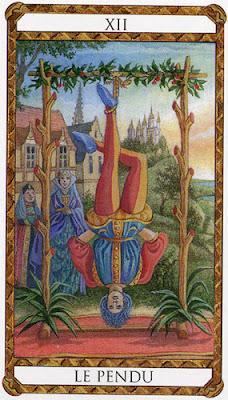
In some ways, as frustrating as any kind of waiting can be, this kind of waiting is one of those "Oh well, may as well make the best of it" kind of times. And with this card you really do make the best of the waiting time and come away from it better off. What's more, you don't have to do much externally. (Well, you can't anyway.) All the good stuff happens internally. Your focus and perspective takes a major shift so when the waiting is over, you're all set to move forward. Getting this card as a signal to wait is a bit easier because you already know if you're caught up like the guy in the card and there's nothing you can do. It's nice to have this acknowledged by a tarot reading so you can accept the situation and get to the internal business rather than struggle against the ropes.
The 4 of Swords is another kind of waiting.

The waiting in this card can be either self-imposed or externally demanded. It indicates a time out either due to illness, imprisonment, a short retreat, even spending time catching up on desperately needed sleep. Like the Hanged Man, it involves gaining perspective, indicated by the swords, as the mental blockade becomes less impenetrable during the time spent in rest. This card advises stepping back and waiting so your mind has an opportunity to settle and in that time you will be better able to go back and deal with the issue. With waiting, time seems suspended and that can be the most frustrating part. Waiting is always less frustrating when we have something to do. But doing isn't always active or physical, it can be mental doing that occupies the time. However, this card says we shouldn't even be doing that. Stop tossing the problem back and forth in your mind for a while. Let it just be and go take care of yourself. Stop obsessing.
And then we have the 2 of Swords:

If ever there was a dilemma card, this one's it. It's not always indicative of indecision. Sometimes it can be a conscious choice to remain neutral in a situation. In terms of waiting, however, this card advises to take that neutral stance until a truth of some kind reveals itself that will undoubtedly break the stalemate. That revelation often comes as the 3 of Swords, an unpleasant truth, but necessary to understand clearly before one knows what to think and do.
Active waiting is another kind, somewhat better to deal with, but still frustrating to get in a reading. The 7 of Pentacles can represent this kind:

In the situation represented by the 7 of Pentacles, you've already put so much time, energy and investment into the situation but you're wondering if you should expend any more. It may be starting to look like it was all a wasted effort and if you continue you may just be throwing good resources after bad. Or maybe when you started you felt more positive about the whole thing but now, you're just not sure it's what you really want. And it's turning out to be a lot more work than you bargained for, too. This card is full of doubt and wishful thinking. Still, there's stuff you can do in the meantime while you're waiting for the situation to ripen. Until something indicates it's time to go in a different direction, you can keep tending to the situation as you have been. I wouldn't invest any more additional resources if you can help it, but just watch and wait to see if things turn out well (or not). This means you'll still be busy, which makes the waiting somewhat more bearable.
Fours in tarot often show stillness, a time of unmoving stability. The 4 of Cups is interesting because cups, emotions, are often anything but still:

Here's the kind of waiting that one does when you're just not feeling it. You had hoped for more and you didn't get it. There's disappointment and feelings of hopelessness. These emotions have a way of dragging you down so you don't even want to keep trying or hoping. Just fuck it, you think, I should just forget it. But you can't. So you wait until something happens to engage your emotions or passions again. Waiting through this card can feel awful, so the advice would be to try not to be so pessimistic and look around you for opportunities you may be missing that would fill your cup again. Take time to just sit with your emotions (or lack of them) and accept that we all go through times like this. I definitely wouldn't make any decisions during this time. Probably unwise. So wait it out.
I really hate the next one, the 8 of Swords:

Stuck. So goddamn stuck. I always get the sense that this woman didn't get into this predicament by herself. While her own thoughts may be keeping her there, she's been hoodwinked and tied up, too. It's as if someone has deceived her and she is now realizing she has been deceived but doesn't know what to do about it and can't find her way out of the deception. The advice here isn't about waiting for rescue, because that isn't going to happen. The waiting in this card is less about standing still any longer, but waiting on your own senses to engage and give you important clues how to release yourself. This woman can use her sense of smell and hearing to gather crucial information. She can smell the sea and hear the waves and know not to move in that direction. She can feel the sand under her feet and take tentative, careful steps across the sand, feeling her way forward. This card can also indicate you've been accepting of your victimization and it's now time to take some control. This card can reveal why you have been waiting but it doesn't exactly advise to keep waiting. It does, however, advise that whatever you decide to do, do carefully and calculatingly.
Usually the 4 of Pentacles is viewed in a rather negative light, as a miserly, greedy, stubborn kind of energy. But in terms of advice and waiting it can mean not these traits but something different:

This is mine and you can't have any. It's telling you to not give any of your stuff, your time, your resources, your attention. Be stubborn and stick to your boundaries. Don't give in. It's not so much about waiting as about taking a stand and refusing to be manipulated or victimized. So if you're wondering what you can do about a situation and this card comes up as advice, don't do anything. Don't give anything. Let them come to you, and even then, don't budge.
While waiting is hard, really hard sometimes, when the advice is clear that waiting is the best course of action, er, non-action, we can at least use the time wisely and productively by following the other clues in the card's advice. If we need to take a break from the situation, do that. Take a long drive, go to a movie, whatever it takes to get away from the anxiousness of waiting. If the card says just keep doing what you've been doing, then do that and try not to stress over what if's. If you're supposed to start taking baby steps, take one. Doesn't matter which one, just move in a direction. If you can't actually do anything, try to see the situation from other perspectives. A change of mind and understanding can actually be the key to getting unstuck. Waiting is always difficult, but with something to do it seems to pass more quickly.
Saturday, May 04, 2013
Fear: Taming Our Overprotective Guard Dog
“What difference do it make if the thing you scared of is real or not?”
~ Toni Morrison
 |
| Original image: Album cover by Alfatec, Brainphobia |
Fear. It is one of our basic, instinctive, primal responses. Fear is necessary to survival and so our brains are hard-wired with this complex response to real or imagined threats to our safety. Fear demands a response, any response, immediately. It prompts our entire body and mind to react and react now.
The sudden flood of these hormones cause changes in the body that include:
- heart rate and blood pressure increase
- pupils dilate to take in as much light as possible
- veins in skin constrict to send more blood to major muscle groups (responsible for the "chill" sometimes associated with fear -- less blood in the skin to keep it warm)
- blood-glucose level increases
- muscles tense up, energized by adrenaline and glucose (responsible for goose bumps -- when tiny muscles attached to each hair on surface of skin tense up, the hairs are forced upright, pulling skin with them)
- smooth muscle relaxes in order to allow more oxygen into the lungs
- nonessential systems (like digestion and immune system) shut down to allow more energy for emergency functions
- trouble focusing on small tasks (brain is directed to focus only on big picture in order to determine where threat is coming from)
Each of us find different situations threatening, so what produces these responses in one person may not in another. When we see someone reacting in the throes of fear we may not immediately understand why they are so uptight and anxious just as others don't always get why we're freaking out. We can understand why a survivor of trauma fears similar situations to the original event, but our minds are so good at fear that we can fear things that have never happened to us. Therein lies the immobilizing power of fear. It holds us back from doing things because we imagine the outcome as dangerous. We can even interpret fear as intuition -- and sometimes it is, hence the confusion -- and refrain from something simply because we are afraid. It's very difficult to move against the onslaught of all those physical chemicals and consciously choose not to react immediately, but that is precisely what we need to do when we are in fear's grip and we are actually not in any immediate danger.
Time permitting, we should examine the source of the fear and determine whether it is real or imagined. Imagined fears aren't necessarily less real. I've never been bitten by a lion, but I am pretty certain I shouldn't waltz into the lion's enclosure at the zoo. There are risks we shouldn't be willing to take. But so many perceived risks have good odds of turning out well, but our brains want to protect us so fear takes over. While I appreciate my body's concern for my well-being, it can get out of hand and smother me with its protection like an overprotective guard dog. So I need to determine whether I am responding to something from a place of fear or a place of curiosity and confidence. Fear holds us back or makes us run willy-nilly in the opposite direction while confidence moves us forward and gives us the inspiration to try new things.

Tarot readings can help sort this. We can ask if we are responding in fear and if so, what is that fear based upon. Is it helping or hurting? We can examine alternative responses and then make conscious, not reactive, choices to a stressful or confusing situation. Because fear can wear many disguises such as anger, apathy, and sadness, sometimes we don't even recognize it as fear. Fear is not weakness, it just is. We simply need to acknowledge it and pat it on its head, thank it for its protection, but not allow it to dictate our decisions.
Here is an example of a simple reading on fear:
 |
| Deck: Original Rider Waite |
What is a more confident response? Knight of Cups. The Knights are pretty courageous guys. They move towards their goal in spite of their fear and this one does so for the cause of love. Despite the very real danger of heartbreak, humiliation, and emotional pain, this knight recommends putting yourself out there for love's sake and to do so from a place of love, not fear.
What is likely to happen if I choose this response? The Tower. This card can by itself provoke fear in many, but take a deep breath and another look. It represents a breaking down of false fronts, walls, and artifices that shouldn't have been erected in the first place. In this reading it shows that the very thing that is needed, courage and love, will break through lies, deception, and ego. From there, things may be lost and rebuilt, but it must happen and will happen regardless. It will clear the air and bring much needed change. Maybe it won't be pleasant, but it will be worth it. Will you maintain control? Probably not. Your fear is justified, but the Tower shows it is necessary to release it and lose it to gain much more.
Scary? Sure. But acknowledging the fear and seeing what is likely to happen when the situation is approached with courage produces confidence which then prompts us to move forward rather than remaining stuck in unhealthy patterns and behavior. We can also likewise determine if the fear is worthy of heeding, if approaching the situation in confidence would actually be foolhardy. Either way, we are consciously choosing our actions rather than merely reacting.
Thursday, November 08, 2012
An Unexpected Lesson From Margaret

I've worked hard to get this job that I have now. I've endured the unique humiliations reserved for call center employees. If you've ever worked in one, you know. Having to go to the bathroom but holding it until the call ends or until your next scheduled break. Getting screamed and cursed at for doing your job. Doing something, or not doing something that you know was an error and freaking out inside because you think you may have just lost your job. Anything and maybe everything is recorded, monitored, checked, graded. These scores can determine your next raise, if you get one, and how much. Being tethered to your desk by a telephone headset cord. Now I'm untethered. I can go to the bathroom when my body needs to. I don't get yelled at. I'm not monitored. In fact, I am now one of the monitors. And I bring to this job a deep sense of compassion for the call center employees that I now try and coach to better their performance. I am grateful, though, not to be in their position anymore.

Which is why, when my manager announced that for our monthly "Team Building Event" we were going to participate in United Way's Day of Caring I was like, "OK, why not?" My company gives its employees two paid days to volunteer in the community and this was the first time I'd ever used any of those days. I like not being tethered to a desk and I like the Quality Analysts I work with. I was curious and eager to participate. Until I heard what we were assigned to do. Our group had been charged with assisting an older couple who lived out in the country, in a trailer. The woman had fallen a couple years ago and was now disabled and her husband needed help with some yard work. They needed windows washed, the back of the house painted, weeds pulled, some bushes moved. I'm thinking this is going to be hard. Really hard. I was right. The husband wasn't some frail old guy. He was a friendly and robust man in his sixties. He'd been taking care of his wife, the house, his job on the farm, everything. But the landscaping was now overgrown. And yes, they lived in not just one trailer, but two, a sprawling double wide beautiful home. So eighteen of us set to work, but no, not until we met Margaret. Bill insisted we had to meet his wife. So all of us crowded into their living room where Margaret sat in her recliner that lifted her up with her walker beside her. She thanked us before we had done a thing. She choked up as she expressed her appreciation for us being there at all.

As I was washing the window in Bill's office, he came in and showed me the books that he'd written and published on his computer. His latest work in progress is a romance that tells the story of how he and Margaret met. He told his stories. And Margaret told hers. And every person that walked into that house that day was asked to tell theirs. One of us would go in to use the bathroom and Margaret would call from her chair the living room, "Come see me when you're finished!" And so she elicited more stories. Every time I went in to use the bathroom, someone different was seated next to her talking and telling her their stories.

It was brutal work that day. The "weeds" were thick, sticker-bushy brush. The "bushes" were tree-like. There were a lot of windows, double paned storm windows. The gnats were horrendous and got in our mouths, eyes, and noses. We rolled wheelbarrow after wheelbarrow full of brush and vines and limbs to the compost hill. We were exhausted and sore. Margaret thanked us. Bill thanked us. We went home.
Stories. I'm telling this one. It has become one of mine. We all have stories to tell and to write and to share, but we don't often think of them as stories or as something anyone wants to hear. Sometimes we think the story has to be a whopper or about some amazing adventure to be worth telling. But Margaret made me realize that everything that happens to us is a story worth telling.
Tarot illustrates our stories and allows us to see them in a kind of set-apart from ourselves way. It has a way of bringing characters to life, shows us what they feel and think and how they play a part in the plot progression. When we lay out the cards and say, "Show me what I need to know" we are illustrating the situation, illuminating the parts we need a visual to understand. As a tarot reader, I am like Margaret. Tell me your story. Let's read it together.

Saturday, October 06, 2012
Honestly? You're Just Being Rude.

I almost scrolled past this picture on my Facebook newsfeed, but I stopped, scrolled back up and commented: "Can be both. No need to be rude." It's funny how small things will set off a whole train of thinking in my head and this was one such trigger. There does seem to be a fine line between saying something honestly and saying something rudely. My friend commented back and said that he never intends to be rude, but I don't think intention is the key. Although by definition to be rude implies that one meant to be impolite or that one doesn't care that they were, it can also be the result of one's own ignorance. We've all made those gaffs, where we say something offensive, not meaning to cause offense, but did so because we didn't know the other person's soft spots. I'm writing this keeping in mind that etiquette expert Miss Manners, Judith Martin, once said that it is the epitome of rudeness to correct another's manners.

Almost any unsolicited opinion will be considered rude, so if you haven't been invited to comment on something, don't. I think posting something on your blog or on a social network is inviting commentary, so it irks me when opinions are given and the original poster says, "I didn't ask for your opinion." Um. Yes, you did. See that "Comment" link under your post? Still, that shouldn't give folks carte blanche to be rude, it just means we did open the floor for comments. I worked with someone who assumed anything that was said within her earshot was fair game. While her comments weren't necessarily offensive, the way she would interject herself into conversations that weren't directed to her was, in fact, rude.
However, if we are in a position, as tarot readers are, to deliver honest feedback we must be aware of this line between honesty and rudeness and walk it carefully. Relationship readings can be minefields that need both honesty and compassion to navigate. So you're reading for someone who has a thing for a guy who has dissed her repeatedly and who has flat out told her he isn't interested. They had a thing a while back and he hasn't communicated in months. She wants a reading on when they will get back together. Depending on what the cards say, and I've been shocked sometimes so I never assume anymore, but let's say the cards are telling her to let go, move on, it's a done deal, and you've got to tell her this without insulting her. You could say, "You're obsessed. Stop it." Or, "Get a clue!" Or you could say, "I honestly don't see, according to these cards, any movement in your direction from him. Is there anything he has said or done recently to give you the impression he is intending to reconcile with you?" She says, "No, but I just know in my heart that he will." So then I might say, "Sometimes when we want something or someone really bad, we can convince ourselves it is true. And sometimes that works and we get what we want eventually. But meanwhile, until it happens, we need to live our lives in the reality of today and today he isn't contacting you, so do you think you can accept that?" OK, you get the idea. Rudeness shuts down two-way interaction and communication. Honesty without rudeness opens that channel. Certainly we all have our own communication styles and some of us are more direct than others. I envy those who are able to be honest, direct, and kind. Me? I'm wordy.
Some agree with Shakespeare that there are times we need to be "cruel to be kind" and that to help someone we must deliver the harsh truth knowing it will sting. It depends on the relationship. This adage from Shakespeare is from Hamlet and it involves a relationship between a son and his mother. It isn't just a random fly by directed towards a stranger or mere acquaintance. In fact, in its original context, Hamlet is burdened by the reality that he must hurt his mother in order to effect the change that must be. Most rudeness doesn't care that much. Therefore, rudeness is not "tough love." It's not love at all.
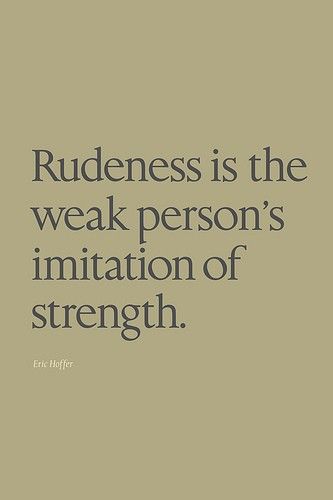
Does honesty without rudeness take more effort? It sure does. Rudeness is lazy. It's also a sign that someone's trying to come off as "tough" or callous. That's fine on occasion, I suppose. I've been known to deliver a rude comeback when the situation or my mood seemed to call for it. Not that rudeness is really ever called for, but yeah, it happens. It means I'm not interested in dialogue, but in slinging verbal shit at that moment. My unintentional rude moments, however, were probably a result of not taking the time to consider how my words will be received or whether they will be productive to discourse. A genuine apology and an explanation which takes the time to empathize with the other person usually closes that gap. Kindness is stronger than rudeness and some of us should exercise our kindness muscles more.
Subscribe to:
Posts
(
Atom
)