Showing posts with label Tarot Miscellaneous. Show all posts
Friday, November 10, 2017
Sex, Lies and the Three of Swords
Look, I'm not a generally hopeful person. I am a realist, practical and grounded, most of the time. It's not hard for me to lose hope, I do it all the time. I am rarely disappointed because my expectations are low. I take life at face value and see things and people for what they are, not what I hoped they would be. This time, though, I've reached a level of hopelessness that I haven't felt in a very long time. I have spent many months in a state of "What is the point?"
I don't have an existential answer to that.
But what is happening now, across the country, in full view of everyone, is tempting me to hope. It is at least a Three of Swords if not a Tower. I don't feel it's a Tower, really, but a Three of Swords, definitely. Harsh truth, blindfolds removed, facing what is true and real. Men and women are publicly speaking out against those who have sexually harassed, assaulted, and harmed them and --here's the best part-- we are LISTENING. Well, many of us are.
 |
| Robin Wood Tarot |
So many women, especially, are feeling triggered. #MeToo. Who knew so many of us have various shades of PTSD just from living our lives in this very bent society that treats us like morsels for male entertainment. Personally, I'm freaking out internally on a daily basis hearing about men creeping on underage girls. My first marriage was to a man who, among other abusive crimes, persistently preyed on adolescent girls, including me at 17 when he was 32. He was arrested on sexual assault of teenage girls several times during our brief marriage and I don't know how many times since. My second husband, a man in his fifties, just married a young Russian woman he groomed at 18 on the internet and then persuaded to come to the US to visit him when she was 19. She's now 23, only 2 years older than our youngest child -- who, by the way, is a young woman herself and has been struggling with the creepy implications of her father in a romantic relationship with someone she considers her peer. A lifelong friend of Mike's has recently been charged with possession of child pornography. He had spent five years in jail for "messing around," he said, with a "seventeen year-old," he said, when he was twenty. He spent ten years in therapy following his release. Although he had to register as a sex offender, he swore he never had The Problem for what he was convicted but said he used the therapy to help himself become a better person. It was all bullshit. We subsequently learned he had actually been convicted for having sex with a girl "13 or younger." The cache of child pornography was discovered by another good friend, his roommate, who went to the police because it was that bad. And of course there is Donald Trump, Harvey Weinstein, Kevin Spacey, Louis CK, and Roy Moore, and...all of the men on this list. I expect the list to continue to grow.
Truth revealed. Three of Swords. Old wounds and betrayals resurface. Three of Swords.
 |
| The Druidcraft Tarot |
Not all men? Three of Swords says "Bet me." Because if "good men" are surprised, shocked, and dismayed at what they are witnessing now, they haven't been listening to women. If they haven't been listening, they were dismissive, complicit, and participated in the culture that allowed it. Too harsh? No -- that's real truth. Three of Swords.
What is the point? Truth, if told, needs time to journey from our ears and our minds to our hearts and our character. Being quiet. Listening from the inside. Four of Swords. Healing. Integration. Peace. We'll get there, if we listen, accept the truth, and listen some more.
 |
| The Druidcraft Tarot |
Meanwhile, now you know why I've been quiet. Too much to say and I don't have the words.
Saturday, November 19, 2016
Me And My Shadow

“You spoke your words as though you denied the very existence of the
shadows or of evil. Think, now: where would your good be if there were
no evil and what would the world look like without shadow?”
― Mikhail Bulgakov, The Master and Margarita
― Mikhail Bulgakov, The Master and Margarita
It has been a hard year or so. That saying that goes, "Bad things come in three's" is a load of shit. Bad things come in two's, three's, four's, five's and so on. In the last year these are the things:
- The car died.
- The laptop died.
- My father died.
- My sister died.
- America died.
That last one was a wry joke my daughter made that still makes me laugh. Tori called me a few days after the election and upon hearing the depressed tone of my voice asked, "What's wrong, Mama?"
Sighing heavily I answered, "It's just hard to be positive right now. I know I'm depressed but I also know it's with good reason given this difficult year. I mean, my sister just died."
"And then America died," she quipped, and I burst into laughter. Thank goodness for dark humor right now.
The world seems a rather dark place at the moment. Putin and Assad are bombing children and kittens in Aleppo. Our soldiers are still killing and being killed in Afghanistan. President Elect Donald Trump (!) is surrounding himself with dark minions. I've gained 20 pounds in the last year, probably due to stress. The rent went up. My salary didn't. Mike lost his job. Despite mine and my family's efforts to save her, my sister died from leukemia four weeks ago. I've every reason to be depressed, but I don't want to be. I never want to be. Depression is a liar, a cheat, and a thief and it's running that train through my daily life.
I have learned from previous treks through this valley that I cannot combat depression by shaming
it away. I can't deny it away. I can't smile it away. I also can't do
nothing. The shadow of depression will thrive unless I sit with it,
face it, and accept the reasons it is here. I must remember not to
listen to its lies, but understand why it tells them. Every day, I am
determined to move in the direction of health and wholeness, but determined in bringing my
shadow with me for the lessons it teaches me are valuable.
So I've been thinking this recent turn in cultural events is like getting the light switched off in a room and having to live with the shadows for a while. That isn't all bad. Just as individuals have a "shadow side" so do countries and governments. I'm not speaking politics here -- so this isn't me saying Democrats are light and Republicans are shadow, that would be nonsense. I am talking about the impulses that we'd rather not have or deal with in others: rage, jealousy, cravings, lust for power, despair and fear. These are the shadows that compel people to violence and petty meanness. These are the shadows we fear in ourselves and in others.

After all, one can’t leave his shadow lying about… and not miss it sooner or later, don’t you agree?
One of the most famous shadows in
American literature is Peter Pan's shadow. At one point in the story,
Peter Pan loses his shadow as it gets caught in the window at the
Darling's. He comes back to retrieve it and Wendy ends up sewing it
back on for him, for which he takes credit as his own accomplishment, a
rather shady thing to do. Separated, his shadow takes on an independent
life of its own and cannot be controlled by Peter. Most importantly,
Peter was not complete without it. Although Peter Pan is the eternal
child, his approach to his shadow is very mature. It's only as we grow
up and learn that certain actions and even feelings are not condoned in
our society do we attempt to dissociate ourselves from our shadow, thus
giving it more power and independence than had we accepted it and kept
ourselves whole.
Carl Jung said that anything of substance will cast a shadow. “How can I be substantial if I do not cast a shadow? I must have a dark side also if I am to be whole” We can't pretend these feelings and the actions based on them aren't real. We can't shush them away. Many in our society have tried through censure and shaming but that doesn't work.
 |
| Light & Shadow Tarot by Michael Goepferd |
On a cultural level we're seeing a lot of unrestrained shadows and I do think this may be because we've spent a tremendous amount of effort to deny their existence, a shadow-lash of sorts. I've heard white people who did not vote for Trump, post election, expressing that they were feeling on edge, frightened and ill at ease in their own communities. People of color, on the other hand, responded that this is how they have always felt. Confronting our own shadow now many are finally experiencing the reality that so many others have lived and we're learning that proclaiming oneself to be "color blind" is revealed to be the mechanic of denial that it is. "Safe spaces" are important, but in practice merely served to silence dissenting speech. We thought we could shush our shadows away.
To be clear, I am not speaking of individuals here -- not the guy with the Confederate flag on his truck chasing motorists of color, not those assaulting Muslim women, not the hurlers of racial and homophobic epithets, not even the ones sexually assaulting women a la Donald Trump in this post-election freedom of shadow expression euphoria. I am speaking of the impulse behind these acts, the parts of human personalities we try so hard to stuff away, ignore, deny, excuse, but never accept.
When we judge others so quickly and harshly, we're doing it. Blame is simply deflecting attention from the shadow. The parents whose child was killed by an alligator in Florida were met not with condolences, but attacks and shaming. Those who overdose on drugs are made fun of in videos. Black men shot by police are subject to a shaming post mortem. The unemployed are told to "get a job!" like that hadn't entered their minds before. We are such a weak and fearful society that cannot deal with shadows but this is precisely the environment in which shadows, separated, thrive.
Y'all need Jesus or group therapy or something.
Sunday, June 19, 2016
Is It Worth It?

When we find ourselves on a particular path that we've devoted a great deal of time and energy to, and the future being what it is, always uncertain, tarot can provide some valuable feedback that we can use to decide "is it worth it?" In fact, there is a specific tarot card for just this dilemma, the 7 of Pentacles:
 | ||
| Cosmic Tarot by Norbert LoscheUS Games 1986 |
This card represents those moments in a project, a relationship, or any goal process where we begin to have second thoughts after already having started. We may have even seen some progress, some reward or at least the promise of it, but we're starting to tire of the work involved. We may not see enough progress for the amount of energy we've put in. Seven is a dreamer's number, full of what if's, possibilities, fantasies, and hopes. Pentacles represent the earth, the solid ground under our feet, things we can touch and own and give and take. It's not always about money, but it can be. Depending on the goal, a certain relationship for example, it could mean a physical reality coming to be such as moving in together or some other show of commitment that you can see and touch, not mere words or promises. Here is that moment where we are weighing the pros and cons of continuing forward with our plans and efforts. This can be harder than starting something because when one has already invested time, energy, and financial resources, it can be extremely difficult to change course.
Other cards in a reading can give important feedback for us to use when making this decision. The reading itself cannot and should not make your decision for you. Only you can do that. In reading for someone in this situation, even if the other cards show some unpleasant experiences, I always communicate that sometimes we have to get to that really tough place before we know for sure what to do. Or the cards may indicate a struggle to come before a success. So we have to be careful not to jump to conclusions based on seemingly "negative" cards surrounding this dilemma. For example, we might see this sequence:


Other cards in a reading can give important feedback for us to use when making this decision. The reading itself cannot and should not make your decision for you. Only you can do that. In reading for someone in this situation, even if the other cards show some unpleasant experiences, I always communicate that sometimes we have to get to that really tough place before we know for sure what to do. Or the cards may indicate a struggle to come before a success. So we have to be careful not to jump to conclusions based on seemingly "negative" cards surrounding this dilemma. For example, we might see this sequence:
 |
| Original Rider Waite Smith |
It appears there may be a tangible setback and a time of material change and struggle, missed opportunities for success or assistance, leading to some disappointment, loss, and regret, but then followed by a period of recovery and healing with clear signs you are now on the way to your goal. In this case, I would say don't give up when the going gets tough. You will come through to the other side having learned important lessons and with a clearer vision of where you are going, even though you will not have reached your goal, you will see what you are supposed to do. This still doesn't say whether the person will ultimately choose to continue or abandon the current project, but it lays out the likely progression which leads to knowing what to do.

In other readings there may be a very clear message to dramatically change direction. For example we might see something like this:
 |
| DruidCraft Tarot © 2004 by Philip and Stephanie Carr- |
The 10 of Swords tells us it's done, there's no more that can be accomplished in the way you have been approaching things. The 8 of Cups shows an abandoning of a way of being that has become emotionally draining, unsatisfying, or stale. The Ace of Pentacles shows a new opportunity that has much more promise. So in this scenario I would urge my client to consider other options and to critically evaluate their current situation for signs that letting go and moving on would be the right choice for them.

This kind of objective feedback is extraordinarily helpful to one in the middle of a quandary over that assessment of whether something truly is worth seeing through or not. We're often given generic cheerleading advise to keep pushing, never give up, anything that's worth doing is worth giving your all, but sometimes that advice may not work for the specific situation you're dealing with. We also have to take into consideration our own patterns. Do we tend to start things and not finish, or only go halfway and give up? Or do we have a history of holding on to something long past its expiry date? Maybe it's time to change that.
Sunday, May 15, 2016
Hypervigilance Masquerading as Intuition

When we're ready to deal with some aspect of ourselves it often bubbles up just to the edges of our consciousness and we start seeing signs and clues for it everywhere. Like connect-the-dot puzzles, those clues lead us to confront, research, and deal with an issue that has been holding us back or hurting us in some way. The symptom of hypervigilance is my connect-the-dot puzzle right now. Specifically, as it relates to intuition. The other day I heard someone on the radio mention one of the symptoms of hypervigilance, which in itself is usually a symptom of PTSD, Post Traumatic Stress Disorder. This was just one of many "dots" that have presented lately. I have been in PTSD recovery for most of my adult life following an extremely abusive marriage in my early twenties. I have been somewhat hypervigilant all my life, probably stemming from childhood abuse.

When I escaped from the abusive asshole husband, I moved back in with my mom for a while. My brother was eighteen or nineteen and still living at home. One evening as my brother and I were talking in the living room we simultaneously noticed we were both nervously and repeatedly glancing out the front window during our conversation. We realized that we were mentally "on alert" for our mother's return from work. During our childhood our mother's mood upon arriving home from work tired and "hangry" was often very bad. We tried to secure her good favor by scurrying around, cleaning up, and whichever one of us was assigned dinner duty had to make sure it was well in process before she walked in the door. We sometimes sat nervously waiting for the car to pull into the driveway. Trying to work out from the way the car was driven, the way she opened and shut the door, what kind of mood she was in. Would this be an evening of calm or anger? At the time my brother and I noticed our behavior in the living room that day we were adults and had nothing to fear from the return of our mother. We awkwardly laughed at ourselves, aren't we being silly? Hypervigilance is subtle.
The negative emotional effects of my childhood were not severe. Like everyone, I had imperfect parents but my childhood experiences did not cause my PTSD. My mother was raised by an emotionally abusive mother and grandmother and alcoholic father who himself suffered from extreme combat PTSD. She married at nineteen and had four children. My parents divorced when the oldest child was nine and the youngest was two. My father was not involved in the child rearing except as financial support. Needless to say, my mother was emotionally ill-equipped to deal with it all and she made mistakes, some horrible. Still, she did her best and she did succeed in parenting better than her parents. Nevertheless, there were damages as there usually are, but I did not display the symptoms of PTSD proper until during and after my first marriage when I was faced with the perpetual threat of being seriously injured or killed by my intimate partner.

While many of my PTSD symptoms have diminished with therapy and the healing of time, I continue to be hypervigilant. I rarely experience flashbacks anymore. The more intense and obvious flashbacks are actually easier to manage after the initial freak-out. I can rationally understand that my current emotions are responding to a past situation and I ride it out, coping by focusing on the present reality. The smaller ones, however, fly under my radar and can trigger extreme hypervigilance that I don't immediately recognize as an inappropriate reaction. I think it's normal for me.
In a dictionary definition nutshell, hypervigilance is the condition of maintaining an abnormal awareness of environmental stimuli. It causes one's body and brain to perpetually maintain a heightened state of awareness which is part of the natural fight-or-flight response. What served as a necessary survival tool during the time of trauma continues on to become a part of one's everyday existence, seamlessly woven into every waking moment, every interaction.
On the plus side, it makes one very observant, keenly so. When it comes to "reading people" and scoping situations out, hypervigilance is like a sixth sense. Those with hypervigilance know more about what is going on than most people ever will. They pick up on others' moods and stresses, hone in on details most people miss, and spot the smallest change in their environments. In practice, hypervigilance seems a lot like intuition because this constant scanning for threats becomes second nature. We don't try to do it, we don't think about it, we just do it. It feels like a gift from the trauma endured. In some situations, truly potentially dangerous ones, it is a gift, but it comes at a cost. The price is paid in depleted mental and physical energy and it could cost your relationships with others.

I think intuition and hypervigilance can merge. It can be difficult to identify which is at work because they share similar "knowing" and results. The main difference is in the physical sensations that accompany them. Hypervigilance is tiring. Exhausting, actually. I often get a sick feeling in the pit of my stomach or a clenching in my throat, and I become restless and there is a strong sense of urgency. That is how I feel fear. By contrast, intuition feels effortless. I am calm and relaxed and my mind just "knows" something or I mentally "hear" a phrase in my head. Hypervigilance develops out of fear and relentlessly gathers external clues. Intuition develops by following one's internal cues rather than external. This is one reason I prefer providing email tarot readings over face-to-face. I can't unconsciously scan the client's facial expressions or body language via text. There is less involvement of my hypervigilance and I can trust that my intuition is coming to the fore. The feedback from my clients suggests that my intuition is quite strong without the hypervigilance in play.

I suspect many people who have what they believe to be very strong intuition are also hypervigilant stemming from a past trauma. Identifying which is operating is key to reducing the cost of the hypervigilance -- stress. Stress, as we know, is incredibly unhealthy and damages the body and brain in measurable ways.

I'm partly loathe to give up hypervigilance as it has been my faithful superpower, but it has degraded my health and well being. I may never release it entirely but I plan to work to replace its function with my intuition. It is comforting to know that I also have developed keen intuition and can continue to strengthen that as I work to reduce the other. For now, I plan to take this wonderful advice given in this in-depth article, Searching for Bad News: The Circuitous Path of Obsessive Thinking by Dr. Heather Stone:
Live with ambiguity. Relax into knowing that, without hyper-vigilance, you have relatively complete and accurate information. The ambiguity that is in and around you is an unclear, imperfect, benign presence that can be trusted and accepted.
The Unknown that you fight so vehemently – that you fear, blame, rail against, and pray would become Real so that it could finally leave you alone – is often better than every known thing you have ever wanted to control. Let me put it another way: every good thing in your life that surprised you was previously unknown to you. You didn’t anticipate or create the people who showed up and loved you. You didn’t manage or direct the gifts that you were given, either literally or metaphorically. Live with the Unknown, because the stuff that will make you happy in life will be the stuff that you can’t control.
Saturday, April 04, 2015
What Your Brave Is

But have you thought about others? Courage is displayed throughout the deck. The 7 of Wands displays a kind of crazy, madman courage in the face of overwhelming odds and besides, he's not ready. He didn't have time to put on proper footwear. The 5 of Pentacles shows the inner strength to persevere when one is at the rope's frayed end but to keep going despite hardships and challenges. The 8 of Cups shows the courage to strike out on one's own, leaving behind what once was cherished.

“There are so many ways to be brave in this world. Sometimes bravery
involves laying down your life for something bigger than yourself, or
for someone else. Sometimes it involves giving up everything you have
ever known, or everyone you have ever loved, for the sake of something
greater.
But sometimes it doesn't.
Sometimes it is nothing more than gritting your teeth through pain, and the work of every day, the slow walk toward a better life.
That is the sort of bravery I must have now.”
But sometimes it doesn't.
Sometimes it is nothing more than gritting your teeth through pain, and the work of every day, the slow walk toward a better life.
That is the sort of bravery I must have now.”
~Veronica Roth,
Allegiant (Divergent Series)

Stories. We all have our stories, our moments, however brief, of striking courage that surprised ourselves most of all. We look back and wonder at our own bravery, or foolish recklessness, because sometimes it's hard to tell the difference. Sometimes we don't even recognize it as bravery. We were just doing what had to be done and didn't feel any special commission that stated, "This is bravery, right here." It was just necessary and we did it.
“Courage doesn't always roar. Sometimes courage is the little
voice at the end of the day that says I'll try again tomorrow.”
Bravery isn't usually on display. It rarely is and that's why we have such high standards for it and don't recognize it in ourselves. We have a Hollywood expectation of bravery. We think that once we do something rash exhibit courage that it should be a game changer, that all will be set right because we finally did what we were afraid to do. That's bullshit. There are times in life when we must find the courage to keep going every single day. That's no better or worse than any other kind of bravery. It's made of the same stuff.
We need to understand that we're not going to understand someone else's brave. What may come easy to one is a daunting struggle to another. My experience of a similar or even the same event is not your experience. I come from a family of introverts, of which I am one just less so, who thought I was brave to dance in front of an audience, speak to large crowds, and tell off a judge (and gained his favor in doing so). These things come easy to me so I don't see the bravery. Sometimes I can look back and see it, but never in the moment. Some of the most courageous things I've ever done were done where no one could see, and even had they seen they probably would not call what I did courageous. Dragging myself off the sofa to take a walk in the midst of a debilitating depression was brave. Leaving one life behind for another while everyone, even I, disapproved was brave. Someone else's brave may be leaving the house determined not to re-check that the stove is off.
My sister was recently diagnosed with leukemia. The chemo made her feel much worse than the disease and she had to go through four agonizing rounds that made her guts raw, her body weak, and took away her beautiful long hair. There were times she said she had frightening thoughts of dying, but overall she tried to remain positive. She told me, "It's just a ride. A crazy ride, but we'll get through it." I don't understand this brave. Were it me, I'd have my funeral planned, written long letters to my loved ones, taken videos to leave them, and cried and cried in mournful self-pity. I once had a biopsy (benign, of course) and did all these things. My sister is now in remission and cancer-free. Brave, not just to face the disease but also to take control of her wellness. She might say no, it was not brave, just something that had to be done. But that's what courage is made of: doing what needs to be done.
“To try to be brave is to be brave.”
~ George MacDonald
~ George MacDonald
Sunday, March 22, 2015
Lazy Tarot
 |
“I choose a lazy person to do a hard job. Because a lazy person will find an easy way to do it.”
~Bill Gates
- Cleanse decks
- Use a classic Significator
- Use astrological associations
- Use Kaballah associations
- Do anything about "energies" (no smudging here)
- Use Reversals
- Look at the "Shadow Card"
- Ruminate on a reading
I'm not an astrologer and feel that trying to learn a whole 'nother vast metaphysical art to overlay tarot is just too much work. If I wanted to learn astrology, I would, and maybe someday I will, but not today. Kabballah, same. I've tried using various stones and crystals and noticed nothing different, so whatever floats your boat is fine, no rocks in my boat. I don't "ground" myself other than one deep
I don't turn the cards physically upside down to read "reversals," I generally get a sense by the position, the cards next to/around it, and the question asked whether the card's meaning is "reversed." I forget to look at the bottom card in the deck, so the Shadow Card remains in the shadows. Sometimes other tarot readers have said they will leave a reading out on a table for days to think about it, ruminate over it, journal it to go back to later. I don't. I have journaled specific readings but I always forgot to go back to them, so what was the point?

I do:
- Shuffle, a lot
- Use a Sort of Significator
- Use symbolism: colors, numbers, elemental, suits, objects, etc.
- Use history
- Pay attention to patterns
- Listen to random observations my mind blurts out
- Use common sense
Most of the readings I do include a card that speaks to what the client is thinking, feeling, and/or how they are approaching the issue at hand. This is a Sort of Significator, and I use it because it gives very useful information for the client to use when formulating a plan of action. They can see whether their approach is helpful or not based on what the reading reveals about the other factors and influences.
For me, symbolism is absolutely key in interpreting tarot. Symbols are the language of all humans in all of history. Language itself is symbolism and vice versa. Connected to this is my understanding of history, culture, and the human experience. I notice patterns in the cards. Numbers, suits, colors that appear repeatedly or in a progression or order mean something. Sometimes my mind will say something really random, like an idiom or lyrics from a song and I've learned these random phrases are hugely significant to the reading. I always use them. There was a time I ignored them and was routinely surprised when the client gave feedback that included that exact phrase! When I started speaking them I found my client's feedback often confirmed that phrase played a key role in the situation.
Finally, I use common sense. When the Lovers card appears in a reading that has nothing whatsoever to do with romance, I do not imply the client will fall in love in the middle of updating her resume. While it is possible she may meet a charming person at a job fair, it just isn't sensible to talk romance when she's trying to find out her best option to advance her career. Not ruling it out, just saying, keep on topic.
The practice of tarot reading is so unique to each reader. What works well for one is cumbersome for another. I have been known to spend untold hours researching symbolism and cultural history in my pursuit to understand tarot card meanings. Many readers would shake their head and say, "Ain't nobody got time for that!" But I love it. I love the research and the richness of history and how people lived in times before, how that relates to the images we see now, the connections, the gaps, all of it. Others feel and experience a very tangible difference when using cleansing rituals or objects. Some can't help but see the astrological or Kabbalistic connections and feel they would be remiss if they didn't include them. Whatever you do or don't do in your reading process matters only to you.
But seriously, lazy is good. Keeping what works efficiently and either re-working or tossing out what doesn't makes sense in everything we do. Time and effort are both valuable resources. Be lazy and enjoy what you do.

Saturday, January 10, 2015
Worrisome Worry

I should never leave a health-issue-related blog post for months without a follow up as several people have written to be sure I haven't succumbed to whatever-it-was. Sorry about that. I tend to withdraw from social interaction when I'm dealing with stuff, like cats hide when they're hurting or sick, me too. UPDATE: Nerve compression is all but gone. I am left with some lingering muscle spasms and twitches but no pain. (Yay!) I'm still working on another issue that will need some outpatient surgery in about a month and that has me worried, still, about finances. All the tests and doctor visits at the end of last year took all of the HSA money and I still owe hundreds of dollars, not counting the upcoming procedure, which I expect will be a few thousand. I am genuinely worried how to fund necessary health care.
Worry is something I'm very good at. If medals were given I'd have a trophy wall dedicated to worry. Logically I know that worry is harmful and doesn't solve anything. I have much improved in the area of worry-control and find I can tame it faster, but I think it's just a natural by-product of my over-thinking mind. Also, worry has actually served me well at times so it's hard to let go of it.
I read this and completely related:
You have mixed feelings about your worries. On one hand, your worries are bothering you—you can't sleep, and you can't get these pessimistic thoughts out of your head. But there is a way that these worries make sense to you. For example, you think:
You have a hard time giving up on your worries because, in a sense, your worries have been working for you.
- Maybe I'll find a solution.
- I don't want to overlook anything.
- If I keep thinking a little longer, maybe I'll figure it out.
- I don't want to be surprised.
- I want to be responsible.
The Worry Cure: Seven Steps to Stop Worry from Stopping You by Robert L. Leahy, Ph.D.
I have found solutions to problems this way. I have come up with plans to deal with unknown outcomes, if they happen. I have figured stuff out this way. So it's hard to completely let go of worry because it has worked for me. And since one of the most common reasons someone requests a tarot reading is due to worry, I bet I have plenty of company in this problem area.
One suggestion I've read is to postpone your worries to a set "worry time." This one doesn't work for me but it may work for others. I do a different but similar thing: I distract myself by telling myself I can't spend time on the worry-of-the-moment right now and I'll deal with it later. So while I don't set aside a certain time, I do push it away for "later."

"If a problem is fixable, if a situation is such that you can do something about it, then there is no need to worry. If it's not fixable, then there is no help in worrying. There is no benefit in worrying whatsoever." -- Dalai Lama XIVOne really helpful step to do is to parse out whether the worry thing is actually solvable. If it's an imaginary "what-if?" it's probably not worth your time. Unfortunately, these are precisely the kinds of worries that so many dwell on. If you are able to take action on your problem right away, then it is probably a productive worry. If not, then it's unproductive. Recognizing the difference helps because action on a problem reduces or eliminates worry and for the ones you cannot act on, such as "What if my child is in a terrible accident someday?" you can more easily let go.

Worrying itself feels productive but it isn't. When we are worrying our emotions are somewhat suspended because the worry keeps us in our heads and distracts us from feeling. While we are thinking about how to solve the problem (or so we tell ourselves that's what we're doing) we're avoiding the underlying emotions. Who wouldn't want to avoid feeling anxious, sad, or other negative emotions? However, suppressed emotions don't go away and tend to fuel even more anxiety to the point that we end up worrying about why we're feeling what we're feeling! Crazy. It can be helpful to tell yourself to just feel whatever it is you're feeling, then cry, get angry, feel sad, have a brief pity party. This one is hard for me, but I'm working on it.
For the solvable worries, brainstorming possible solutions and/or doing a tarot reading can help tremendously. The problem you're worrying about is often real and the steps toward a solution are very real and actionable, too.
Monday, May 12, 2014
The Tarot Bones
I've said it before and I'll say it again: Tarot cards do not mean anything and everything you think they might mean. There is a foundational framework of symbolism that has been collectively accepted and agreed upon by human culture over space, time, and history.
There seems to be a certain hesitancy in social tarot groups to tell someone they goofed,they got it wrong, they missed something when they state their take on a particular card. While there is a whole wide area of wiggle room within the confines of that framework, there is a framework. They are the bones of tarot over which everything else rests, is connected to, grows and moves. If you remove the bones you are left with a blob of inert, gloopy stuff that doesn't hold together very well.

So don't tell me the Ace of Swords is about passion without logic, or that the 2 of Cups is about taking a gym class with a friend. No. Just no. While the Ace does contain energetic passion and the 2 is about duality and togetherness, the suit characteristics were mixed up. Wrong.
The problem arises when someone has the cajons to say, "Hey, I don't think that's quite accurate," and are met with predictable nonsense about how tarot card meanings are not "set in stone" and can mean anything to anybody and we all see things differently but equally valid. Nope. If your interpretation isn't tied by even the finest thread to the bones of tarot, your interpretation is invalid.

The bones of the Minor Arcana are the suit and the number or member of court. That isn't too hard or restrictive. Hard, cold steel of the Swords does not equate to illogical, firey passion of a burning brand (Wand) but to precise facts. Flowing liquid in Cups cannot be held in one's hand like a Pentacle. These are the basics and the basis of tarot interpretation and just make sense.
HOWEVER --- (disclaimer time) --- There are people who read cards in just this formless, boneless way and they read beautifully. I am not negating this style of divination. The cool thing about this style is one doesn't even need a tarot deck. Any image or collection of images will work. Oracle decks are wonderfully suited for this sort of reading. There are no rules, there is no framework, one simply allows intuition to guide and bubble up meaningful connections and phrases and ideas and so forth. It's a tremendously useful way to strengthen one's intuition and learn to trust it and hone it.
But if you're setting about reading tarot then read tarot and don't try and serve up some oracular mishmash and claim it's because the meanings are not "set in stone" and "that's the beauty of tarot." Yes, there are some meanings set in stone and no, pulling something contradictory to those foundational meanings is not beautiful, it's tripe. See, if a singular tarot card can mean anything to anyone then there is no way you can teach what you know about tarot. Because you don't know anything until you are faced with a question and a card that has changed its meaning based on the situation. You can certainly coach others to use this same talent, to draw meaning from images relevant to the client's situation, but you aren't teaching tarot. You are helping them develop their intuitive skill. Different.

If one does not assign meaning to any particular card, suit, number, court, etc. then fine, but that's not tarot reading. That's divining with a tarot deck, and there's nothing wrong with that, but I'm drawing this line for reasons of clarity because I'm tired, so tired, of the argument among tarot readers that the cards can mean anything to anyone at any time. I think maybe we confuse our intuitive flashes with reading tarot because they happen often while reading tarot. Those flashes are cool and often strikingly accurate but they don't change the foundational meaning of the card for the next reading. The bones are the starting point and the body that each reader fleshes out from the bones to the outer layer of skin will fluctuate and change depending on the conditions, but the bones don't change. Your understanding of them will deepen as you learn, but they will always be what they are and placed where they belong or the tarot reading will not run, walk, or move.
Sometimes we'll get stumped on a card because what we know about a situation (the flesh) or what we are getting intuitively (also flesh) does not appear to fit well over the bones. Good tarot readers don't discard the bones because the flesh doesn't seem to fit. A good tarot reader digs deeper to see how the flesh connects, finds the sinews, ligaments and muscle fibers that latch to the bone.
Get digging. Find the connective tissue. That's tarot reading.
There seems to be a certain hesitancy in social tarot groups to tell someone they goofed,

So don't tell me the Ace of Swords is about passion without logic, or that the 2 of Cups is about taking a gym class with a friend. No. Just no. While the Ace does contain energetic passion and the 2 is about duality and togetherness, the suit characteristics were mixed up. Wrong.
The problem arises when someone has the cajons to say, "Hey, I don't think that's quite accurate," and are met with predictable nonsense about how tarot card meanings are not "set in stone" and can mean anything to anybody and we all see things differently but equally valid. Nope. If your interpretation isn't tied by even the finest thread to the bones of tarot, your interpretation is invalid.

The bones of the Minor Arcana are the suit and the number or member of court. That isn't too hard or restrictive. Hard, cold steel of the Swords does not equate to illogical, firey passion of a burning brand (Wand) but to precise facts. Flowing liquid in Cups cannot be held in one's hand like a Pentacle. These are the basics and the basis of tarot interpretation and just make sense.
HOWEVER --- (disclaimer time) --- There are people who read cards in just this formless, boneless way and they read beautifully. I am not negating this style of divination. The cool thing about this style is one doesn't even need a tarot deck. Any image or collection of images will work. Oracle decks are wonderfully suited for this sort of reading. There are no rules, there is no framework, one simply allows intuition to guide and bubble up meaningful connections and phrases and ideas and so forth. It's a tremendously useful way to strengthen one's intuition and learn to trust it and hone it.
But if you're setting about reading tarot then read tarot and don't try and serve up some oracular mishmash and claim it's because the meanings are not "set in stone" and "that's the beauty of tarot." Yes, there are some meanings set in stone and no, pulling something contradictory to those foundational meanings is not beautiful, it's tripe. See, if a singular tarot card can mean anything to anyone then there is no way you can teach what you know about tarot. Because you don't know anything until you are faced with a question and a card that has changed its meaning based on the situation. You can certainly coach others to use this same talent, to draw meaning from images relevant to the client's situation, but you aren't teaching tarot. You are helping them develop their intuitive skill. Different.

If one does not assign meaning to any particular card, suit, number, court, etc. then fine, but that's not tarot reading. That's divining with a tarot deck, and there's nothing wrong with that, but I'm drawing this line for reasons of clarity because I'm tired, so tired, of the argument among tarot readers that the cards can mean anything to anyone at any time. I think maybe we confuse our intuitive flashes with reading tarot because they happen often while reading tarot. Those flashes are cool and often strikingly accurate but they don't change the foundational meaning of the card for the next reading. The bones are the starting point and the body that each reader fleshes out from the bones to the outer layer of skin will fluctuate and change depending on the conditions, but the bones don't change. Your understanding of them will deepen as you learn, but they will always be what they are and placed where they belong or the tarot reading will not run, walk, or move.
Sometimes we'll get stumped on a card because what we know about a situation (the flesh) or what we are getting intuitively (also flesh) does not appear to fit well over the bones. Good tarot readers don't discard the bones because the flesh doesn't seem to fit. A good tarot reader digs deeper to see how the flesh connects, finds the sinews, ligaments and muscle fibers that latch to the bone.
Get digging. Find the connective tissue. That's tarot reading.
Saturday, March 08, 2014
It's Your Own Damn Fault
 |
| Regret. Cyn McCurry |
Yes. She was right. However, her being right didn't help. It never helps me to point out this obvious fact that my suffering is my own doing. That's right, it NEVER helps. It hurts. It comes under the category of if you don't have anything nice (or helpful) to say, don't say anything at all. That's because my default is to blame myself for everything that happens to me. This is why I don't say certain things out loud because I am sure that someone will say, "Well, it's your own fault." I miss my kids. I miss them with everything in me. I hurt tangibly and physically sometimes because I miss them. I made the heart-wrenching decision seven years ago to be the one to leave the family home when their father and I divorced. I moved a two hour's drive away. It's still close enough to see them and they have spent time with me, but that pain never lessened or went away. Now that they're older and have less time to spend with their mom, it's harder to arrange time to see them. We talk on the phone and on Facebook, but, well, you know, not the same. This pain is my fault. I know this and beat myself up about it on a regular basis. Yes, I know that's not helpful.

There are people who don't take enough responsibility for their choices. These are the blamers, the ones who point their finger at everyone and everything else for their pain. Stuck in victim mode, their misfortune is always the result of something outside of themselves. Saying, "It's your own damn fault," to them only helps if you first acknowledge their pain and accept that they are hurting. It's difficult to show compassion to someone like this, but it's absolutely necessary if your goal is to speak a harsh truth to them. They have to know first that you care, that you have their best interest in mind and you're not just another outside force causing more pain.
On both ends of the spectrum, whether one takes on too much responsibility for the painful situation or not enough the most helpful advice is to focus on right now. Before someone can take steps in a positive, forward moving direction, they have to release themselves of the blame, both directed at themselves and others. The self-blamer believes that if she can isolate the actions and circumstances that caused the pain in the first place she can avoid the pain in the future. The other-blamer relieves themselves of the responsibility to make changes and keep doing what they're doing because they aren't in control. One assumes too much control while the other assumes too little. Regardless of their locus of control, neither has the ability to move forward. The fear of pain keeps them stuck.
In my tarot practice, I focus not on what will happen but on looking for ways to view the situation as it currently is and on steps one can take from here forward. Taking responsibility for the choices we make in life is one thing. Regretting them is something that happens often because once choices have been made they can't be unmade and they come with unknown and unintentional consequences. The last thing anyone needs when they cry out in pain from shooting themselves in the foot is the reminder that they did it to themselves. They already know that. They're already kicking themselves with the uninjured foot.
Sunday, October 06, 2013
Back To School with Tarot?

So my car died. The transmission was being stupid and every day it was being a little more stupid. My mom bought herself a new car and gave me her older one, a PT Cruiser. If I had won the lottery, the PT Cruiser is not the car I would have chosen but it is very nice and it certainly beats a dead car. So I'm extraordinarily grateful to my mother. In the process of registering the car, I had to produce my birth certificate to prove I am my mother's daughter but the problem was I couldn't find it. I tore through some boxes of stuff in storage and found not what I was looking for but a whole slew of old tarot journals from when I was learning to read. I didn't realize how many notes I'd taken, how many readings I wrote down, card meanings, musings, etc. Many.
I'm frequently asked how to learn to read tarot. Several people have asked if I offer classes. I can do that. One of the roles I play at my day job has been as a trainer. I can teach adults the stuff I know. But tarot is different. Some people thrive in a classroom setting and there are some wonderful readers offering wonderful tarot courses and classes, but I'm hesitant. Because that's not the way I learned tarot. I realize not everyone is an autodidact, a self-taught person, but I learn best when I research and practice on my own. Besides, I'm not sure I can teach anyone how to read tarot exactly. I can teach the history of tarot cards and I can show how to lay them out in spreads and I can hand out a set of acceptable meanings, but that's not reading. Besides, you can get that within the little booklet that comes packaged with almost every tarot deck. So what would a class really offer that one can't get on their own?

Maybe I'm being dense. Learning tarot in a class is much like learning anything else. If I took a class on cake decorating but then didn't practice on my own at home, I wouldn't get any better at creating rosettes. If I took a language class and yet continued to use the translation dictionary, the words, the subtle meanings and the natural flow of speaking and understanding wouldn't embed itself in my brain. Maybe this is why I don't take classes unless they are a means to an end such as earning credits toward a degree. If I have a passion to learn something, I just go do it and learn as I go. I have thoroughly enjoyed taking classes, don't misunderstand. I love learning new things. But learning a skill is different and learning tarot is more different still.
While there is a right and wrong way to bake a cake and pronounce a word in another language, there is no right or wrong way to read tarot (or pronounce it, for that matter). While I can equip you with the basics, you must take it from there. You will need to work with your cards every day several times a day. You will be thinking about them even when you're not working with them. You will be reading about them, talking with others about them, writing about them and yes, reading, reading, reading them. You will make discoveries and apply them to your readings. You will study the cards, research symbols, colors, numbers, and incorporate what you find. Or not. Maybe you will find whatever you find in the cards. Maybe you will develop your own set of meanings and symbols and use those. No one can teach you these things.
Because the language of tarot comes from your own conscious and subconscious connections and experiences, every reader speaks a different dialect of tarot. When I read for someone who also reads tarot, I am often asked how I arrived at a particular card meaning. I don't know? I can only tell you what I know about the card itself but how the connection came to be made between that and what I told you in the context of your reading is a complex domino effect of associations that happens so quickly in my brain that I couldn't begin to unravel it for you.
The first tarot reading I received was so mind blowing for me that when I began the process of learning tarot, I wanted to read like THAT. I wanted to be able to read those cards like a story, connecting them in a way that not only made sense linguistically but made sense in the life of the one I was reading for. Just as learning a language is best done by immersing oneself in the culture and environment of the language, so it was for me with tarot, too.

That said, I've been thinking about offering something, though, along the lines of teaching tarot. Just because I learn best on my own doesn't mean everyone does. I'm not against a tarot class, per se, but maybe a kind of tarot mentoring or coaching would be more beneficial? For those who might be interested in a tarot class, what would you be looking for? What would you want to accomplish by taking such a class? When the class was over, what would you expect to be equipped to do?
Saturday, August 24, 2013
Get Lost

It is good to feel lost... because it proves you have a navigational sense of where "Home" is. You know that a place that feels like being found exists. And maybe your current location isn't that place but, Hallelujah, that unsettled, uneasy feeling of lost-ness just brought you closer to it.
~Erika Harris
Looking out of the car window in the dark, nothing looked familiar. I could hear my mom mutter under her breath. One of us would inevitably ask the question, "Are we there yet?" and then the snapped answer, "We're LOST!" Gasp! Oh no! Our eyes would widen as we scanned the foreign land around us. How will we make it home? What will happen to us in this dangerous, unknown place? "Lock the doors," Mom commanded. We quickly obliged, then slunk down into the seats, not wanting the people of the outside to see us. Sitting ducks. Inevitably, being lost meant wandering through the "bad" parts of town. Anything could happen. We could run out of gas. A gang of rabid squirrels could attack the car. We could keep going round in circles and not get out of there, wherever there was. It's a scary, frustrating thing being lost.

The thing about getting lost is that it just happens. You can't make it happen, I've tried. I've intentionally taken wrong turns, driven until the road ends, went places I had no idea where they went to, and still mostly knew where I was. It's pretty much an exercise in bullshit trying to get lost, so I'd end up back home not feeling at all satisfied. When you're truly lost it happens in what seems like a blink of an eye. You're in familiar territory then all of a sudden you're not. Nothing looks right. It dawns on you that you have never seen that building, that road, that sign. Uh oh. So you try very hard to listen to your intuition to guide you out and you feel very strongly you need to take that turn, go that way. So you do, and keep following your gut. And you end up going in a big goddamn circle. Now you've lost faith in yourself, your inner compass, and you really don't know how to find your way home. Now it's at least an hour later and it's dark and you can't see the road signs. Not that they'd help you because you don't know the names and you don't know which one you're supposed to take. One leads to a cul-de-sac, so you just turn around. Another leads to a dead end. Yet another ends up in someone's driveway. You're getting more hopeless and frustrated but you know you can't stay where you are. You don't belong there. You begin to feel like prey. Don't act lost, you think, someone will smell your fear. Someone will take advantage of you. You try to act like you belong there even though everything inside of you feels like a gnawing, nagging desperation that knows you don't.
What to do? Might as well pray. Got nothing to lose. Please, God, show me the way home and I'll never get lost again! Then you look around and keep your eyes peeled for a sign. Nothing. Crickets. A beautiful night sky blinks in starry silence. Fuck it. Go. This way. Then that way. Keep going. Stop, get more gas. Ask directions. Get laughed at as they tell you the highway exit you've been looking for is a mile away. That way. Feel relieved and stupid at the same time. Laugh at yourself. Turn the radio back on, relax and go. As you drive into familiar areas, you relax even more, turn the volume up and start dancing in your seat as you feel the stress of the evening leave your body as you sing along with the radio at the top of your lungs. You know where you are. You're home.

“Getting lost is just another way of saying 'going exploring.”
― Justina Chen, North of Beautiful
― Justina Chen, North of Beautiful
Getting lost is an unnerving experience for many. For others, it's an adventure. It's a matter of perspective and circumstances. For my mother, the responsibility of four young children added to her stress because she felt responsible for our safety and well being, too. If you're on your own and have no pressing external obligations or responsibilities, no one worrying about you being dead in a ditch, you're less likely to freak out. If you have a lifeline like a cell phone or a GPS in your car, you're also less likely to panic. If your internal compass leads you in the right direction the first time, it's all good. But I don't consider those kinds of circumstances truly lost. You're simply misdirected, misaligned, out of your way. Being truly lost is to be without lifelines, directions, internal compasses, and sometimes even hope.
It gets harder and harder to literally get lost these days. The world is a smaller and smaller place and increasingly interconnected. With all the franchise and chain stores in the strip malls and shopping centers, most towns look a lot the same. While you may not know where you are, at least things look familiar. Pull into the McDonald's and use the free WiFi and figure it out. Get on Facebook and ask your friends. Google it. Get instant answers. We're not able to get lost these days it seems, except inside, except in life. There isn't a roadmap for your inner journey. No GPS for your life. Your Facebook friends can't direct you. That friendly guy at the gas station? Nope. And the stars just stare and blink, still silent.
And it's not even that you're stuck, but maybe running in circles. There are plenty of roads, but not a clue which one to take. All the familiar storefronts are here, but it doesn't feel like home. We can divine tarot for direction, but ultimately even that advice must resonate with your internal compass before you agree to take it. Ultimately, in life as in being lost on the road, we just say "Fuck it" and go. Any direction different from the circles you've been going. Because it doesn't really matter which way you go as long as you go. Because there's one thing you know: here is not home. It may not feel like it, but this is a good experience. Even as a child I knew we would make it home. Somehow.

I may not have gone where I intended to go, but I think I have ended up where I intended to be. ~Douglas Adams
Saturday, August 03, 2013
When Tarot Says Wait
Of all the hardships a person had to face, none was more punishing than the simple act of waiting.
-Khaled Hosseini, A Thousand Splendid Suns
-Khaled Hosseini, A Thousand Splendid Suns
Tarot is a master of dilemmas. One of the finest uses for tarot is sorting through the angles and what if's and projecting possible outcomes. It's what makes it such a great tool for brainstorming and decision making. So when the advice the cards give is to wait it can be extremely frustrating. We've been waiting, hence the stalemate of the stubborn problem, and we decide to give tarot a go at the situation and even tarot is being stubborn! At first you might think tarot is being obtuse. Like, no shit Sherlock, I already know I'm stuck, give me a freaking answer already!
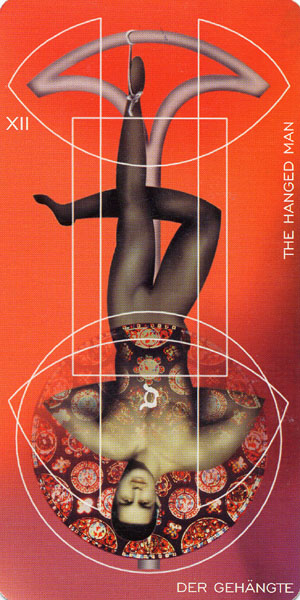
There are several cards in the deck that indicate waiting. The Hanged Man is probably the most obvious as he's got no other option.
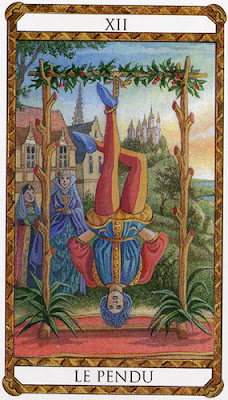
In some ways, as frustrating as any kind of waiting can be, this kind of waiting is one of those "Oh well, may as well make the best of it" kind of times. And with this card you really do make the best of the waiting time and come away from it better off. What's more, you don't have to do much externally. (Well, you can't anyway.) All the good stuff happens internally. Your focus and perspective takes a major shift so when the waiting is over, you're all set to move forward. Getting this card as a signal to wait is a bit easier because you already know if you're caught up like the guy in the card and there's nothing you can do. It's nice to have this acknowledged by a tarot reading so you can accept the situation and get to the internal business rather than struggle against the ropes.
The 4 of Swords is another kind of waiting.

The waiting in this card can be either self-imposed or externally demanded. It indicates a time out either due to illness, imprisonment, a short retreat, even spending time catching up on desperately needed sleep. Like the Hanged Man, it involves gaining perspective, indicated by the swords, as the mental blockade becomes less impenetrable during the time spent in rest. This card advises stepping back and waiting so your mind has an opportunity to settle and in that time you will be better able to go back and deal with the issue. With waiting, time seems suspended and that can be the most frustrating part. Waiting is always less frustrating when we have something to do. But doing isn't always active or physical, it can be mental doing that occupies the time. However, this card says we shouldn't even be doing that. Stop tossing the problem back and forth in your mind for a while. Let it just be and go take care of yourself. Stop obsessing.
And then we have the 2 of Swords:

If ever there was a dilemma card, this one's it. It's not always indicative of indecision. Sometimes it can be a conscious choice to remain neutral in a situation. In terms of waiting, however, this card advises to take that neutral stance until a truth of some kind reveals itself that will undoubtedly break the stalemate. That revelation often comes as the 3 of Swords, an unpleasant truth, but necessary to understand clearly before one knows what to think and do.
Active waiting is another kind, somewhat better to deal with, but still frustrating to get in a reading. The 7 of Pentacles can represent this kind:

In the situation represented by the 7 of Pentacles, you've already put so much time, energy and investment into the situation but you're wondering if you should expend any more. It may be starting to look like it was all a wasted effort and if you continue you may just be throwing good resources after bad. Or maybe when you started you felt more positive about the whole thing but now, you're just not sure it's what you really want. And it's turning out to be a lot more work than you bargained for, too. This card is full of doubt and wishful thinking. Still, there's stuff you can do in the meantime while you're waiting for the situation to ripen. Until something indicates it's time to go in a different direction, you can keep tending to the situation as you have been. I wouldn't invest any more additional resources if you can help it, but just watch and wait to see if things turn out well (or not). This means you'll still be busy, which makes the waiting somewhat more bearable.
Fours in tarot often show stillness, a time of unmoving stability. The 4 of Cups is interesting because cups, emotions, are often anything but still:

Here's the kind of waiting that one does when you're just not feeling it. You had hoped for more and you didn't get it. There's disappointment and feelings of hopelessness. These emotions have a way of dragging you down so you don't even want to keep trying or hoping. Just fuck it, you think, I should just forget it. But you can't. So you wait until something happens to engage your emotions or passions again. Waiting through this card can feel awful, so the advice would be to try not to be so pessimistic and look around you for opportunities you may be missing that would fill your cup again. Take time to just sit with your emotions (or lack of them) and accept that we all go through times like this. I definitely wouldn't make any decisions during this time. Probably unwise. So wait it out.
I really hate the next one, the 8 of Swords:

Stuck. So goddamn stuck. I always get the sense that this woman didn't get into this predicament by herself. While her own thoughts may be keeping her there, she's been hoodwinked and tied up, too. It's as if someone has deceived her and she is now realizing she has been deceived but doesn't know what to do about it and can't find her way out of the deception. The advice here isn't about waiting for rescue, because that isn't going to happen. The waiting in this card is less about standing still any longer, but waiting on your own senses to engage and give you important clues how to release yourself. This woman can use her sense of smell and hearing to gather crucial information. She can smell the sea and hear the waves and know not to move in that direction. She can feel the sand under her feet and take tentative, careful steps across the sand, feeling her way forward. This card can also indicate you've been accepting of your victimization and it's now time to take some control. This card can reveal why you have been waiting but it doesn't exactly advise to keep waiting. It does, however, advise that whatever you decide to do, do carefully and calculatingly.
Usually the 4 of Pentacles is viewed in a rather negative light, as a miserly, greedy, stubborn kind of energy. But in terms of advice and waiting it can mean not these traits but something different:

This is mine and you can't have any. It's telling you to not give any of your stuff, your time, your resources, your attention. Be stubborn and stick to your boundaries. Don't give in. It's not so much about waiting as about taking a stand and refusing to be manipulated or victimized. So if you're wondering what you can do about a situation and this card comes up as advice, don't do anything. Don't give anything. Let them come to you, and even then, don't budge.
While waiting is hard, really hard sometimes, when the advice is clear that waiting is the best course of action, er, non-action, we can at least use the time wisely and productively by following the other clues in the card's advice. If we need to take a break from the situation, do that. Take a long drive, go to a movie, whatever it takes to get away from the anxiousness of waiting. If the card says just keep doing what you've been doing, then do that and try not to stress over what if's. If you're supposed to start taking baby steps, take one. Doesn't matter which one, just move in a direction. If you can't actually do anything, try to see the situation from other perspectives. A change of mind and understanding can actually be the key to getting unstuck. Waiting is always difficult, but with something to do it seems to pass more quickly.
Subscribe to:
Posts
(
Atom
)