Wednesday, August 30, 2006
The Tarot Court: The Page of Cups
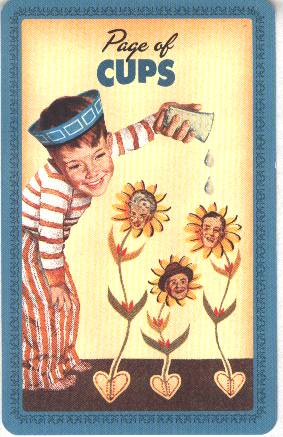 There's something about this guy that just makes me go, "Awwwwww!" He's so sweet. He reminds me of my son, Josiah, when he was a little boy. Josiah would pat my knee and say, "I neeeed a hug," several dozen times a day. If scolded for wrongdoing he would blink tears away from those deep brown eyes and just look so wounded that you just had to hug him even if you were angry with him. He's now 13 years-old and still as sweet and sensitive. (I'm sure he would just cringe if he heard me say that.) There is a soft innocence to the Page of Cups that can melt your heart.
I chose the Housewives Tarot Page of Cups not only because he brings a smile to my face...how could he not? Look at him!...but also because it portrays the elemental combination of this Page very nicely. Pages are represented by the earth element and this Page, being of the suit of cups, is of water. Therefore, the Page of Cups is known as "earth of water." Here, the Page is shown watering flowers with the faces of his loved ones on them and beneath the earth are heart shaped roots. He is barefoot in the dirt and his trousers are muddied. He clearly receives a lot of pleasure from expressing his feelings with those he loves and feels very at home in doing the earthly, tangible things that show his affections. He doesn't just talk about how he feels, he demonstrates his feelings with acts of service and gifts. His naivete is usually charming, and his gifts may be things like, "I was taking a walk and thinking about you and I picked up this really pretty rock for you." His gifts are often handmade and very thoughtful. He spends so much time on them, making them just so, thinking of the recipient of his handiwork the entire time.
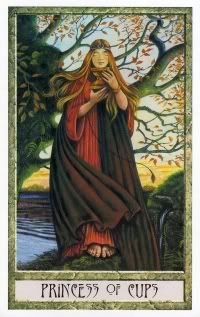 This Page is playful, inquisitive, sensitive, and honest. He or she cries easily, but laughs just as easily. She doesn't hold grudges and is quick to forgive. She often has a slightly less than practical view of relationships and life, preferring her fantasy version over reality, and clings stubbornly to romantic and idealized notions of how things ought to be. Her earth element causes her to believe that if she puts in the efforts to love, then how could she not be loved in return? She also expects others to return her love in like manner, thereby leaving her open to frequent disappointment and heartache when other people don't tread carefully on her sensitive feelings.
When this Page appears in a reading he could be showing you a side of yourself that clings to romantic or idealized notions. He can come as a warning this way to guard your sensitive heart and be aware that not everyone shares your feelings about the subject at hand. Conversely, as advice, the Page of Cups may be encouraging you to be a bit more playful in your approach, NOT take things so seriously, indulge in a bit of romantic fantasy and play, let your inner child out and see things, emotionally, with fresh eyes. He may also be hinting that you might want to show those in your life how you feel about them with a tangible display of your feelings with a heartfelt gift maybe.
As a messenger, the Page of Cups may herald a new love or friendship, a relationship that engages your heart and which brings new emotional energy to your life. Traditionally it is said that the Page of Cups may bring news of a baby, a new birth, but personally I have not seen this evident in my own readings. I can see how he could, but I usually see him coming to bring messages of an emotional nature, and not that a baby announcement is not emotional, it is, but the kinds of messages I have seen him deliver are more along the lines of, "I miss you!" or "I thought you could use cheering up today," with a plate of your favorite muffins.
There is very little that is inherently negative about the Page of Cups except her tendency to get hurt easily. That's not her fault, really. She hasn't, and likely won't develop the tough shell of a crab to defend herself. In many decks her companion is a fish which symbolizes the spiritual, intuitive nature of this Page and her ease with emotions. However, when upset this Page can become tiresome with her tears and frequent need to be treated with kid gloves. Sometimes they can exasperate you and you just want to shake them and say, "Get real!" or "Knock it off!" But then you feel like a total louse because they give you that wide-eyed look that says, "How could you do that to me? Why did you?" More than likely you'll then not only be patting their heads about whatever it was that upset them in the first place, but now also profusely apologizing for being insensitive yourself. Tiptoeing around their feelings can be difficult at times, but given the resiliance of their youthful outlook, these phases of melancholy usually do not last long, thank goodness.
The Housewives Tarot Copyright 2004 by Paul Kepple and Jude Buffum. Published by Quirk Books.
DruidCraft TarotCopyright 2005 Philip Carr-Gomm, Stephanie Carr-Gomm, Will Worthington. Published by St. Martins Press
Saturday, August 26, 2006
The Tarot Court: The Page of Swords
 So my son, Jonathan, when he was a lot younger, says to me, "Mom, how come leaves are green?"
"Because they produce their own food and it's green."
"No it isn't," he says.
"Um, yes it is," I counter.
"Nuh uh, sometimes it's red."
Ok, he had me there. Japanese Maples have red leaves. He used to do this sort of thing all the time, still does, in fact, though his questions have changed now that he's a teenager. On the one hand you think, bright kid. On the other you think, god, he's such a snot. Didn't I just get set up there? Why do I feel I was set up?
The Page of Swords is like that. Their minds go nonstop and they're looking at things from all the angles, trying to figure out twelve different things at one time. One question leads to another and to another and sandwiched in between the questions are statements about what they know that you don't. The Page of Swords favorite question is "Why?" Running a close second is, "How?" These mentally taxing people are usually very intelligent with keen insight. They communicate well, if not verbally then in writing, and their natural curiosity fuels their mental activity. They can be shy, though, or what comes across as shyness. What they're really doing is sizing up a situation, mentally gathering information and processing it before they feel comfortable enough to speak. When they do finally speak, they will dazzle you with their newfound discoveries and mental and verbal gymnastics. Like that Knave (Page) of Swords up there from The Fey Tarot.
The Page of Swords penchant for discovering new information has garnered him the reputation of a "spy." This is someone who digs up the necessary scoop on situations, people, and ideas on his own. He's not above cyber-sleuthing to find things out he feels he needs to know, in fact he sees the internet as a valuable tool in his research. He's right, of course, and its just your own fault if you happen to leave all your personal information available at the click of a Google search. Talking with him might feel as if you're being interrogated at times, as he fires off a volley of questions one after another.
This is because while all Pages' element is Earth, the Sword Page's suit element is Air. So he is what is called "earth of air." He wants his mental meanderings to be rooted in tangible fact. So he's going to dig for the evidence to find their solid basis. This need is at the root of his constant questions about why and how things are the way they are. His immaturity is usually evident in his arrogance, his need to always be right, and he tends to show off a bit where his mental prowess is concerned. He can be blunt, sometimes too blunt, like telling someone right off the bat they could stand to lose a few pounds and here's how to do it: the body works like this, see, and when you eat things like simple carbohydrates the body stores them when you don't use them, but if you eat complex carbohydrates the body has to work harder at processing them....and so on. He is completely oblivious to the fact that he just insulted you and truly thinks he's offering welcome information that you want and need. Still, he's not too arrogant to admit he could be wrong, or he might need more research, or that he still has to find out more. He'll often question his own conclusions and ask, "Wait, did I get that right?"
As a messenger, the Page of Swords delivers truth and insight, facts and knowledge. In a reading he may represent a piece of info you need, that last puzzle piece that allows you to see something clearly. This may come, for example, as a call from your doctor with the test results or the letter from your school advising you whether or not you passed a course and your grade in that course. This is the web page you stumble on by accident that tells you precisely what you needed to know in order to repair that broken thingamajig.
When the Page of Swords appears in a tarot reading he has much to say in the way of advice. His is the way of research and honesty. He advises you to ground your thoughts in fact, think before you speak, find out before you mouth off. He tells the reader there is usually more to this than meets the eye and you need to cautiously proceed, observe a while longer, check your facts. When in the position of another person in your reading he could indicate that that someone has a keen interest in you and may be watching you from afar, checking you out. This is the potential employer checking your references or the potential suitor watching you take the same bus as him every day and trying to figure out if you're married or single or what. The Page of Swords could be telling you to speak the truth bluntly, but make sure what you say really IS the truth and not just words intended to pierce someone.
The Fey Tarot Deck and Book Set Copyright © 2002, LoScarabeo Book written by Riccardo Minetti Artwork by Mara Aghem Published LoScarabeo ISBN 0-7387-0280-3
Friday, August 25, 2006
Training Wheels: The Tarot Pages
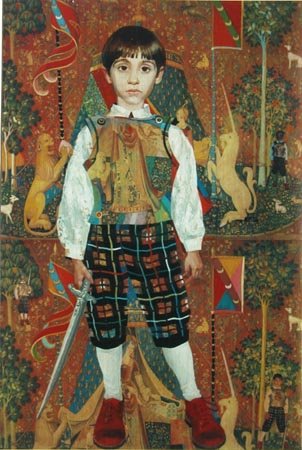 To understand the meaning of the Pages in tarot, I think a little smattering of history is in order. Tarot cards were created in the middle ages when everyone understood what was meant when someone was a "Page."
A castle Page was a boy of a nobleman or a vassal who, if he did not already reside in the castle, was sent to his lord's castle to live for the duration of his training. That is, until he became a knight. Lest the romance of it all soften this image, the knight was a soldier. He was trained for war. Thus, very young children were conscripted into training away from their families into a program so comprehensive that as they grew into young men, they would be fully prepared to serve their lord unto death, no questions.
Tarot Pages, I believe, cover the entire duration of what was actually a two-stage process from Page to Squire, for the next court card is the Knight. Pages waited the lord's table, cared for his clothing, and was trained in the proper procedures of these duties, such as how to properly carve a roast at table. He was uniformed in the colors and crest of his lord. The women of the castle looked after the younger pages and oversaw their education in religion, etiquette, and social skills. The boys were also to begin acquiring the skills of a knight so they began training in lance tilting, pell jousting, hunting, and hawking. Pages would be encouraged in sword play with wooden swords and shields and fighting on piggyback to acquire the balance needed in mounted combat. The Page was elevated to Squire status at around fourteen years of age. At this stage he would be the junior to a Knight and would more seriously begin training to knighthood. He would be at his knight's disposal at all times, even sleeping at the foot of his bed at night. In this phase the Squire was taught chivalry, courtly etiquette, music and dancing, the rules of heraldry, horsemanship and practice using genuine weapons while jousting. Squires accompanied their knights onto the battlefield, tending to the horses and dressing them. Many squires were killed on the battlefields before reaching knighthood at age twenty-one.
Thus, in tarot the Page is a servant, a messenger. He or she is also one who is in the process of learning new skills and ways of living. They are either chronologically young, or simply young-at-heart, possibly unskilled, but maybe just immature. In many ways they are ignorant, but it is that innocent kind of ignorance, not the closed-minded, stubborn kind. They are often very enthusiastic and eager to try out their newfound skills. They may attempt a project over their skill level, overestimating themselves, and are liable to make quite a few mistakes.
These guys are literally Knights-on-Training-Wheels. In jousting training they used to use wooden horses on wheels pulled by two pages while another page sat on top with a wooden lance aimed at a target, sometimes a hanged dummy or some other form of pell. A page may become so practiced at this exercise that he believes himself capable of riding a real horse or really jousting an opponent. That overconfidence is typical of the novice and often results in some pretty harsh reality checks. So if a page appears in your reading, one thing to keep in mind, especially if it is telling you something about yourself, is to check yourself for this type of overestimating your own abilities. Not that we shouldn't reach for the stars, but recognizing one's limitations in any area will allow you to learn at your own pace without too many of those fall-on-your-face humiliations that often come from biting off more than you can chew.
The thing to remember with the Pages in tarot is that they are beginning to put the lessons of their particular suit in practice. They are beginning to learn how to use their sharp swords, their reasoning and logic skills; their cups, the lessons of chivalry and emotional navigation; their wands (clubs, lances), their passion, energy directed towards goals; and their pentacles, their bodies, their resources, their ability to create something tangible, as well as managing their money.
Sometimes the meaning of the Page is even more direct. Pages, being messengers, can mean a letter, a phone call, a notice, an advertisement for something you need, an email or some other form of communication having to do with their suit. For example, the Page of Pentacles might be a message about a job or something having to do with your job whereas the Page of Cups might be a message having to do with relationships and other emotional matters. They might bring invitations to attend an event when you will meet a higher member of the court. Pages don't always bring good news, but they do bring news of some kind with information you need to know.
As mentioned in my introductory post in this series, the way to determine which meaning is suitable is by keeping the question asked in mind, examine the position in which the Page appeared, consider the possibilities of what this Page is trying to tell you, and most of all, listen to what he is saying with those internal ears of intuition.
Thursday, August 24, 2006
Court Cards: Oh, The Confusion!
 Tarot court cards, the Minor "people cards," can be confusing to many tarot readers because they can and do represent so many different possible interpretations. Well, so can most of the cards, but court cards are unique because they can represent a certain individual; or they can imply a particular facet of a person, either someone else or the querant; or they can be recommending a certain kind of action; or they might be telling the querant they are displaying a certain type of behavior; or....well, you see? It can be difficult to know what to make of these folks when they show up in a reading.
So, I decided to tackle this subject by way of a series of posts, much like my series on the Aces. (You can find them here: Part I, Part II, Part III, Part IV) There are entire books written on the subject of the Tarot Courts, which gives an idea how rich the subject can be. The funny thing about these cards is that while they are clearly stereotypes of certain people, which makes them barely two-dimensional: rendering them rather flat and static, but when you get to know them as characters in the Tarot story, they truly do develop into people with more three-dimensional characteristics.
There is a historical reason for this. In the early French playing card decks the courts were actually associated with genuine figures of power such as King Charles, Caesar, Judith, Rachel, and Judas Maccabee. (No, not Iscariot, different Judas) The figures' identities were not consistent from card maker to card maker, so it appears the designation may have been left to individual preference. Associating the courts with real historical figures personified them in a way that a generic "King" or "Queen" does not because the qualities of the real person become associated with the particular card. But this naming of court cards was peculiar to the French and not practiced in other European decks and the practice ended after the French Revolution. Wealthy royal families who commissioned tarot decks often had their own images painted as certain figures in the cards, too, so those would have clear association with a particular person as well. In the Vacchetta deck, The Tarot of the Master, the Queen of Swords (shown above) is vividly associated with the Biblical figure of Judith who has clearly succeeded in beheading invading General Holofernes. You can see his decapitated body in the background and yep, that's his head in the bag she is carrying. She kicks ass.
The court card associations with genuine people help in some ways, but are limited in others. If we associate the King of Cups with Charlemagne we will probably miss out on some of the other qualities not associated with that card. Too, if we too closely associate the courts with specific people in our own lives, we can also limit who or what the card may be representing. So while associating specific people to the court cards helps us to gain a more fleshed-out idea of who they are, try not to get locked into just those associations.
Well, how do we know who is who? I'll elaborate more in subsequent posts, but basically there are four courts in each suit. Most decks follow this pattern: Page, Knight, Queen, and King. The Thoth and its variants follow a different structure: Princess, Prince, Queen, Knight. Still other decks, like the DruidCraft use Princess, Prince, Queen, King. Basically they are all similar, though, because the Page/Princess represents the person who is just learning to apply the lessons of the suit, the Knight/Prince is where the hands-on learning and action commence, the Queens are the delegators, management group, and the Kings are the ones who have pretty much mastered the qualities of the suit. Sexist? Yeah, no doubt. It helps to keep the feminist hackles from raising when I remind myself that these are cultural stereotypes and yes, yes we do live in a patriarchal culture. Given the historical time period the cards were invented, too, those were the clear social status levels as well.
It still bugs me, but the saving grace here is that courts, no matter which sex is represented on the card, can represent either gender. You don't have to be a woman to be a Queen nor a man to be a King. Because the courts represent qualities and characteristics, personas and attitudes. In some situations you may show up as a Page, for example, such as when you embark on a new course of study or training wheras in another part of your life, say at work you may find yourself a King if you are a manager or supervisor of people and within your personal relationships you may display more qualities of a Queen. So, they really aren't gender nor age specific.
The biggest struggle in interpreting these cards is not really about their characteristics. Those can be learned and understood much as you learn the meanings of the other cards. What stumbles readers is the question: Is this someone who plays a significant role in this situation or is it a facet of myself that I need to understand? The answer to that is reading specific and dependent on the spread, the position and, very importantly, the question that was asked of the cards. If I am asking about a relationship or social issue I can expect the other people involved to show up in the reading. If I am asking about my own self development, it's more likely the court represents a facet of myself. So then, if I am asking about a social issue having to do with my dealings with others and a court card appears, how then can I know if it is referring to me or to someone else? That depends on the position in the spread. Easy ones are positions like: "What does the other person think of me?" Queen of Swords. Ok, so the qualities (good and bad, ahem...don't forget the negative ones when it's referring to you) of the Queen of Swords is the impression this person has of you. This is good to know if you were aiming to project more of the Queen of Wands' style but have come across as the Queen of Swords instead. More complicated interpretation is needed when a court appears in a position like, "Outcome of the situation." It could be a person that will figure prominently in the resolution of the issue at question, but often I see it as the qualities in the querant that will be strengthened or that will be necessary to come to the fore. In these positions the court card can be read as advice. Ask yourself, "What would the King of Pentacles do in this situation?" Reflecting on that question gives you an idea how to proceed, what attitude to assume, which qualities in yourself you need to rely on and use to your benefit.
Courts CAN be tricky because they will often show up where you least expect them and their advice isn't always clear. Getting to know them as people in their own right helps tremendously. So in the following posts I'll introduce you to the Tarot Court as I have come to know them. Your own relationships with them will likely be a little different than mine, as you will have different associations with them and different interactions. Just as with the real people in our lives, we may have different views of them than other people do depending on our experiences with them. So it is with the Tarot Court people, too. Don't rely on other people's relationships with them, develop your own. Only then will they speak directly to you rather than through an interpreter. Consider my character sketches as my introduction of someone I have come to know, but with whom you will come to know in your own way as well. You may find the person to be all I said they were and then some, or you may disagree with my assessments. That's terrific. You do that.
The Tarot of the Master is produced by Lo Scarabeo in Italy, but is distributed in the US by Llewellyn. Copyright 2002.
Monday, August 21, 2006
The Blues in Tarot
Several years ago I happened to be in one of those bored and flipping TV channels modes and though I usually skip right over the country music channel, (Sorry, but it's just not my style) this time I didn't because I heard something deeply soulful and mesmerizing. It was a video by a very young man whose voice did not appear to match his face.
I quickly learned that this artist's name was Jonny Lang and he had begun performing blues professionally when he was a mere fourteen years old. This song is entitled, "Breaking Me" and the desperation in his voice surprised me coming from someone so young. How young? Fifteen. Fifteen freaking years old and already a bona fide blues guitarist and singer!
I went and saw Jonny Lang in concert last Wednesday. If you like blues, soul, rock or anything in between I highly recommend catching his show. He's a little older now, married, and he's polished his voice and guitar skills and he's only getting better. What does this have to do with tarot? Why, the Blues, of course.
Blues Music is a distinctly American music genre. It is a mixture of African and European styles, produced by African slaves mainly in the southern United States. The songs were meant to be sad and mournful dialogues between the singer and his instrument. The "call-and-response" style is a hallmark of the blues style as well as the passionate emotions and heartbreaking lyrics that speak of loneliness, depression, and oppression. It's a haunting and soulful style and it takes a great deal of musical accomplishment to play it well, but it seems that no matter who you are, everyone can and does "sing the blues" from time to time.

Tarot encompasses the wide range of human experience and emotion, and as such there are a number of cards where the blues are depicted, but the one I feel most singularly represents the emotional landscape of the blues is the Five of Cups.
The grief evident in this card is stark and obvious. The more optimistic among us are quick to point out the cups that are left standing, as many versions of the Five of Cups depict three cups spilled and two remaining, often behind the mourning figure. But here in the Cosmic Deck all five cups are upended and drained. A wilted rose bud lies pathetically in front of her and her face is pinched in a mask of despair. Outside the door the wind blows dead leaves off a bare tree as storm clouds descend. This card hurts.
I like this image because it forbids the hastening of grief. There are no cups standing, no rushing the mourning figure to look at all she has left. There is nothing left. The sadness is overwhelming. Sometimes, no, lots of times, this card actually brings a sense of relief to someone getting their cards read. It acknowledges their pain, it sits with them in their sadness, it tells them, "I know how you feel." Just like the blues. We listen to the songs that pour out their, and our, pain and we say, yes, "I know just how you feel. Me, too." As you lower your head and rock slowly with the beat, you identify with the singer, with the grief and loneliness. Here is a place we should not rush the seeker to leave the fallen cups behind, but instead offer empathy and understanding. In due time they will move on. They will right the cups and fill them again, but for now let us stay with her a moment and share her pain. Listen as she sings that mournful song, feel your heart break in the strains of agonizing despair. There is a time to laugh and a time to cry, says the writer of Ecclesiastes, in every thing there is a season.
To tell people to stop feeling their pain is insensitive at best. To try and move them along to a place where you would feel more comfortable being with them is usually the disguised motivation. Why don't we just tell those slaves of long ago who first sang the blues to just look on the bright side, then? As I've said before, you can't run from grief. It dogs your every step until you sit with it. It commands your attention, your full attention, for a time. A funny thing happens when we finally sit down with our grief, or the grief of someone you know. It passes more quickly than if we attempt to push it away too soon. There is a time for sad songs and an appreciation of the emotions that create those melodies.
Appreciation of sadness? Yes. I said that. For in those deep wells of pain and darkness comes understanding and wisdom. There was a line that director Tom Shadyac cut from the movie Bruce Almighty where God was telling Bruce :"To paint a picture like that, you've got to use some dark colors." He goes on to say,
"You know, the most powerful stories we tell are about people who come from dark colors. They're people who've been challenged by addictions or abuse. And to overcome those things is really the light overcoming the darkness. Without the darkness, you've lost humanity and the power of the light."
In every landscape there must be dark colors. They add richness and depth, a sense of realism and perspective, all so important in art and in life. Without those dark colors the picture is flat, even though all the brighter colors are there. Our time spent in the blues is not wasted nor unnecessary. Even a child of fourteen could find something in his experience to relate to the blues he sang. It's part of the human experience and something some scientists believe we are hardwired to respond to. It has been suggested that certain sad music elicits chills because music hooks directly into the brain's primitive emotional circuits; more specifically, that music has some sort of relationship with the call of an infant crying for its mother. Separation calls are expected to evoke powerful feelings in people and human separation calls have properties related to chill-producing sounds, such that the cry is at once intense, familiar and sad. It's natural to respond to someone crying and yet our western society makes that response feel unnatural, uncomfortable, and indulgent. That kind of "chin up and all that" nonsense is counterproductive to resolution of grief and the recovery of joy.
When the Five of Cups appears in a reading, recognize the pain. Speak its name. Reach out and respond to that separation call rather than be too quick to point out the silver lining on that dark cloud. Believe me, the grieving one is despondent enough without you reminding her what she should or ought to be feeling instead of this emptiness. She feels it. She hurts. And that is why she is singing the blues.
Cosmic Tarot By Norbert Losche Published by US Games Copyright 1986
I quickly learned that this artist's name was Jonny Lang and he had begun performing blues professionally when he was a mere fourteen years old. This song is entitled, "Breaking Me" and the desperation in his voice surprised me coming from someone so young. How young? Fifteen. Fifteen freaking years old and already a bona fide blues guitarist and singer!
I went and saw Jonny Lang in concert last Wednesday. If you like blues, soul, rock or anything in between I highly recommend catching his show. He's a little older now, married, and he's polished his voice and guitar skills and he's only getting better. What does this have to do with tarot? Why, the Blues, of course.
Blues Music is a distinctly American music genre. It is a mixture of African and European styles, produced by African slaves mainly in the southern United States. The songs were meant to be sad and mournful dialogues between the singer and his instrument. The "call-and-response" style is a hallmark of the blues style as well as the passionate emotions and heartbreaking lyrics that speak of loneliness, depression, and oppression. It's a haunting and soulful style and it takes a great deal of musical accomplishment to play it well, but it seems that no matter who you are, everyone can and does "sing the blues" from time to time.
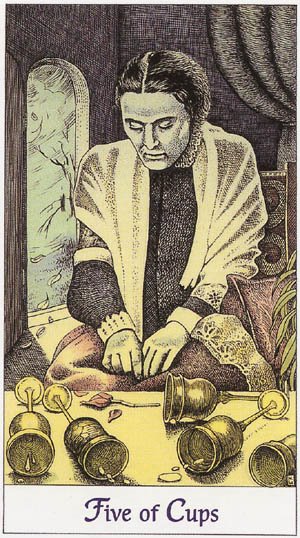
Tarot encompasses the wide range of human experience and emotion, and as such there are a number of cards where the blues are depicted, but the one I feel most singularly represents the emotional landscape of the blues is the Five of Cups.
The grief evident in this card is stark and obvious. The more optimistic among us are quick to point out the cups that are left standing, as many versions of the Five of Cups depict three cups spilled and two remaining, often behind the mourning figure. But here in the Cosmic Deck all five cups are upended and drained. A wilted rose bud lies pathetically in front of her and her face is pinched in a mask of despair. Outside the door the wind blows dead leaves off a bare tree as storm clouds descend. This card hurts.
I like this image because it forbids the hastening of grief. There are no cups standing, no rushing the mourning figure to look at all she has left. There is nothing left. The sadness is overwhelming. Sometimes, no, lots of times, this card actually brings a sense of relief to someone getting their cards read. It acknowledges their pain, it sits with them in their sadness, it tells them, "I know how you feel." Just like the blues. We listen to the songs that pour out their, and our, pain and we say, yes, "I know just how you feel. Me, too." As you lower your head and rock slowly with the beat, you identify with the singer, with the grief and loneliness. Here is a place we should not rush the seeker to leave the fallen cups behind, but instead offer empathy and understanding. In due time they will move on. They will right the cups and fill them again, but for now let us stay with her a moment and share her pain. Listen as she sings that mournful song, feel your heart break in the strains of agonizing despair. There is a time to laugh and a time to cry, says the writer of Ecclesiastes, in every thing there is a season.
To tell people to stop feeling their pain is insensitive at best. To try and move them along to a place where you would feel more comfortable being with them is usually the disguised motivation. Why don't we just tell those slaves of long ago who first sang the blues to just look on the bright side, then? As I've said before, you can't run from grief. It dogs your every step until you sit with it. It commands your attention, your full attention, for a time. A funny thing happens when we finally sit down with our grief, or the grief of someone you know. It passes more quickly than if we attempt to push it away too soon. There is a time for sad songs and an appreciation of the emotions that create those melodies.
Appreciation of sadness? Yes. I said that. For in those deep wells of pain and darkness comes understanding and wisdom. There was a line that director Tom Shadyac cut from the movie Bruce Almighty where God was telling Bruce :"To paint a picture like that, you've got to use some dark colors." He goes on to say,
"You know, the most powerful stories we tell are about people who come from dark colors. They're people who've been challenged by addictions or abuse. And to overcome those things is really the light overcoming the darkness. Without the darkness, you've lost humanity and the power of the light."
In every landscape there must be dark colors. They add richness and depth, a sense of realism and perspective, all so important in art and in life. Without those dark colors the picture is flat, even though all the brighter colors are there. Our time spent in the blues is not wasted nor unnecessary. Even a child of fourteen could find something in his experience to relate to the blues he sang. It's part of the human experience and something some scientists believe we are hardwired to respond to. It has been suggested that certain sad music elicits chills because music hooks directly into the brain's primitive emotional circuits; more specifically, that music has some sort of relationship with the call of an infant crying for its mother. Separation calls are expected to evoke powerful feelings in people and human separation calls have properties related to chill-producing sounds, such that the cry is at once intense, familiar and sad. It's natural to respond to someone crying and yet our western society makes that response feel unnatural, uncomfortable, and indulgent. That kind of "chin up and all that" nonsense is counterproductive to resolution of grief and the recovery of joy.
When the Five of Cups appears in a reading, recognize the pain. Speak its name. Reach out and respond to that separation call rather than be too quick to point out the silver lining on that dark cloud. Believe me, the grieving one is despondent enough without you reminding her what she should or ought to be feeling instead of this emptiness. She feels it. She hurts. And that is why she is singing the blues.
Cosmic Tarot By Norbert Losche Published by US Games Copyright 1986
Thursday, August 17, 2006
Seeds of Change: The Aces (Part IV: The Ace of Pentacles)

Earth fills her lap with pleasures of her own-William Wordsworth (1770-1850), British poet
The pentacles, or coins, suit in tarot should be a favorite of those who live in the state of Missouri, the "Show Me" state. For all the Doubting Thomas' who wouldn't take some poser named Jesus' word that he had risen from the dead and instead insisted that he had to see the crucifixion wounds for himself, this suit takes the thoughts, energy, and emotions from the other three suits and produces something you can hold in your hand. This is the "manifest your destiny" suit. If you can change the way you think (Ace of Swords) and focus on what you desire, and feel the emotions (Ace of Cups) surrounding that desire, and follow those hunches and flashes of inspiration (Ace of Wands) and act on them, you will indeed manifest your own reality (Ace of Pentacles). There, now you know The Secret --- oops! I've let it slip. Aw crap. Well, they don't call these cards arcana for nothing, right?
The Ace of Pentacles is yet another seed of promise, but it differs from the other Aces in that it actually shows the results of one's actions, thoughts, and emotions in tangible form. It's a return on your mental, physical, and emotional investments and because those often seem intangible, the seeds we scatter in those realms are often forgotten until one day, the Ace of Pentacles appears as though a gift from the gods. Surprise! Yet, because it, too, is but an Ace it is in itself a seed of its own kind. It may be a job offer, a small windfall, an unexpected upturn in your finances, or a material gift of some kind. It remains up to you how you might invest this gift to your own or others' benefit. Will you take the job? Will you waste the money? Will you say yes to the suitor on bended knee offering the engagement ring?
Have you ever noticed, behind the counter at a small coffee shop, a framed one dollar bill? If you ask, they will tell you it was the first dollar made when the shop opened its doors. This is a perfect representation of the Ace of Pentacles. Pentacle comes from the Latin root pend, which meant to hang. It is meant to be a talisman or amulet hung around one's neck. (It is often represented in tarot by the pentagram, the five pointed star. This symbol is associated with magic, with the divine feminine, and with the earth.) To hang a pentacle was to protect or bring good luck, and so the hanging of a framed dollar bill is done much in the same vein. Therefore, the Ace of Pentacles is often a promise of things to come, a deposit on a future harvest of abundance.
While this gift often seems to come out of the blue, it can usually be traced back to something you've invested somewhere. A small kindness you did for someone or a collaborative effort that finally pays off down the line. For the job opportunity really doesn't come out of nowhere. Somehow, some way, you made your talents and skills known with effort on your part. Pentacles are the fruit of the earth and while nature yields fruit seemingly effortlessly, (it's not, there is mu
 ch energy involved) we, on the other hand, usually need to put forth something of our own energy, if even first in thought form, to produce a tangible product.
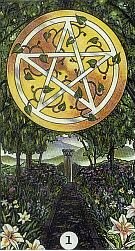
This Ace can symbolize conception of a baby, either literal or figurative, the seed of a future life. And just as all the other aces are dependent upon your action, so is this ace, too, dependent upon your nurturing to bring it to maturity. The image of the Ace of Pentacles in the Robin Wood tarot deck is one of my favorites. It depicts a lush garden scene with a path that leads to an empty pedestal. That pedestal is for your finished creation when it is completed. It is as yet unformed, but the Ace gives you the raw material with which to begin working. It's the clay for the potter, the paint for the painter, the flesh and blood for the body builder, the flowers for the florist. This Ace is the seed of creation which, when taken in hand and formed and shaped and multiplied and worked becomes a masterpiece, YOUR masterpiece. You are the Master Gardener of your life, and this Ace is your prizewinning, tremendously rare and treasured seed. What will you do with it?
Classical Tarot - Italy, © 2000 Lo Scarabeo(engravings from 1835)
The Robin Wood TarotRobin Wood Copyright Copyright ©1991Llewellyn WorldwideISBN 0 87542 894 0
The Robin Wood TarotRobin Wood Copyright Copyright ©1991Llewellyn WorldwideISBN 0 87542 894 0
Wednesday, August 16, 2006
Seeds of Change: The Aces (Part III: The Ace of Wands)
 The singular passion
 Abides its object and consumes desire
In the circling shadow of its appetite.
-Allen Tate (1899-1979), U.S. poet.
What sets your mind, your heart, your desire aflame? What sparks your curiosity? What can keep you up late at night because you want to work on it, finish it, immerse yourself in it? When is the last time you had a flash of inspiration in the shower? Seems like a good place for those, the shower. I think it's the white noise and soothing warmth of the water that allows the mind to receive those flickers of ideas that, acted upon, become our next endeavor. The Ace of Wands is like that. A flash, a spark, an idea that flares up in the conscience like a small torch. Grab it and use it, else, like a matchstick, it consumes itself and is gone.
All work, both great and small, starts with an idea. Did you ever wonder how someone thought to do something we now find ordinary, but which, at the time was someone's flash of inspiration in the shower? Take wristwatches for example. Sometime in the mid 1800's, Patek Philippe, in the shower, no doubt, thought to string a watch to a bracelet for women. As new ideas often get rolly-eyed responses, so did Philippe's "wristlet." In fact, no self-respecting man would be caught dead wearing one. It was a bauble, a trinket, a woman's adornment, not even expected to keep correct time. That is, until the late 1800's and into World War I when soldiers found fumbling for their pocket watches with their hands full of grenades cumbersome and began strapping the pocket watches to their own wrists. Nobody called them sissies for it, so when they went back
 home and continued wearing their "trench watches," civilian men, probably wanting to get in on the masculine, soldier cache with the ladies, began wearing watches on their wrists, too. So there you have it. Patek Philippe's Ace of Wands moment. Bet you didn't know that.
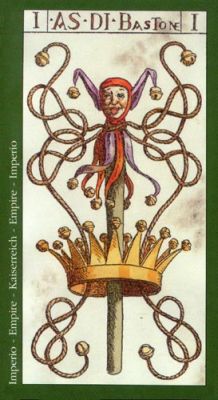
Don't you hate it when you get this brilliant idea for something, say, a widget of some sort and you think, "Wow, I should make that and sell it and make a million bucks!" But you don't. Then a year later you see it advertised by Ronco for $19.95 on late night TV and somebody is making a million bucks off YOUR idea! Rats. Well, that's because they got that Ace of Wands in the shower, too, and instead of just feeding the dog and going to work, they actually did something about it. That's the fleeting nature of this Ace of fire. You have to act on it, or it's just another brilliant idea that gets snuffed out before it gets a chance. The seeming foolishness of some creative geniuses is well represented by the Vacchetta As di Bastoni. (That's Italian for "Ace of Wands") A jester's marotte, with its tongue sticking out for gosh sakes, bells everywhere. New ideas are often subjected to ridicule and mocking. This alone could quench the fire unless you are willing to play the Fool.
This Ace is about passion, the will to act, the desire to start something. Start something? Oh yeah, that, too. It can often indicate a flash of anger, a fight. It's quite dramatic, too, with fine china being thrown and everything. It's the skirt swooshing exit with the slamming of the door. It's not a simmering, seething hatred, though. Oh no. It's over almost as soon as it started. All's well in an hour or so when ruffled feathers are smoothed or after someone takes a nap.

Wands, being fire and passion, also represent sexual desire. In many tarot decks the wands totally look phallic. The classic Rider Waite deck is a perfect example. Don't believe me? Look. Ok, so most penises aren't sprouting leaves, but still. And being the good feminist that I am, I must point out that, in tarot, two suits are considered "masculine" and two suits are "feminine." While swords and wands may be considered phallic, cups and pentacles are vaginal or womb-like. Considering both sperm and egg are still needed for healthy procreation, that balance is represented in tarot. The Ace of Wands represents the more aggressive sexuality historically associated with the phallus. Ok, so to get more direct, the Ace of Wands basically means you're horney. Well, someone is. That can be quite the motivating drive sometimes. Still, while it represents that initial sexual attraction, with attending physical response, ahem, it's not the firmest foundation for a lasting relationship. (It's not for nothing that the Knight of Wands gets his "player" reputation.)
Passion comes in various forms, but its common characteristic is a burning desire. The fire of the Ace of Wands brings energy to create, to bring something from nothing. Without this inspiration, there would be no energy to do the necessary work of creation. The Ace is just a spark, so if you haven't gathered wood for the fire, go get it. This Ace will even tell you where to find it. Now go! Ok, you're in the shower. I'll wait for you to dry off and get dressed.
Vacchetta Tarot by Giovanni Vacchetta Published by Il Meneghello © 2001
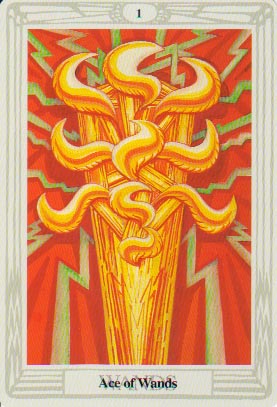
Thoth Tarot copyright US Games Inc.
Universal Waite copyright U.S. Games, Inc. All Rights reserved
Tuesday, August 15, 2006
Seeds of Change: The Aces (Part II: The Ace of Cups)
 My heart leaps in wonder.
 Cold, fresh, deep,
I feel the word 'water'
spelled in my left palm.
-Denise Levertov (b. 1923), U.S. poet.
My friend, Jonna, does not read tarot, but she likes to leaf through my decks and choose her favorite cards. When an image strikes her she puts it to the side. From each and every deck I have shown to her she has pulled out the Ace of Cups. Truly, this is her card. She is deeply emotional, she can't even try to hide it. Her emotions bubble up and out and pour over her whether it be joy or sorrow, anger or love. This Ace is like that. It is a flood, a rush of emotion, usually joyous and loving, but not always. We'd prefer that, I'm sure, that the Ace of Cups is always about love and happiness, but it isn't. Sometimes it's a wave of tears gushing forth from a dammed up river of grief.
The suit of Cups represent the emotions, its element is water, a fitting metaphor for these untamable forces that draw us towards and away from people, things, and experiences. The Ace is a solitary number, though, it represents just one. This Ace is a personal emotional force, the swelling of feelings inside one's soul often in response to something seen or experienced. It doesn't necessarily presage falling in love with another, although certainly one may experience the Ace of Cups in that process. It can, instead, represent attending to one's own emotional wellbeing.
This is one of the most welcome cards in tarot readings. As Martha Stewart would say, "It's a GOOD thing." Once or twice I've seen it come up as an emotional storm, like a temper tantrum, or tears on tap, manipulative crocodile tears, but other, surrounding cards brought about those interpretations. All by itself, it's as welcome as a cool spring on a hot day. Aces are rather dramatic, that must be why I like them so much, drama queen that I can be. They're like the switch turned to the ON position and the volume cranked up. They're like the Enterprise on warp speed, and just like Scotty would protest, "She canny take much more, Captain!" aces have a rather short lifespan. They're bursts of power, in this case an onslaught of emotion, which doesn't last. So it's all about striking when the iron is hot with the Aces.
I've had very long emotional dry spells in my life. Quite unwelcome, but there I was in the emotional desert all the same. I had no tears to shed, no joy either, rather like an emotional flatline. Depression can do this to a person, but so can the tedium of life. Too, a person who is very much an emotional giver can find themselves tapped out, with nary a drop left in their own cup to sustain neither themselves nor anyone else. At these times the Ace of Cups is most welcome and often shows up to advise a time of refilling. You can't keep water in a leaky bucket, so how one goes about taking this advice is to first find where the leaks are. Most of us simply go for the filling station and don't pay attention to the leaks and breaks. What then happens is you come back from your holiday feeling wonderfully refreshed, the spiritual retreat was most enlightening, you're bouncing with newfound energy until about the next day when you wake up and find yourself just as bereft and dry as before you went off. If not more. Wha' happened? And so we go from filling station to filling station and never feel full.
Plug up the leaks. Where are you emotionally broken? Where have you been torn open? Set to mending those places before you head off to the filling station. Wot? You mean this isn't a gift? I have to work for it? No...no, 'tis a gift. But if you can't keep it then how will you use it? And how will it spill over abundantly from a leaky cup? I know I'm making sense here whether you like it or not.
Aces, remember, are all about seeds of change, promise for something yet to come. They are the raw energy of the suit, but as yet unusable in its current form. It's the push of the wave under the surfboard, the white water under the raft. But only with the skill of the surfer and the oars in the hands of the rafter can you navigate the direction and the result. So, bring it on, yes! Let the flood come, hallelujah! It's about time, right? But it can wash over you and recede back into the sea, or you can gather it in a water-tight sand pail and actually use it.
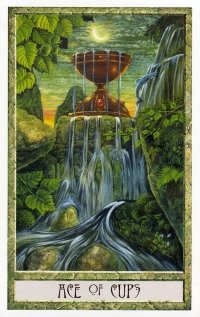
The Druid Craft TarotText by Philip & Stephanie Carr-Gomm Copyright © 2004Illustrations by Will Worthington Copyright © 2004Eddison Saad Editions Copyright © 2004ISBN 1 85906 144 3
Monday, August 14, 2006
Seeds of Change: The Aces (Part I: The Ace of Swords)
 Aces in Tarot are, they say, gifts from heaven. When you get an Ace in a reading, the inclination is to feel like it's a few days before Christmas and you just know a gift is coming. What is it? The anticipatory reaction is understandable, but not always warranted. While Aces are powerful cards, they are also the lowest number in the suit. Just like with regular playing cards, depending on the game, an Ace can win a game or turn out inconsequential. The English word 'ace' comes from the Old French word 'as' (from Latin 'as') meaning 'a unit', from the name of a small Roman coin. It originally meant the side of a die with only one mark, before it was a term for a playing card. Since this was the lowest roll of the die, it traditionally meant 'bad luck' in Middle English, but as the ace is often the highest playing card in many modern games, its meaning has changed to mean 'high-quality, excellence'. So which is it? Does the Ace in Tarot herald something magnificent? Or is it just an inconsequential blip on the screen of life? Well, both. Or neither. It depends?
The Tarot Ace that reflects this ambivalence the most is the Ace of Swords. Its equivalent in playing card decks is the Ace of Spades. In Robert Louis Stevenson's story "The Suicide Club" (1878), the Ace of Spades functions as the "sign of death" within a secret society whose members commit "suicide" by submitting to be killed, if they draw the Ace of Spades from a pack of 52 cards during a club meeting, by another member drawing the Ace of Clubs. The Ace of Spades was also used as "the death card" in the Vietnam War. It was erroneously believed that Vietnamese ancient traditions held the symbolism of the spade to mean death and ill-fortune. The soldiers were quick to pick up this misconception, and in a bid to scare away Viet Cong soldiers without firefight, it was common practice to leave an Ace of Spades on the bodies of killed Vietnamese and even to litter the forested grounds and fields with the card.
The sword is obviously a deadly weapon and can, literally, kill. However, in Tarot, the suit represents the activity of the mind, the mental processes and the communication that thoughts bring about. It does represent conflict, too, so in a very real way swords can be deadly, though not in a physical sense. When the Ace of Swords is present in a tarot reading, it usually heralds an "Aha!" moment, a flash of insight that separates truth from illusion. This double-edged blade can hurt in that moment of clarity, when truth is laid bare before you, cutting away a possibly cherished, but untrue, notion. While the truth can hurt, and if the one wielding the sword is barbaric and boorish it can hurt more than needed, it is also enlightening and can put one on a path of a new way of thinking and seeing things, because if what you formerly held is shown to be untrue, then there are adjustments to be made and learning to be done. That is the beginning this Ace signifies: a newfound insight that sets you on a path of clearing the way for new understanding and knowledge and truth.
Aces in tarot represent the seed of force needed to bring something new into creation. That's why "Eureka!" moments are so powerful and often life changing. They have to be, or you'd never notice them. Epiphanies wouldn't be so "Ta da!" without the powerful, enlightening force behind them that changes the way you view something and then results in change in your actions. And with the Ace of Swords, something is cut away, hence the "death" imagery, old ways of thinking die off in an instant as you learn something new that cancel them out.
But I'm being dramatic here. I've certainly had Ace of Swords epiphanies and they are wondrous indeed, but sometimes the Ace isn't all that. Sometimes it simply means the bank calls and tells you they made a mistake on your statement and it wasn't in your favor and now they've fixed it, so you've been operating on the notion of $20 extra bucks in your account and now you have to adjust for that. No, nothing is going to bounce, but it's a mental adjustment. You might make a mental note to keep your own books instead of relying on bank statements for the truth from now on. It could be telling you to speak the unvarnished truth to a friend.
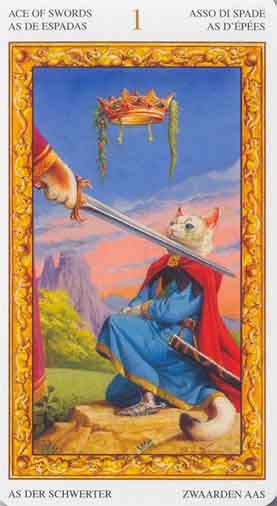 It's s risk, it could change things between you, but it's imperative to the friendship that you do. So yeah, be careful where you point that thing. It's sharp. And pointy.
I also see the Ace of Swords in a kind of video game analogous way of "Levelling Up." As the Tarot of the White Cats depicts the knighting of a cat, it represents an accomplishment of a sort. As we grow in understanding, the sword ace brings us up to a new level of awareness and with it the beginning of new responsibilities: to act in accordance with this new level of understanding. (Witness the cyclical nature of the suits of tarot, from 1-10 in each suit, always at work in our lives in various ways.) When you "level up" in a game, you often find yourself in the role of "beginner" again, somewhat at a disadvantage, in a new realm that you have to explore. You have the advantage of taking with you all the treasures and tools you gained on the levels you have already passed through, but on this level you don't yet have a clue.
Therefore, the Ace is powerful, yes, and it's a gift, yes, but it is only a beginning after all. It's the raw material of creation, but it is not the product. It is the new idea, the insight, the impulse to change, but it is not the change itself. You still have to do the work in order to get to the next level. So while the Ace may very well be a gift from the divine powers that be, if it lies unused in the box, what good is it to you?
Tarot of the White Cats by Severino Baraldi © 2005 Lo Scarabeo ISBN# #073870463-6
Classical Tarot - Italy, © 2000 Lo Scarabeo(engravings from 1835)
Sunday, August 13, 2006
Tarot Dancing
 Carol gave me the Three of Cups yesterday because I was such a mess on Friday. And then do you know what happened? I went dancing! I received an invitation last night to go out and see my favorite local band and danced my booty off. This is one of the things I really love about tarot, the layers of meanings in the cards, from the literal to the metaphorical. While Carol's intention of giving me that card was clearly a way of expressing her friendship and support to me, little did she (or I, for that matter) know that it was a literal prediction, or prescription perhaps, to remedy my state of mind.
There is a dance we do among the meanings when we look at a card, a mental and emotional dance that, as a tarot beginner, feels awkward and out-of-synch at first, but which becomes easier and more fluid the longer we work with the cards. I remember becoming very frustrated with the dance when I first started learning the card meanings because there seemed to be so many different choices, how was I to know which one to choose? I could look at the Three of Cups and see, literally, a get-together with women friends, or metaphorically a supportive environment, feeling at one with humanity, friendship, or caring. As I stumbled through the dance steps of tarot reading, I would become frustrated and wonder how I was ever going to actually read these cards. This was a new dance and I felt so out of step with the music. In fact, I couldn't even hear the music at first.
I think my initial stumbling was natural, of course, as one doesn't learn to tango simply by looking at a chart of steps in a book, but by actually getting up on your feet and dancing, rather badly at first. To music. Which isn't to say the diagrams aren't helpful, they can be. Books about reading tarot are helpful, too. But reading cards by the book is not reading the cards any more than mimicking dance steps on a chart is actually dancing. I mean, does that feel like dancing to you? I'll tell you what feels like dancing to me: when I become so caught up in the music that my body responds so naturally and fluidly to the sound that there is very little thought put into my movements. It's trancelike and it feels right. There's a similar "zone" to tarot reading, when you're feeling your way through the images and while you are intimately familiar with the traditional meanings, you have practiced the "steps," you become carried off on the waves of imagery and feel which combination of meanings is right for this reading, for this dance.
I'm sure you've heard the encouragement to "dance like no one's watching." Well, read tarot like that, too. Shut off the internal critic. Dare to stumble and get it "wrong." Be foolish and say the first thing that comes to mind, even if it's something nonsensical to you like, "I'm thinking rutabaga here, have no idea why." Go out on limbs and read tarot like that. Oh sure, you'll stumble. You'll miss a beat. The music might fool you and you'll go left when you should have gone right. Yes. That will happen. Stepping on toes is part of the process. But I danced barefoot last night in a crowd of drunken people fully understanding the risk. I got up there when no one else was dancing and danced alone. Like no one was watching.
Illustration from the Lover's Path Tarot. U.S. Games Systems, Inc., Stamford, CT 06902 USA. Copyright 2004 by U.S. Games Systems, Inc.
Subscribe to:
Posts
(
Atom
)


