Friday, November 25, 2011
No Longer Switzerland

Janet Boyer has been a reviewer of tarot products for a long while. I, personally, don't care about what other people think about decks and books so I rarely read her reviews. I think whether or not someone likes a product or finds it usable is entirely subjective. What I find distasteful in a deck another reader loves, so a review is, well, just another opinion. She has been known to be brutally honest in her appraisals, which is great. I appreciate that and have even warned those who have solicited me for reviews that I would do likewise. I have pissed off at least one deck creator for honestly expressing my opinion about her deck on a tarot forum. However, there is a distinction between being brutally honest and being a shithead and sometimes Janet has been known to cross that line into a biased, personal vendetta. Again, whatever. I am Switzerland.
The other day, Janet crossed another line and I feel angry, disgusted, and no longer able to be Switzerland. She published a short story on Amazon for Kindle called The Ones I Refused To Leave in which she thinly veils the identities of herself and others that she despises in the Tarot community. If it were just a scathing screed of petty grievances, I would still be Switzerland. But the story is about how a tarot reviewer murders a podcast show host, clearly Donnaleigh de la Rose, of Beyond Worlds, simply because the reviewer doesn't like her, and shits on her grave. The murder takes place at a tarot convention that sure seems to be the Readers Studio. She also insults other major contributors to the community while she's at it. As I said, if this were just an expression of petty grudges and backbiting, I'd ignore it. The story is a piece of shit anyway. Quite suitably, the final scene describes in detail the feces she leaves on the woman's grave. It's not well-written, it's not compelling from a literary standpoint. The problem? It is a thinly disguised threat of lethal violence against another nonfictional, very real person. There are laws against this. While Janet may be able to hide behind the "it's fictional" defense, I call bullshit. I'm calling her out for this harassment of someone who she has every right to dislike but no right to threaten. We're all entitled to our opinions, but when you cross the crazy line to threatening murder, "fictionalized" though it may be, you've gone too far.
UPDATE: It appears the link to Ms. Boyer's short story no longer exists, but she has published this blog entry in reference to the story.
Sunday, November 20, 2011
Tarot Hypochondria

I recently read about how doctors are getting frustrated with patients who gather medical information about their symptoms via the Internet. This TIME article by Dr. Zachary Meisel illustrates an all too common scene in today's doctor's office:
The medical intern started her presentation with an eye roll. "The patient in Room 3 had some blood in the toilet bowl this morning and is here with a pile of Internet printouts listing all the crazy things she thinks she might have."
The intern continued, "I think she has a hemorrhoid."
"Another case of cyberchondria," added the nurse behind me.
In the end, the patient did, indeed, have a hemorrhoid.This made me laugh because a number of years ago I did something very similar, but in my case I didn't even have any symptoms. Simply browsing the Internet I came upon a description of a rare, genetic disorder, Marfan Syndrome, that, it appeared to me, I might have. It didn't matter that no one in my family had ever been diagnosed with this disorder nor met their premature end as a result of this disorder, I became increasingly convinced I was at least potentially one with this life-threatening condition. The scary part about it was that it involved a weakness in the heart's aorta and death could come instantly without warning as the aorta ruptures. I spent weeks in nervous anxiety, thinking every twinge in my upper back, every weird sensation in my chest, was an indication that I did have this condition. I even ended up imagining being carted out of my house by EMT's on a stretcher while my young children, bewildered, looked on helplessly, thinking it would be the last time they would see their mother alive. Oh, I was a wreck.
So, I scheduled a physical with my doctor. She was wonderful. I remember her smiling and even warmly laughing a little at my concern. I admitted I felt foolish, having dredged up this information on the Internet. She commiserated, sharing that, being a doctor, she had too much information at her disposal and had done the same more than once. She said, "You understand how rare this disorder is, don't you? And you're not tall, so..." I nodded. "But I do share many of the other indications, and that worries me," I said. She said, "Ok, I understand. Let's do an echocardiogram and put your mind at ease." Bless her. Tests revealed I do not, in fact, have Marfan Syndrome and I stopped having imaginary traumatic death scenes play out inside my head.

THE TOWER.--Misery, distress, indigence, adversity, calamity, disgrace, deception, ruin. It is a card in particular of unforeseen catastrophe. Reversed: According to one account, the same in a lesser degree also oppression, imprisonment, tyranny.Nice. You're screwed. Oh noes! So, if you're like me, you do more research. You ask the cards what the hell they are talking about and what means the Tower in this situation. It's answer? Ten of Swords:
Whatsoever is intimated by the design; also pain, affliction, tears, sadness, desolation. It is not especially a card of violent death. Reversed: Advantage, profit, success, favour, but none of these are permanent; also power and authority.Good grief. Well, at least I won't die violently. And the Swords indicate conflict, but it is likely something verbal or that is going on inside my own head. I'd rather see this card follow the Tower than the 5 of Pentacles reversed:
The card foretells material trouble above all, whether in the form illustrated--that is, destitution--or otherwise. For some cartomancists, it is a card of love and lovers-wife, husband, friend, mistress; also concordance, affinities. These alternatives cannot be harmonized. Reversed: Disorder, chaos, ruin, discord, profligacy.But it's still disconcerting, so how about we have a do-over? Shuffle. Shuffle some more. Shuffle more. Now my hands are sweaty and random cards fall out of the deck. Do they mean something? Nah, I'm just perspiring. But what if they do? Strength fell out, but was it upright or reversed? I don't know because it fell on the floor sideways.
Power, energy, action, courage, magnanimity; also complete success and honours. Reversed: Despotism, abuse if power, weakness, discord, sometimes even disgrace.I need to know if it was upright or reversed, so I draw another card to ask this. I get 7 of Wands:
Reversed: Perplexity, embarrassments, anxiety. It is also a caution against indecision.Now the tarot is making fun of me and my anxious state over this whole reading. "Very funny, " I say out loud. Further readings, of which there are several, yield results no better and less clear.

First, calm down. Even doctors need to consult other doctors. Tarot readers need to consult other tarot readers sometimes, too. All it took for me to find peace when I thought I was suffering from an incurable condition was an understanding physician and a simple test. It was worth the co-pay. It was not worth the weeks of dread and anxiety I waited because I thought I was being foolish. The objectivity that another reader can provide is priceless.
Sunday, November 06, 2011
A Mind Divided
As every divided kingdom falls, so every mind divided between many studies confounds and saps itself.
-- Leonardo Da Vinci
And if a house be divided against itself, that house cannot stand.
-- Mark 3:25
 |
| Original Rider-Waite Tarot published by US Games 1999 |
The Two of Swords in the Rider Waite imagery left me with curious questions, so I spent some time researching the symbolic origins. It wasn't an easy task because much of the esoteric imagery of the decks that arose from the Hermetic Order of the Golden Dawn were symbolic of secrets only the initiates and adepts were privy to. What they publicly were said to mean could differ significantly to what they privately meant. Or not. One never really knows.
A hoodwinked female figure balances two swords upon her shoulders.
Divinatory Meanings: Conformity and the equipoise which it suggests, courage, friendship, concord in a state of arms; another reading gives tenderness, affection, intimacy. The suggestion of harmony and other favourable readings must be considered in a qualified manner, as Swords generally are not symbolical of beneficent forces in human affairs.
Reversed: Imposture, falsehood, duplicity, disloyalty.
So we have some key symbols mentioned in his description as well as visible on the card itself.
Blindfold or Hoodwink:
The term "hoodwinked" in reference to the blindfold is used in its archaic definition, to blindfold, rather than the more modern definition: to take in by deceptive means. The blindfold on the woman is not there for purposes of deception but to heighten her awareness of her other senses. This essay by Mason Brother Henry Taylor, written in 1923, explains the psychological, symbolic, and functional reasons for the hoodwink in ceremonial rites of their secret society. In reference to the blindfold featured on the 2 of Swords, this quote by Taylor is most appropriate:
Of the inward and constitutional lack of faculty, the Hoodwink is the fitting symbol. It stands for that darkness which is due, not to accident, or to tyranny, but to a lack in the soul itself, which the darkened one alone has the means to remove.She has the physical ability to remove her blindfold herself, unlike the figure in the 8 of Swords whose hands are bound. However, her hands are otherwise occupied with the two swords. It appears that the darkness will not be lifted until she can resolve the issue represented by the swords.
The Latin code of gematria is a common means to explore the inner meaning of mystical writings and scriptures by use of numerology, specifically by exchanging letters and/or phrases with its numerical equivalent and is known to be used by secret societies in their writings. In this system, "hoodwinked" has the value of 1080. This is the female, or lunar, component of the number of fusion (1080 + 666 = 1746) and ascribed to the Holy Ghost. If we use this numerical clue, we can then see why the figure is female and also why she is "hoodwinked." She is attempting to hear the intuitive voice inside of her soul, often called the Holy Spirit by Christians, by temporarily blinding her sense of sight.
The Swords:
We know that Swords in Tarot indicate the mind, mental activity, communication, challenge, conflict, and the actions that arise from there. In this image they are posed crossed with the points of the blade upward. Symbolically upward pointing crossed swords indicate an active battle as opposed to downward crossed blades which symbolize the battle is over. Upward crossed swords can often be seen as a symbol of victory if the figure is holding the swords crossed over his head, but here the swords themselves are not crossed, but her arms are crossed over her heart in the sign of an X. The X is the symbol for Chi in Greek which is the first letter in Christ and has long been used as a symbol for the Christ. It is an ancient symbol of transformation and is often seen as the position for the arms of a body laid at rest after death. While some would attribute this practice to Christianity, one can see this same position in Egyptian mummies, which predate Christianity considerably. The X is the Egyptian sign of Osiris, the Sun God, who was later associated (by Christians) with Christ, the Son of God, so the crossed arms of Egyptians were most likely in honor of Osiris, the Great Lord and signifying their own transformation into the afterlife. The opposing thoughts or ideas represented by the swords are being held by a woman who is attempting to listen intently to her inner voice in order to be transformed in some way by the inner conflict.
The Moon:
 |
| Lunar Eclipse December 20, 2010 |


The Number Two:
Two is the number of the Major Arcana High Priestess and if we place the cards side-by-side we can see the clear imprint of the High Priestess on the 2 of Swords.
 |
| Original Rider-Waite Tarot published by US Games 1999 |
Ok, so that was some really cool investigative work, but besides telling us what we likely already know, that we're stuck in an inner conflict between opposing ideas, how would this card help us move out of that place? What is interesting about this card is though it is of the Swords suit, it actually recommends a very non-Swords approach. Its advice is to turn not to the light of the sun, the rational, but to the reflective light of the moon, the intuitive and emotional. Hence the imagery of seeing the moon during the day, to incorporate the intuitive with the rational. The process itself is transformative because what results is a new thing, a new truth or idea that comes as a blending of intellect and emotion, spirit and reason, divined from the wisdom ensconced within you.
No telling how long one must sit in this stillness, in this uncomfortable quandary. It might be brief or it may last quite a while, but to remove the swords to their downward position to indicate the battle is over and peace reigning, we must must be willing to wait in quietness. Sooner or later, that insight, the third sword, will break through.
 |
| Original Rider-Waite Tarot published by US Games 1999 |
Sunday, October 30, 2011
Honoring Death


The practice of taking over existing cultural holidays and "Christianizing" them is something the Church has done practically since its inception. In a well-known speech to the Athenians in the 1st century, the Apostle Paul declares the deity they called "Agnostos Theos," or unknown god, was actually the Hebrew god, whose name was too holy to say. (Acts 17:22-31) There was a temple in Athens dedicated to this god, but it wasn't viewed so much as a deity itself but as a way the Greeks could cover their spiritual hindquarters in case there was a god that existed that they didn't know about and didn't want to inadvertently insult. Paul, being an educated scholar, used his understanding of the Greek culture and literature to sway his listeners to a different spiritual concept, but also using one that was already embedded in the culture. Conversion to Christianity, in Paul's experience, came as a dramatic "Aha!" moment in which he was struck blind for a time. When he could see again, it was as if he saw everything in creation in a new light with a new perspective. Therefore, the effort to convert others to Christianity involved, at least early in the history of the movement, persuading them to see their existing world through the lens of a Christian perspective. That Sun God you worship? That's the Son of God. The death and rebirth you witness each year on the earth? That symbolizes Christ's death and resurrection, and so on and so forth. It wasn't until the Church became a civil authority with the conversion of the Roman Emperor Constantine that it had the official power to not only persuade but demand certain feasts and festivals honor Christian concepts rather than pagan. Constantine himself was Roman and did not cease to be Roman after his conversion. Rather, he credited his successes to the Christian High God but continued to honor the Roman deities as well. In fact, he instructed that Christians and non-Christians alike were to observe the venerable day of the sun. This edict would lead to the transforming of the pagan holiday of Yule into Christmas, but Constantine was happy with it as it was.


Meanwhile, as we don our costumes, attend parties and trick-or-treat, we are participating in an amazing cross-cultural, cross-spiritual event, whether we recognize it or not. We're paying homage to Death and, by extension, to Life. We're facing our fears, whistling in the dark, and honoring our ancestors who have all had to face the same ultimate end. We all participate in the dance macabre.
Monday, October 17, 2011
Occupy Justice

So often we think the power lies "out there" and it's all a matter of what other people and forces do that affect us, but we're the ones that create and shape our world. Justice always seems like an "other" type of force, something outside of us that decides for or against us. Thing is, we are the ones that set Justice in motion. Even if one views her as a kind of karmic balancer, rather than an internal virtue, then she is still profoundly influenced by our actions: past, present, and future. St. Thomas Aquinas defined justice as the constant and perpetual will to render to everyone his due. Injustice, then, occurs when a person or group receives either less or more than what is due to them. The problem, as Lennon observed, is in the lack of awareness that most people possess, either because of apathy or ignorance. People who are educated, informed, and aware of injustice react to it, almost instinctively, and seek to set things to right again. The only way a small, albeit powerful, group could have succeeded in tipping the scales so profoundly in their favor and against the majority without Justice intervening is because the majority wasn't looking or they thought Justice is something done by others and not something they themselves produce by their own decisions and actions.
 |
| Ancient Minchiate Etruria by Pietro Alligo, Lo Scarabeo 1996 |
It is in justice that the ordering of society is centered. ~Aristotle
Among the opponents of the recent protests are those who think the people who are protesting are just pissed off that other people are wealthy and have made something of themselves and that the protests are nothing more than folks with a bad case of sour grapes. What I see instead is the awakening of many people to the reality that we, both individually and collectively, wield Justice's sword. While it is true that Justice represents the decisions made by the "powers that be," what is often overlooked is that we are the creators of those offices, those powers, and it isn't by divine right that those in power maintain their positions. It is all of human artifice and design and therefore can be balanced only by human influence.
Because Justice is a Major Arcana card in the tarot deck, the idea that its power is "fated" or "destined" and is somehow outside of one's control comes into play in many tarot readings. It isn't entirely untrue, that interpretation. As a society, we do vest power in our legal institutions to decide for us, on our behalf. Therefore, when we find ourselves in a situation in which our "fate" must be decided by they who are granted those powers, we can feel quite powerless in the court of Justice. And while our power may be limited in its influence in that moment, we are not powerless. Sometimes Justice rules in our favor and sometimes she doesn't, but nevertheless when Justice is served we know it. It's when we see the scales of Justice totally off kilter that something within rises up, attempts to seize the sword from her hand and start hacking away at whatever resides on the weighty side, and yes, that is our right and duty. It is at Justice's invitation and and plea that we act upon that inner sense of hers inside of us that ultimately determines her final decree.
The problem with human justice is that it is limited by our perceptions. All the checks and balances placed within the system can be circumvented and corrupted by the very people who rely on it to serve them. There is a well-known story in the Gospel of John called the "Pericope de Adultera" about Jesus and the woman taken in adultery. The governing authorities brought a woman who had been caught "in the very act" (ahem) of adultery to Jesus for dispensing of justice. The story illustrates something very important about not only Justice, but who should, and more importantly, who should not wield her sword. Adultery was a capital offense in ancient Jewish society and the sentence was to be carried out by stoning the offender. When the officials brought the woman to be judged, the crowd gathered with stones in their hands in order to, they thought and believed, exact justice. All too often, this is how most of us respond to the call to justice. We follow what we have been taught and so believe to be right. Our inner scales are already weighted with our customs, our upbringing, our cultural mores. With one sentence, Jesus strips the blindfold off Justice by saying, "He who is without sin, cast the first stone." The statement blatantly reveals that not one of us is unbiased, impartial, nor unstained with personal opinion that renders the human being incapable and indeed unworthy of passing such a serious judgement upon another.
All we can do is strive to balance the scales, but we must do so in the understanding that our perceptions are probably skewed and that perfect human justice is probably unattainable. No social movement will ultimately "fix things." However, that should never stop us from trying. The next time Justice appears in a reading, consider where balance ought to be restored and how one might contribute to that effort. If it indicates you are in the position to "render judgement" then consider carefully that you, too, carry the human flaw of bias. If you are the defendant in Justice's court, don't lose heart or feel powerless, but seek to understand your own influence in the events. In human affairs, Justice is something we all work to achieve, but never quite possess.
Sunday, August 28, 2011
The Star's Hope
 |
| Classic Tarot by Carlo DellaRocca Published by Lo Scarabeo 2000 |
 |
The generic description of the card features "a goddess"...wait, which goddess? And do they call her a goddess because she is both beautiful and naked or because she represents a particular goddess myth? Choosing to go with the latter, I researched goddesses associated with either stars or water. I found Inanna, Sumerian goddess of rebirth. Hold up. Rebirth? Wouldn't that be better associated with Judgement? Maybe, but there's a lot more. Others have seen the similarities to Inanna and the tarot Star card, too, and what they are seeing is more than rebirth but alignment with a myth that is only a part, but an important part, of Inanna's legend. Typically, images of Inanna show her either richly dressed or naked. In the story, "Inanna's Descent to the Underworld," which is most useful for the Star imagery, she is stripped of her clothing. Also, for a time during that journey, nature "dies" with Inanna and nothing would grow. It was only when she returned to earth that things began blooming and growing again, hence her fertility goddess role and the watering of the earth. Also, her symbol all over Mesopotamia is the 8-pointed star.
Maybe I should tell the story. Essentially, Inanna needed to visit her sister Ereshkigal who rules the Underworld. She heard her sister's baneful moaning and felt compelled to see her. Any trek to the Underworld risks death, so she garbed herself accordingly: with her crown on her head, lapis lazuli around her neck, a golden bracelet, and a royal robe on her body and a breastplate. She also took a lapis measuring rod and line. When she was announced at the gate, her sister became more agitated and only allowed each of the gates to be opened a crack and Inanna had to remove her garments and ornaments in order to squeeze through each one. She arrived at her destination naked and vulnerable. The judges of the Underworld ruled against her and her sister killed her. She became a rotting corpse and was hung from a hook on the wall.
Her companion outside the gates waited three days and then went seeking help from various Gods and finally Enki,God of Wisdom and Water who had originally blessed Inanna prior to her descent, came to his aid. He created two creatures and gave them the food and water of life to take to Inanna. They snuck into the Underworld and found Ereshkigal in a very distressed state, moaning and crying. Whatever agony she named, they would speak it back to her. Finally she stopped and blessed the creatures and promised to give them whatever they asked. They asked for Inanna's corpse, of course. As part of the deal of reviving her, though, she had to choose another person to go in her place. She ended up choosing her husband because while she was gone, he had gone about his life as if nothing had happened. Though she loved him very much it was clear he didn't love her the same.
Carl Jung, pioneer psychoanalyst who worked extensively with archetypes and myth in his practice and writings wrote some commentary on the Inanna's Descent myth. I found this commentary to be so very enlightening with respect to the Star imagery. The commentary focuses on the Inanna story as it illustrates a journey of deep depression. His commentary, even more than the myth itself, speaks to why this card doesn't always feel so "happy" or "good." It represents the afterwards, the time following a very rigorous examination of one's shadow self, a time of deep darkness and depression. It's as if there is a pause between the Tower and the Star, a time spent in the Underworld groaning, moaning, and dying, a time of utter hopelessness. We don't see this in tarot as it happens in the nether realms, but it is important to understand the cause of the hope the Star implies. The article states: "The solution to depression lies not in great intellectual power, nor in great emotional power. It comes from Wisdom, which encompasses all of the psychological functions." Ah! The missing virtue in tarot! Prudence! The hope she has comes from Wisdom, and from knowing that whatever depths she has visited can be overcome with Wisdom. She has also discarded her former garments for she has learned their value is little compared to the experience of facing her shadow self and integrating it into her being and becoming whole.
Being a veteran of my own treks to the Underworld, I know intimately the cost of depression. Upon my return, I was not happy-go-lucky but I did acquire hope. In the depths, I could not see what there was to look towards. In my ascent, I had hope that things would get better, I would get better. The Star is that time, when you have integrated something rather dark, tragic, painful and costly into your being and, surviving that after having already survived the Tower experience that preceded it, your skin still raw and wet from rebirth, your psyche still wounded and painful to the touch, you spend some time tending to that which you could not when you were "away." Inanna's earth would not grow, so she is watering it to revive its life. The water would not flow, so she is pouring her tears into the stream. It is a time of reclamation, without which we could not move on. You may have to cut ties with people who, as you found out when you were gone, didn't really give a crap about you, like Inanna's husband. You start the process of pruning the overgrowth. This isn't an easy time, but it is a hopeful time. It's a time when others may expect you to be back to "your old self." How do you tell them your old self has died, never to return? Besides, it will be a while before the process of reclamation is done, before you get where you're appointed to go. But it will never be as it was before. You are changed. Your direction will likely change. This is a card of work and healing and growth and yes, rebirth.
Now I understand why it unsettles me so. I know this work. There is a reason stars only shine at night and why the Moon follows this one in tarot progression. It's like that poem by Robert Frost, "Stopping By Woods on a Snowy Evening."
Whose woods these are I think I know.
His house is in the village, though;
He will not see me stopping here
To watch his woods fill up with snow.
My little horse must think it queer
To stop without a farmhouse near
Between the woods and frozen lake
The darkest evening of the year.
He gives his harness bells a shake
To ask if there's some mistake.
The only other sound's the sweep
Of easy wind and downy flake.
The woods are lovely, dark and deep,
But I have promises to keep,
And miles to go before I sleep,
And miles to go before I sleep.
Saturday, August 27, 2011
Paranormal Tarot Investigations
I've always wanted to see a ghost. I don't know what I would do if I actually saw one, but since I was young I have been fascinated with the idea of actually seeing, with my own eyes, an apparition of a spirit entity. My friends who have seen such things assure me it's not all it's cracked up to be and it would scare the living crap out of me. I expect they are correct. So maybe it's a good thing that I don't "see dead people" on the regular. However, I have had a few odd experiences that I cannot explain. I thought I would use tarot to shed some light on these strange experiences.
 I have a shadow cat. I have had this "companion" for a long time and cannot remember when I first began noticing its presence. All I know is that it tends to simply be in my home, wherever my home may be, and its appearance is incredibly random. I never told anyone about the "cat" because I value being seen as a sane individual and partly figured it might be a figment of my imagination anyway. This "cat" will move about my home, under furniture, around corners, and rub against me. I will usually only see it out of the corner of my eye as it walks behind the sofa, under the table, or around the corner into the next room. I feel very comforted when I see it, it makes me smile both inside and out, like a real cat companion would. I do not know its gender, if it has one, nor its name. I see it as a black cat, but that could be because it is shadowy. I didn't mention any of this to my boyfriend, Mike, when we moved in together. Why would I? I mean, it's all in my mind, right? That is, until he spoke up one night and said, "I saw a cat in the apartment today." I stared at him.
"We don't have a cat," I said, stating the obvious.
"I know, silly. It wasn't a cat, really, but I saw a cat kind of slink under that table over there and into our bedroom. It was weird."
"Oh. That's my cat." I tried to sound nonchalant.
"And you were planning to tell me about this when?" he eyed me.
"Never. But now that you've seen it." I shrugged. I was acting quite cool about it but in reality I was amazed that someone else had seen my cat. Mike is very empathic, but I didn't think he'd actually see my cat. Now I'm not so embarrassed about it because his seeing it validates that I am not imagining it.
I was talking about my cat to a friend while my daughter was in the room. She had never heard me talk about it before, and her eyes widened and her mouth dropped open. I thought she was thinking her mom had gone mad.
"What?" I asked.
"Well, you never told me that before," she said.
"I don't parade my insanity before my children," I laughed.
"Well, because one night I was semi-sleeping and I felt a cat jump on my bed. I thought it was Cinnamon (our real cat), but when I reached out to pet him, there was nothing there."
"Really? Wow. Ok, yeah, that was probably my cat. I wish you had told me because it wasn't until Mike told me he saw it that I realized it wasn't all in my head."
I really wish I knew why this cat has hung around me for so long and if there is a particular spiritual significance other than companionship for its presence. Some have told me it is my "familiar" but I'm not into witchcraft or anything like that. Is there any reason a non-witch would have a familiar? And I have no control over when it shows up. It's not like I can call it and it appears. It shows up very randomly of its own accord.
I asked tarot to tell me about the cat:

The 6 of Swords is a transitional card having to do with moving and traveling, but because it is of the Swords suit, we focus more on the state of mind which prompts the progression from moving from a rather unhealthy state to a more peaceful frame of mind. Two elements are featured prominently in this card: air and water. The wooden boat suggests earth as well, though it is designed to float on the emotional water. The implication here is that it is a time when one can evaluate one's thought process and one's emotions without being engulfed by the attending emotions, safe and grounded in an earthen vessel. The ferryman is a guide to this process. So could the cat be a manifestation of a guide that assists in my life transitions?
I love that the Strength kitty showed up. It's definitely feline. Offering a kind of peaceful strength in times when its needed. It may also suggest that the unassuming kitty may be a lot more powerful than I think. The Moon may suggest I'm crazy and seeing illusions and imagining things, which I thought was true, but since both my partner and my daughter have validated my sightings, I'm more inclined to think the Moon is pointing to the spiritual feminine and the shapeshifting qualities of such an "animal." There is an otherworldly aura to the Moon, a card of spiritual and subconscious depth and intuition. The light of the moon is a shadowy guide through the night, so again it feels like it's saying the cat is an intuitive guide.
Another weird and very disturbing sighting of something I have no name or explanation for happened randomly one evening when Mike and I were driving to a friend's home across town. It was dusk, but we didn't need the headlights on just yet. Our friends lived in an apartment complex behind a large cemetery, so Mike, who was driving, took a shortcut on the road that runs through the cemetery. He was driving slowly as one does in a cemetery, like 15 mph or something. I was gazing out the passenger side window at the headstones and saw a..."creature" walking between the graves and down a slight hill. It looked odd so I sat up straight and looked closer. It was as large as a Great Dane but its hind end was higher than its front, much as a human might be postured if down on hands and feet, but its gait was smooth and comfortable as opposed to a human trying to awkwardly travel that way. It was covered in gray, shaggy, medium length fur. It's muzzle was elongated, and its head quite large. This was no dog or wolf nor was it a deer, as some have suggested. It did not appear to notice us and it casually walked on in the opposite direction that we were driving. "What was THAT!" I exclaimed and looked over at Mike. When I looked back at the creature it had disappeared. Mike didn't see it but he saw the look on my face and heard the slight panic in my voice. He has no doubt that I saw something very unusual given my reaction. I described what I saw in as much detail as I could, and I was seriously shaken.
"I wish you had seen it," I said.
"I didn't need to see it, I saw your face after you saw it," he answered.
Upon arriving home that evening I tried to research what I might have seen. The closest description is of a Black Dog or Barghest, but I am not sure.
I drew three cards on my graveyard sighting and this is the result:

The Tower suggests the shock I felt and still feel at seeing the creature. It was entirely unexpected, I wasn't on any sort of paranormal exploration nor did I remotely expect to encounter anything out of the ordinary. Judgement is rather eerie here with the image of the graves and the formerly dead rising out of them. Did I encounter an otherworldly or undead being? The angel, too, suggests a spirit guardian of sorts and these types of mythical dogs have a reputation of being "guardians of the corpse-ways" and are, according to the stories, often sighted in cemeteries. Angels are also messengers, but I don't know, even four years since, what message this sighting was supposed to have brought. The 9 of Pentacles gives an assurance that all is well, however, no need to be frightened, I am safe and secure and well-grounded -- i.e., not crazy.
I'm glad tarot, at least, defends my sanity.
I'd love to hear others' views on these weird experiences. Any insights? Feel free to share your own strange experiences and any readings you've done on them.

"We don't have a cat," I said, stating the obvious.
"I know, silly. It wasn't a cat, really, but I saw a cat kind of slink under that table over there and into our bedroom. It was weird."
"Oh. That's my cat." I tried to sound nonchalant.
"And you were planning to tell me about this when?" he eyed me.
"Never. But now that you've seen it." I shrugged. I was acting quite cool about it but in reality I was amazed that someone else had seen my cat. Mike is very empathic, but I didn't think he'd actually see my cat. Now I'm not so embarrassed about it because his seeing it validates that I am not imagining it.
I was talking about my cat to a friend while my daughter was in the room. She had never heard me talk about it before, and her eyes widened and her mouth dropped open. I thought she was thinking her mom had gone mad.
"What?" I asked.
"Well, you never told me that before," she said.
"I don't parade my insanity before my children," I laughed.
"Well, because one night I was semi-sleeping and I felt a cat jump on my bed. I thought it was Cinnamon (our real cat), but when I reached out to pet him, there was nothing there."
"Really? Wow. Ok, yeah, that was probably my cat. I wish you had told me because it wasn't until Mike told me he saw it that I realized it wasn't all in my head."
I really wish I knew why this cat has hung around me for so long and if there is a particular spiritual significance other than companionship for its presence. Some have told me it is my "familiar" but I'm not into witchcraft or anything like that. Is there any reason a non-witch would have a familiar? And I have no control over when it shows up. It's not like I can call it and it appears. It shows up very randomly of its own accord.
I asked tarot to tell me about the cat:

I love that the Strength kitty showed up. It's definitely feline. Offering a kind of peaceful strength in times when its needed. It may also suggest that the unassuming kitty may be a lot more powerful than I think. The Moon may suggest I'm crazy and seeing illusions and imagining things, which I thought was true, but since both my partner and my daughter have validated my sightings, I'm more inclined to think the Moon is pointing to the spiritual feminine and the shapeshifting qualities of such an "animal." There is an otherworldly aura to the Moon, a card of spiritual and subconscious depth and intuition. The light of the moon is a shadowy guide through the night, so again it feels like it's saying the cat is an intuitive guide.
Another weird and very disturbing sighting of something I have no name or explanation for happened randomly one evening when Mike and I were driving to a friend's home across town. It was dusk, but we didn't need the headlights on just yet. Our friends lived in an apartment complex behind a large cemetery, so Mike, who was driving, took a shortcut on the road that runs through the cemetery. He was driving slowly as one does in a cemetery, like 15 mph or something. I was gazing out the passenger side window at the headstones and saw a..."creature" walking between the graves and down a slight hill. It looked odd so I sat up straight and looked closer. It was as large as a Great Dane but its hind end was higher than its front, much as a human might be postured if down on hands and feet, but its gait was smooth and comfortable as opposed to a human trying to awkwardly travel that way. It was covered in gray, shaggy, medium length fur. It's muzzle was elongated, and its head quite large. This was no dog or wolf nor was it a deer, as some have suggested. It did not appear to notice us and it casually walked on in the opposite direction that we were driving. "What was THAT!" I exclaimed and looked over at Mike. When I looked back at the creature it had disappeared. Mike didn't see it but he saw the look on my face and heard the slight panic in my voice. He has no doubt that I saw something very unusual given my reaction. I described what I saw in as much detail as I could, and I was seriously shaken.
"I wish you had seen it," I said.
"I didn't need to see it, I saw your face after you saw it," he answered.
Upon arriving home that evening I tried to research what I might have seen. The closest description is of a Black Dog or Barghest, but I am not sure.
I drew three cards on my graveyard sighting and this is the result:

The Tower suggests the shock I felt and still feel at seeing the creature. It was entirely unexpected, I wasn't on any sort of paranormal exploration nor did I remotely expect to encounter anything out of the ordinary. Judgement is rather eerie here with the image of the graves and the formerly dead rising out of them. Did I encounter an otherworldly or undead being? The angel, too, suggests a spirit guardian of sorts and these types of mythical dogs have a reputation of being "guardians of the corpse-ways" and are, according to the stories, often sighted in cemeteries. Angels are also messengers, but I don't know, even four years since, what message this sighting was supposed to have brought. The 9 of Pentacles gives an assurance that all is well, however, no need to be frightened, I am safe and secure and well-grounded -- i.e., not crazy.
I'm glad tarot, at least, defends my sanity.
I'd love to hear others' views on these weird experiences. Any insights? Feel free to share your own strange experiences and any readings you've done on them.
Sunday, July 24, 2011
It's Not The Hand, It's How You Play It

I think many people choose to get a tarot reading because they are feeling some lack of control in some area of their lives and they want to look ahead and see what's coming around the bend. There are many things that happen to us that are outside our immediate control and they can be worrisome. But there are things that only seem as if they are outside our control that can be brought into our control if we adjust our thinking and then our actions. At minimum, even if we cannot control the situation itself, we can control our own responses to it.

These studies support what I have thought all along: that a sense of lack of control predisposes a person to believe in tarot as a vehicle for fortune-telling. That belief is neither right or wrong, but it, along with feeling more of an external locus of control in the given situation, is often what will compel a person to get a reading. Given that a stronger internal locus of control contributes to a better outlook on life and less stress, finding that card in the reading that can shift that locus of control more to the internal side of the scale is often a crucial key in changing a situation's outcome.
But locus of control is only one factor. Another is self-efficacy. A person who is looking to quit smoking, for example, may fully believe and understand that smoking cigarettes is completely within their own control, but not believe they are capable of following through on cessation. Knowing something is within your control but not believing you can do what is required to make something happen is less about thinking fate or chance has the power but that you lack the power, so resignation and/or acceptance of something you wish you could change but can't sets in. Which is why even when that Advice card is really helpful, we don't always follow it and the outcome happens anyway. This lack of self-efficacy can also impact us in situations that truly are outside our control as well. Using the poker analogy, one may likewise feel a lack of confidence in one's abilities to play the cards "right" or in such a way that will yield success.
Here's an opportunity to dig a little deeper. So if the cards show a recommended course of action that you know would be helpful but you really don't feel inspired to follow, throw some additional cards seeking how to get to that place. Locate the block and the wedge that will split that block wide open. Maybe there is some inspiration to be found. What do the cards have to say about that? Where is the resistance inside and why is it there? In pop star Rihanna and rapper Eminem's new single, Love the Way You Lie, Part II, the lyrics reveal there is more to an abusive relationship than one may see, there may be addiction, love, stubbornness, and attraction from both sides. When someone knows that change is needed but is unwilling to act to make the change happen, more is going on under the surface than simple good advice can fix. The Advice card, therefore, can be a stepping stone rather than a resolution. It can act as catalyst to find the answers inside of you that will bring you to a deeper understanding of the choices you made and continue to make that, along with the choices others make (outside of your control) conspire to create this situation at hand. You may find, for example, that you really don't enjoy playing poker and don't want to learn the best way to manage your hand. You decide (a decision is in your control) you'd rather just allow others to continue to control your life's circumstances so you can conveniently blame others for your misfortune, even though you're a really good person and don't deserve all this mess. Good luck just wasn't "in the cards" for you. I honestly don't know anyone for whom that sounds appealing.
I think most of us fall somewhere in the middle. We acknowledge there are external forces outside our control that impact and influence our lives, sometimes for good, sometimes not. While there may be nothing we can do about those events, we can proactively choose the perspective with which we view the events as well as our active responses to them. While we may not be able to control how we feel about an event, we can express our feelings in productive ways that strengthen rather than weaken us. So even in the midst of feeling a lack of control, there are ways to take control of some aspect of yourself or the situation so that you gain a better foothold on the path you're on. Most of us know we actually are in control of a lot more than we give ourselves credit for. Following the path of least resistance often leads us to just coast along without direction, even though we know we could change course if we wanted. For example, if I am unhappy at my job but continue to go to work every day, month after month, year after year, without actively putting out resumes and queries into other work, because the effort to look for another job seems like too much on top of the effort I'm already expending at the job I hate, I am acknowledging that I could change my situation but I'm not willing. If I complain that I am too fat to fit into my clothes but refuse to either exercise or buy new clothes, I am simply going to be unhappy with myself and my clothing. Why we do this to ourselves for extended periods of time, I don't know. I've done it. We all do it from time to time. Then one day we get an Ace of Wands up our butts and do something different and actually make a change. If I could bottle Ace of Wands energy and sell it, I'd be a millionaire.
The whole purpose of my tarot reading is to help one increase their internal locus of control. Come to a reading feeling a lack of control, leave the reading feeling you've gained some control or at least a perspective or plan on how to gain more. Some may say I'm working myself out of a job, for if only people who feel a lack of control seek out a reading, then helping people empower themselves by shifting to an internal locus of control is counterproductive to my earning a living reading tarot. Not so. Tarot's usefulness extends beyond this. Knowing one has control but not being sure which choice to make often leads people to a tarot reading. The desire to identify internal blocks and the best means to break them also prompts tarot readings. Sometimes the reading itself serves as Ace of Wands in a can and prompts someone to act on their own behalf. But my aim is always to push a bit further into that internal place where one's own Ace of Wands need igniting and provide the match.
Saturday, June 25, 2011
Good Advice From The Devil
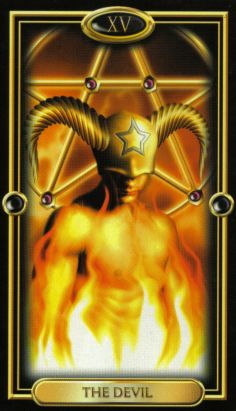 |
| Gilded Tarot by Ciro Marchetti Llewellyn 2004 |
 | |||
|
The thoughtful and wise part of me knows that what Wilde is saying here is absolutely true, but there are many caveats, exceptions and asterisked footnoting going on in my brain. Certainly many could take this as carte blanche and defend rampant selfishness and reckless douchebaggery, weak argument though that may be. If I am tempted towards harming someone, my soul would grow exponentially more ill if I gave into that temptation. So let's just rule out giving into any temptations involving robbing, maiming, abusing, or killing anyone, m'kay? In the original context, Wilde is talking about how society sets up a code of "morality" that forces a great number of people to live deceptive lives in which they pretend to abide by the code but instead are secretly breaking it. Living a lie is very stressful and the ripple effect is detrimental to not only one's own psychological health in terms of unnecessary guilt and self-recrimination, but it also affects the health of society as a whole with far-reaching repercussions of pent-up frustrations spilling over into violence, overindulgence in response to forbidden temptations, lost jobs, broken families, and just a whole lot of hurt all around. Wilde was a successful poet and playwright enjoying high society life in Victorian Britain when he was accused by his male lover's father of "posing as a sodomite." He sued the accuser for slander and lost. A guilty verdict on the charge of sodomy at that time meant life imprisonment and a lesser "gross indecency" conviction garnered a two-year hard labor sentence. He received the latter judgement and his career went down in ruin. Ironically, had he not sued his accuser, probably nothing would have happened. By attempting to deny an accusation Wilde knew to be true, he brought about his own professional demise. Prison humiliated and humbled Wilde and caused him to reflect on his former indulgent lifestyle:The only way to get rid of temptation is to yield to it. Resist it, and your soul grows sick with longing for the things it has forbidden to itself, with desire for what its monstrous laws have made monstrous and unlawful"– Oscar Wilde, The Picture of Dorian Gray 1891
"Desire at the end was a malady, a madness or both. I grew careless of the lives of others. I took pleasure where it pleased me and passed on. I forgot that every little action of the common day makes or unmakes character...I ceased to be Lord over myself. I was no longer captain of my soul."
- Oscar Wilde, De Profundis
The balance is a delicate one, sure. How do we know when we are crossing the line from healthy self-care to selfish harm? Wilde's observation holds a tremendous clue: when you risk losing your freedom, when the thing desired or the desire itself begins to control you instead of the other way around. But sometimes yielding is exactly what we need to do because the temptation itself has become the problem and doing what we want to do, consequences be damned, is the healthiest choice. If one's fight against temptation has resulted in living a lie, that lie itself is the Devil's bondage. Ciro's Devil must remove the helmet to see and so must we when dealing with temptation. If we refuse to examine the ripple effect of our yielding to this tempting thing, we cannot know if it will be harmful or not, nor will we care. When temptation arises, the Devil card gives the best advice because it prompts us to examine our motivations and ultimately urges us to choose wisely for our soul's best interest.
Monday, June 13, 2011
Intuition Needs Your Input

Professor Gerard Hodgkinson of the Centre for Organisational Strategy, Learning and Change at Leeds University Business School led a study team on intuitive research and they concluded:
"Through analysis of a wide range of research papers examining the phenomenon, the researchers conclude that intuition is the brain drawing on past experiences and external cues to make a decision – but one that happens so fast the reaction is at a non-conscious level. All we’re aware of is a general feeling that something is right or wrong." (University of Leeds. "Go With Your Gut -- Intuition Is More Than Just A Hunch, Says New Research." ScienceDaily, 6 Mar. 2008. Web. 13 Jun. 2011.)In the article, Professor Hodgkinson cited the recorded case of a Formula One driver who braked sharply when nearing a hairpin bend without knowing why – and as a result avoided hitting a pile-up of cars on the track ahead, undoubtedly saving his life.
“The driver couldn’t explain why he felt he should stop, but the urge was much stronger than his desire to win the race,” explains Professor Hodgkinson. “The driver underwent forensic analysis by psychologists afterwards, where he was shown a video to mentally relive the event. In hindsight he realised that the crowd, which would have normally been cheering him on, wasn’t looking at him coming up to the bend but was looking the other way in a static, frozen way. That was the cue. He didn’t consciously process this, but he knew something was wrong and stopped in time.”Neuroscientists discovered a few years ago that the human brain has both conscious and unconscious systems for receiving and analyzing sensory impressions. The unconscious takes the sensory impressions and compares them with previous experiential sensory data. Our brains remember much that we don't realize we captured. Along with that data, we also remember if the experience was positive or negative. When presented with a new experience, our brains swiftly and unconsciously assess the situation at hand and predict the outcome. Memories are stored, however, only if they matter to us, if we are somehow committed to the experience in some way. Also, the more variations we have of a similar experience, the more varied the data is stored in the unconscious which is accessed to compare to present situations. Therefore, the longer someone has worked in an area of expertise the more accurate these assessments tend to be.

When my daughter was nine, a routine cold turned into something unknown and quite serious when she complained that her neck hurt. We suspected meningitis, but a long visit to the Emergency Room and a spinal tap ruled that out. Her condition worsened dramatically over the next 48 hours and I took her to her doctor's office very concerned that this wasn't just a "cold in the neck" as the ER docs had said. Her physician shared an office with my boys' pediatrician. Dr. Aaronson was an older doctor and though very respected in the area, some people dismiss the older professionals as outdated or not up on the latest medical techniques. He saw all three of my boys and I grew to trust his instincts as he seemed to make the right decisions for my kids time and time again. My daughter's doctor was not in the office that day so she was seen by a very competent nurse practitioner. A thorough exam showed nothing new, but to be sure she had covered all her bases, the LNP consulted with Dr. Aaronson before sending us home. Without even examining the child himself, Dr. Aaronson directed us to head back to the hospital and insist on an X-Ray of her neck. After much waiting and a minor outburst by me to the negligent ER staff, my daughter's neck X-rays revealed a very swollen and infected lymph node in the back of her neck that was threatening to impede her air passage. Dr. Aaronson's intuition was spot on. The Ear, Nose, and Throat specialist said this sort of thing was very rare and in all his years working at children's hospitals, he had only seen a few cases. How did Dr. Aaronson know? Experience. His unconscious had stored away all the details of all the years of seeing sick children and came up with the right answer for Tori that none of the younger, more sophisticated and newly minted doctors and health professionals could.
Brain research on intuition tends to focus on practical applications of the findings. They are not too concerned with making sure tarot readers give good card readings. They are more focused on finding out how we process information, how we learn best, how we make decisions, etc. However, it stands to reason that the longer we have been doing something the storehouse of images and sensory input grows. There is value in a tarot reader's experience. What also makes sense is how the brain remembers an event, whether it turned out well or not. We remember our good readings and our bad ones, so we tend to unconsciously choose from the outcomes that were good and use that data for the reading at hand. Therefore, we tend to rely more and more on our intuitive judgements because when we used them before, they worked. We didn't know how they worked, we only knew they did. We are left only with a physical sensation or simply a general "knowing" that something is right or wrong.


So if you want to be a better tarot reader, read more tarot. But also, and maybe more importantly, live a life full of experiences and meaning. Feed your unconscious storehouse with sensory rich data. Hone your skills, keep doing what you love to do, gain experience in your endeavors. Lars-Erik Björklund, author of a 2008 dissertation in education research from Linköping University in Sweden explained, "We need to see, feel, smell, hear, taste, and experience with our senses. This collection of data can’t be replaced by studying course literature,” he writes. “Experience is under-evaluated today, and this is perhaps because we haven’t understood this type of tacit knowledge. Now we know, thanks to brain researchers.” ( Linköping University. "Intuition Can Be Explained." ScienceDaily, 2 Jul. 2008. Web. 13 Jun. 2011.)
Also referenced:
Max-Planck-Gesellschaft. "Decision-making May Be Surprisingly Unconscious Activity." ScienceDaily, 15 Apr. 2008. Web. 13 Jun. 2011.
University of New South Wales. "Complex Decision? Don't Sleep On It." ScienceDaily, 11 Aug. 2008. Web. 13 Jun. 2011.
Subscribe to:
Posts
(
Atom
)


