Saturday, January 05, 2013
The Decision Analyzer

Many tarot readings are prompted by being faced with a tough decision, one in which your mind and your heart or gut are conflicted and giving you opposing opinions. Upon seeing those boots on Amazon my desire for them leaped and did cartwheels. My mind, upon seeing the $398 price tag immediately chided, "Are you insane?" So my heart started persuading, "But they're FRYE, which means they are very well made and they will last forEVER and they're a classic equestrian boot that NEVER goes out of style and they're WORTH it!" To which my mind replied, "You're an idiot."

Of course, I don't need to do a tarot reading on whether to buy the boots, but there are many opportunities in life that may require a bit more deliberation. Using tarot intelligently for decision making can be extremely helpful, but I don't suggest using a Yes or No type of spread for that. I mean, you could, but it's not particularly empowering and it would probably be faster to flip a coin. Here's a more insightful spread that will help examine the competing arguments inside you. It's called the Decision Analyzer (click on the image to enlarge):
 |
| DruidCraft Tarot by Stephanie Carr-Gomm & Philip Carr-Gomm & Will Worthington Published by Connections 2005 |
In this example, a career opportunity is in the analyzer. The mind thinks it's a wonderful opportunity as the Sun shows what the person is thinking. Maybe it's something the person has dreamed of doing since they were a child. However, the heart isn't so sure. The 5 of Swords indicates there are some gut reservations. There's something about the offer this person isn't fully on board with. Maybe they don't trust the person offering it or the company seems shady. Or maybe it's just a nagging unease coming from some other emotional source that is causing the "bad feeling." It's important, though, to listen carefully to one's intuitive or gut feelings, so this is vital information. What this person wants, the 10 of Pentacles, shows they want long term financial security and stability. The offer may be lucrative and the potential income may be tempting the mind to ignore what the emotional instincts are warning. What they should do, the 4 of Swords, is not act on this immediately but take some time out to think carefully and consider all aspects of the offer and situation. In this example, the action advice is inaction, don't jump on this opportunity just yet. The correct decision will become clear in a short time.
So have at it and let me know how this spread works out for you.
Thursday, December 13, 2012
Wishlists for the Fiercely Independent

At Christmastime my family, like many families, exchange wish lists. There was a time when my wish list took up several pages, but over the years my wish lists have diminished considerably to just a few items. This has happened due to various internal and external shifts in living and priorities. I am no longer in accumulative mode, collection mode, nor redecorating mode. But the reality is that the things that I really wish for are things no one in my family can give me. They are things like a better paying job, a newer car and a wad of cash to pay off my credit card. So I stand up tall and accept the fact that I am a grown up and proceed to tackle these challenges on my own. Only it seems that every effort made stalls, or the door I thought would open doesn't and is instead slammed in my face. I look frantically around for open windows, another door, anything to get moving again. They say failures are like stepping stones, but I feel like I'm treading water with no stone in sight.
My partner and I had a discussion in which it was observed that I don't ask for help. I am fiercely independent and don't ask unless I am extraordinarily desperate. Even then, it is really hard for me. He asked me if I had fallen and injured myself and could not get up, would I not ask for help then? I recounted the story of the time I was in labor with my daughter. We were rushing to the hospital because she was birthing fast, I could feel her crowning in the car, and I could no longer sit but had to partially stand on the floorboard, bracing myself on the door handle. When we pulled up to the Emergency Room entrance, I opened the car door and stepped out of the car only to find myself crumpled to the curb. My legs would not hold me. Did I call for help? No I did not. I grasped the car door and attempted to pull myself up on to the car seat. Others tried to help, of course, and brought a wheelchair (Hello? I cannot sit! Oh well. I stood on the footrests and braced myself up on the armrests). It seems to be a very primal response in me that does not ask for help but instead relies on every bit of internal strength and resource for my survival, alone. Mike laughed and said I was ridiculous. I know this. I understand this, but I cannot make myself do that which is essentially unnatural for me.
 |
| Not my daughter's cake, but looks very much like it |
I deeply appreciate help when it is given. I have two children with birthdays in December and one falls in January. Between Thanksgiving and the end of January was always a particularly busy time for me, a mother of four with a perfectionist streak a mile wide. I enjoyed creating fabulous home birthday parties for my children with themed decorations that I often made myself, a custom birthday cake also self-created, and themed activities. One particular year, my daughter requested a "Unicorn in Candy Land" theme. WTF? But I actually found party goods that featured a unicorn with a gingerbread house behind it -- SCORE! I made a cake shaped like a horse head, white frosting with purple mane, and a pointed ice cream cone for the horn. I baked huge gingerbread man cookies and the party activity was decorating them. We had already made a gingerbread house for the centerpiece of the table, which I placed on an old Candyland game board. I made pink bubbly jello using club soda and served it in plastic champagne glasses. My daughter was recovering from the flu and could not energetically enjoy this birthday party, but it went as well as it could have.
 |
| Not my son's cake, but you get the idea. |
A week later, we hosted my son's Lego-themed birthday party sleepover, complete with my custom Lego brick cake and Lego-themed games and contests. Meanwhile, my daughter had passed her flu to her other brother, not the birthday boy, and in addition to the two birthday party preparations, I had been sick child caretaking throughout the month, so far. The morning after the sleepover, as I made pancakes for the guests I noticed birthday boy camping out on the living room sofa with sick brother and he looked quite pale. Uh oh. After cleaning up the vomit and saying goodbye to the last of the party guests, thus started yet another week of sick child caretaking. That, and decorating the house for Christmas, going Christmas shopping, and all the usual pre-holiday rush. On Christmas Day, my daughter had a flu relapse and spent the day mostly sleeping, even as we dragged ourselves to Gramma's to visit. We were supposed to drive to New Jersey to visit the in-laws a few days after Christmas, but the night before we were to leave I began to feel a tightness in my chest. By the next morning, I was in such pain that I could not pack my clothes for the trip. I had managed to drag the suitcase out of the closet before I collapsed on the bed. Steve took one look at me and said, "I'm taking you to the ER." I wouldn't have asked to go. After whooshing me through X-ray to make sure I wasn't experiencing a pulmonary embolism, I was diagnosed with pleurisy. Nice.

I urged my family to head up to New Jersey without me. After all, the family was expecting them and I could use the time alone to recover. I didn't realize how much this illness incapacitated me until after they left. I could barely breathe, nor walk, much less make food to eat. I sat on the sofa and cried pitifully. The doorbell rang. I shuffled my way to the door and found a friend standing there. He hugged me and I literally melted into his arms. He said his wife would bring me dinner. Then he prayed for me, out loud. My neighbor brought me yogurt and bananas, to combat the negative effects of the strong antibiotics, and checked in on me every day. Another friend brought dinner and stayed to chat later in the week. My in-laws sent video of the kids enjoying their Christmas visit up north. I was enormously grateful to my friends who helped me through that week, however everything they did was done without my asking, and to me that makes their generosity and kindness all the sweeter.
But how did they know I needed help? Steve told them. He asked on my behalf because he knew I wouldn't. I get that this is probably a life lesson for me, that I must learn to ask for help when it is needed. But part of my problem is not knowing when it is needed. I often overestimate my own ability to handle things by myself and therefore don't even know when to ask. Yet, when I look back on the times when I have very desperately needed help, not just wanted help or thought I needed it but literally needed it, help came. And suddenly I feel like The Grinch Who Stole Christmas when he heard the song arising from Whoville on Christmas morning.

What if wishes come without wish lists or expressions of need? What if they come because you simply need them? But! my rational, contrary mind objects, What about those who are injured and alone and they die because no help comes? Clearly this need wish thing isn't foolproof. Yet having confidence in my own ability to handle adversity and, if I fall short, believing that help will arrive, is not such a bad thing at all. Plus, it doesn't require that I act contrary to my nature or berate myself for not asking for help. It has worked so far and I have no reason to believe otherwise and much evidence to believe it usually will."And the Grinch, with his Grinch-feet ice cold in the snow, stood puzzling and puzzling, how could it be so? It came without ribbons. It came without tags. It came without packages, boxes or bags. And he puzzled and puzzled 'till his puzzler was sore. Then the Grinch thought of something he hadn't before. What if Christmas, he thought, doesn't come from a store. What if Christmas, perhaps, means a little bit more.”
Saturday, November 24, 2012
The Gift of the Three of Swords
We tend to focus more on the darker, scarier cards in tarot. Where are the happy bunny cards? I'll get to them. But just so you know, they have their dark sides, too, just like the darker cards have some light. The dark places in life have their own virtues as described in this poem by Rumi an early 13th century Persian poet:
The Guesthouse
This being human is a Guest House.
Every morning a new arrival
A joy, a depression, a meanness,
some momentary awareness comes
as an unexpected visitor.
Welcome and entertain them all!
Even if they are a crowd of sorrows,
who violently sweep your house
Empty of its furniture,
Still, treat each guest honorably.
He may be clearing you out
for some new delight
The dark thought, the shame, the malice,
meet them at the door laughing,
and invite them in.
Be grateful for whoever comes,
because each has been sent
as a guide from above.
In line with my current obsession with all that is bleak, sad, and upsetting, how about this one? Ooomph! Not one, not two, but three swords piercing a heart. Dreadful card. The stormy sky doesn't help matters either. This image, from the Robin Wood deck doesn't mess around with the symbolism. There's no mistaking or second-guessing this card. This HURTS.
Sigh. Yes. Yes, it does.
This card is about heartache, no kidding. You know when you've just gotten really bad news, painful, heart-piercing news and at first you feel nothing but searing pain? And then your mind begins to engage and you start to process what you just heard. It's what happens when you begin to mentally reconcile the bad news, processing it in one's mind to gain emotional stability. It's the act of trying to make sense of what one knows in one's head to how one's heart feels.
There's no way I can say this card isn't hurtful because it usually is. The intensity of the pain is relative to the situation, but painful it is. However, it's a painful truth you need to know. A good illustration is to first look at the 2 of Swords where the individual is blindfolded and withholding judgement. They're not convinced, they're maintaining the peace, waiting for more information to decide. Then blam! Ace of Swords incoming! That's the big sword in the center. And now it all makes sense. A painful truth truly is better than living a lie.
So that Rumi is on to something. Far be it for me to sugarcoat any of the starker, gut-punching cards in the tarot deck, but there is something valuable to be gained from the darker moments in life. I won't lie and tell you it's going to be easy or that it won't hurt, but I will tell you, in 3 of Swords moments, that the truth that you're hearing is something you need to know. And I'll confess that there are times when I've been in that 2 of Swords place so damn long I plead for that third sword just to break the tension. Just give it to me straight.
I think that's often why we turn to tarot, for those straight answers. We're hoping to cut through the crap of our own wishful thinking, our giving the benefit of the doubt, our denial and illusions to hear the real, unvarnished truth. That's the goal anyway. Whether the reading actually gives it to you depends on whether you're ready to hear it. Sometimes we're not ready, and that's fine. Another time.
I have always loved that poem of Rumi's because it reminds me that everything will be alright. Even if they are a crowd of sorrows, who violently sweep your house empty of its furniture. Even then. Because maybe you needed some new things anyway and you were too busy trying to make your old things work for you when they no longer did. Because you will survive it and you will be OK. Even though you may not be grateful to the messenger, the message is invaluable. And maybe you won't realize this in that moment of heartrending pain, but you will. Then you will know the gift that is the 3 of Swords.
The Guesthouse
This being human is a Guest House.
Every morning a new arrival
A joy, a depression, a meanness,
some momentary awareness comes
as an unexpected visitor.
Welcome and entertain them all!
Even if they are a crowd of sorrows,
who violently sweep your house
Empty of its furniture,
Still, treat each guest honorably.
He may be clearing you out
for some new delight
The dark thought, the shame, the malice,
meet them at the door laughing,
and invite them in.
Be grateful for whoever comes,
because each has been sent
as a guide from above.
In line with my current obsession with all that is bleak, sad, and upsetting, how about this one? Ooomph! Not one, not two, but three swords piercing a heart. Dreadful card. The stormy sky doesn't help matters either. This image, from the Robin Wood deck doesn't mess around with the symbolism. There's no mistaking or second-guessing this card. This HURTS.
 |
| By
Robin Wood
Published by Llewellyn 1991 |
This card is about heartache, no kidding. You know when you've just gotten really bad news, painful, heart-piercing news and at first you feel nothing but searing pain? And then your mind begins to engage and you start to process what you just heard. It's what happens when you begin to mentally reconcile the bad news, processing it in one's mind to gain emotional stability. It's the act of trying to make sense of what one knows in one's head to how one's heart feels.
There's no way I can say this card isn't hurtful because it usually is. The intensity of the pain is relative to the situation, but painful it is. However, it's a painful truth you need to know. A good illustration is to first look at the 2 of Swords where the individual is blindfolded and withholding judgement. They're not convinced, they're maintaining the peace, waiting for more information to decide. Then blam! Ace of Swords incoming! That's the big sword in the center. And now it all makes sense. A painful truth truly is better than living a lie.
So that Rumi is on to something. Far be it for me to sugarcoat any of the starker, gut-punching cards in the tarot deck, but there is something valuable to be gained from the darker moments in life. I won't lie and tell you it's going to be easy or that it won't hurt, but I will tell you, in 3 of Swords moments, that the truth that you're hearing is something you need to know. And I'll confess that there are times when I've been in that 2 of Swords place so damn long I plead for that third sword just to break the tension. Just give it to me straight.
I think that's often why we turn to tarot, for those straight answers. We're hoping to cut through the crap of our own wishful thinking, our giving the benefit of the doubt, our denial and illusions to hear the real, unvarnished truth. That's the goal anyway. Whether the reading actually gives it to you depends on whether you're ready to hear it. Sometimes we're not ready, and that's fine. Another time.
I have always loved that poem of Rumi's because it reminds me that everything will be alright. Even if they are a crowd of sorrows, who violently sweep your house empty of its furniture. Even then. Because maybe you needed some new things anyway and you were too busy trying to make your old things work for you when they no longer did. Because you will survive it and you will be OK. Even though you may not be grateful to the messenger, the message is invaluable. And maybe you won't realize this in that moment of heartrending pain, but you will. Then you will know the gift that is the 3 of Swords.
Thursday, November 08, 2012
An Unexpected Lesson From Margaret

I've worked hard to get this job that I have now. I've endured the unique humiliations reserved for call center employees. If you've ever worked in one, you know. Having to go to the bathroom but holding it until the call ends or until your next scheduled break. Getting screamed and cursed at for doing your job. Doing something, or not doing something that you know was an error and freaking out inside because you think you may have just lost your job. Anything and maybe everything is recorded, monitored, checked, graded. These scores can determine your next raise, if you get one, and how much. Being tethered to your desk by a telephone headset cord. Now I'm untethered. I can go to the bathroom when my body needs to. I don't get yelled at. I'm not monitored. In fact, I am now one of the monitors. And I bring to this job a deep sense of compassion for the call center employees that I now try and coach to better their performance. I am grateful, though, not to be in their position anymore.

Which is why, when my manager announced that for our monthly "Team Building Event" we were going to participate in United Way's Day of Caring I was like, "OK, why not?" My company gives its employees two paid days to volunteer in the community and this was the first time I'd ever used any of those days. I like not being tethered to a desk and I like the Quality Analysts I work with. I was curious and eager to participate. Until I heard what we were assigned to do. Our group had been charged with assisting an older couple who lived out in the country, in a trailer. The woman had fallen a couple years ago and was now disabled and her husband needed help with some yard work. They needed windows washed, the back of the house painted, weeds pulled, some bushes moved. I'm thinking this is going to be hard. Really hard. I was right. The husband wasn't some frail old guy. He was a friendly and robust man in his sixties. He'd been taking care of his wife, the house, his job on the farm, everything. But the landscaping was now overgrown. And yes, they lived in not just one trailer, but two, a sprawling double wide beautiful home. So eighteen of us set to work, but no, not until we met Margaret. Bill insisted we had to meet his wife. So all of us crowded into their living room where Margaret sat in her recliner that lifted her up with her walker beside her. She thanked us before we had done a thing. She choked up as she expressed her appreciation for us being there at all.

As I was washing the window in Bill's office, he came in and showed me the books that he'd written and published on his computer. His latest work in progress is a romance that tells the story of how he and Margaret met. He told his stories. And Margaret told hers. And every person that walked into that house that day was asked to tell theirs. One of us would go in to use the bathroom and Margaret would call from her chair the living room, "Come see me when you're finished!" And so she elicited more stories. Every time I went in to use the bathroom, someone different was seated next to her talking and telling her their stories.

It was brutal work that day. The "weeds" were thick, sticker-bushy brush. The "bushes" were tree-like. There were a lot of windows, double paned storm windows. The gnats were horrendous and got in our mouths, eyes, and noses. We rolled wheelbarrow after wheelbarrow full of brush and vines and limbs to the compost hill. We were exhausted and sore. Margaret thanked us. Bill thanked us. We went home.
Stories. I'm telling this one. It has become one of mine. We all have stories to tell and to write and to share, but we don't often think of them as stories or as something anyone wants to hear. Sometimes we think the story has to be a whopper or about some amazing adventure to be worth telling. But Margaret made me realize that everything that happens to us is a story worth telling.
Tarot illustrates our stories and allows us to see them in a kind of set-apart from ourselves way. It has a way of bringing characters to life, shows us what they feel and think and how they play a part in the plot progression. When we lay out the cards and say, "Show me what I need to know" we are illustrating the situation, illuminating the parts we need a visual to understand. As a tarot reader, I am like Margaret. Tell me your story. Let's read it together.

Saturday, October 06, 2012
Honestly? You're Just Being Rude.

I almost scrolled past this picture on my Facebook newsfeed, but I stopped, scrolled back up and commented: "Can be both. No need to be rude." It's funny how small things will set off a whole train of thinking in my head and this was one such trigger. There does seem to be a fine line between saying something honestly and saying something rudely. My friend commented back and said that he never intends to be rude, but I don't think intention is the key. Although by definition to be rude implies that one meant to be impolite or that one doesn't care that they were, it can also be the result of one's own ignorance. We've all made those gaffs, where we say something offensive, not meaning to cause offense, but did so because we didn't know the other person's soft spots. I'm writing this keeping in mind that etiquette expert Miss Manners, Judith Martin, once said that it is the epitome of rudeness to correct another's manners.

Almost any unsolicited opinion will be considered rude, so if you haven't been invited to comment on something, don't. I think posting something on your blog or on a social network is inviting commentary, so it irks me when opinions are given and the original poster says, "I didn't ask for your opinion." Um. Yes, you did. See that "Comment" link under your post? Still, that shouldn't give folks carte blanche to be rude, it just means we did open the floor for comments. I worked with someone who assumed anything that was said within her earshot was fair game. While her comments weren't necessarily offensive, the way she would interject herself into conversations that weren't directed to her was, in fact, rude.
However, if we are in a position, as tarot readers are, to deliver honest feedback we must be aware of this line between honesty and rudeness and walk it carefully. Relationship readings can be minefields that need both honesty and compassion to navigate. So you're reading for someone who has a thing for a guy who has dissed her repeatedly and who has flat out told her he isn't interested. They had a thing a while back and he hasn't communicated in months. She wants a reading on when they will get back together. Depending on what the cards say, and I've been shocked sometimes so I never assume anymore, but let's say the cards are telling her to let go, move on, it's a done deal, and you've got to tell her this without insulting her. You could say, "You're obsessed. Stop it." Or, "Get a clue!" Or you could say, "I honestly don't see, according to these cards, any movement in your direction from him. Is there anything he has said or done recently to give you the impression he is intending to reconcile with you?" She says, "No, but I just know in my heart that he will." So then I might say, "Sometimes when we want something or someone really bad, we can convince ourselves it is true. And sometimes that works and we get what we want eventually. But meanwhile, until it happens, we need to live our lives in the reality of today and today he isn't contacting you, so do you think you can accept that?" OK, you get the idea. Rudeness shuts down two-way interaction and communication. Honesty without rudeness opens that channel. Certainly we all have our own communication styles and some of us are more direct than others. I envy those who are able to be honest, direct, and kind. Me? I'm wordy.
Some agree with Shakespeare that there are times we need to be "cruel to be kind" and that to help someone we must deliver the harsh truth knowing it will sting. It depends on the relationship. This adage from Shakespeare is from Hamlet and it involves a relationship between a son and his mother. It isn't just a random fly by directed towards a stranger or mere acquaintance. In fact, in its original context, Hamlet is burdened by the reality that he must hurt his mother in order to effect the change that must be. Most rudeness doesn't care that much. Therefore, rudeness is not "tough love." It's not love at all.
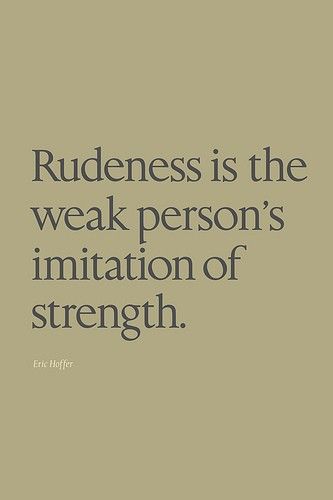
Does honesty without rudeness take more effort? It sure does. Rudeness is lazy. It's also a sign that someone's trying to come off as "tough" or callous. That's fine on occasion, I suppose. I've been known to deliver a rude comeback when the situation or my mood seemed to call for it. Not that rudeness is really ever called for, but yeah, it happens. It means I'm not interested in dialogue, but in slinging verbal shit at that moment. My unintentional rude moments, however, were probably a result of not taking the time to consider how my words will be received or whether they will be productive to discourse. A genuine apology and an explanation which takes the time to empathize with the other person usually closes that gap. Kindness is stronger than rudeness and some of us should exercise our kindness muscles more.
Saturday, September 01, 2012
Regret is Life's Hangover

I don't think other animals experience regret as humans do. I don't imagine my dog is ruefully kicking her own ass over getting into the garbage and strewing it all over the kitchen even though it cost her crate time and a scolding. Though the experience may, we can hope, teach her not to do it again, because animals learn as we do to avoid negative experiences (if the negative outweighs the positive, anyway), I doubt she's feeling that bad that it will cause her not to chase the next squirrel she sees into the neighbor's yard. We humans have this amazing memory that associates itself with strong emotions such that it can impact both our present and future experiences.
One of the motivations for getting a tarot reading is this desire to avoid anticipated regret. We want to make the right choice, i.e., the one that won't bring regret, and analyzing our current mindset and attitudes and peeking at the likely outcomes is all part of a thoughtful deliberative process. But I think life is rigged in such a way that we can't avoid regret if we want to learn anything.
"I see it all perfectly; there are two possible situations - one can either do this or that. My honest opinion and my friendly advice is this: do it or do not do it - you will regret both." --Soren Kierkegaard
 |
| Housewives Tarot |
Since we're stuck with regret, it's probably best to learn to live with it. A tarot reading can certainly help parse out the possibilities and assist with making a decision you feel mostly positive about. This is a good thing because when the inevitable regrets come, you can be assured that you made your decision in the best way you could, given the information you had at the time. Life can be understood backwards, hindsight being 20/20 and all, but it must be lived now and forward. And some things can't be changed, there are no do-overs. While it may never be too late to go back to school and earn that degree, we can't turn back time and erase having married someone, having children, or any of our other choices and experiences. The healthiest adults accept this and accept also that it's really never too late to earn more regrets.
"The man who insists upon seeing with perfect clearness before he decides, never decides. Accept life, and you must accept regret." --Henri Frederic Amiel
The challenge is not to live without regrets, but to accept them, to integrate them into the sum of your lived experiences, and to use the education that comes with them not to avoid regret in the future but as additional information with which to make your decisions now. Becoming wiser doesn't have to mean losing one's capacity for new risks and daring opportunities. Becoming wiser means having the experience to know how to deal with the regrets when they happen. Because happen they will. The strongest regrets those in hospice centers express tend to be not the things they have done, but things they didn't do.
“Of all the words of mice and men, the saddest are, "It might have been.”― Kurt Vonnegut
Sunday, July 22, 2012
Unashamed Intution
The universe is full of magical things, patiently waiting for our wits to grow sharper.
~Eden Phillpotts

One of the appeals of going to a fortune teller, a psychic, or a medium is the magic of being told things a stranger shouldn't know. I think that's a legitimate bit of entertainment. When people talk about their experiences with getting readings, the tone is often so casual and like, "Whatever." Even when recounting accurate, spot on readings where the reader did indeed tell the client private things and predictions that came true, the one telling the story usually ends it with, "Yeah, but who knows?" There are always a good mix of good psychic and bad psychic stories which only partly accounts for the cautionary attitudes. Of course we need to be wary of people who deliver bullshit and take your money for it. But I find it fascinating when people who have experienced a genuine psychic reading still appear to shrug it off. So few are confident enough to say, "I know there are a bunch of sham readers out there, but the one I saw was legit." Why is that?
I think it stems from embarrassment or an unwillingness to be seen as someone who believes in "that stuff." It's like we're so scared to admit there's more to this life, our experience of it, than what we can see. We feel nudges, hunches, and odd feelings all the time. We make synchronistic associations all the time. We see signs and we dream and make connections. But we feel awkward admitting it and accepting this other input as valid. Even as a tarot reader, I still experience the same feelings. There are some days when I am sure I am spewing nonsense, just pulling random things out of my underwear. (Funny how, on those days, my readings are better.)
We are grounded to this earth in these physical bodies, so we like to be able to touch, see, and measure things. We want to know for sure and hold it in our hands before we believe. That is entirely valid and I don't think we should dismiss the need for substantive validation. Science has it's place and yet I don't think science should be the only thing we rely on. Look at how scientific discoveries change our realities, not always for the better. The USDA nutrition guidelines are a good example. For years we've been told our diet should look like this:

And then we got fat. And heart disease. And diabetes.
Now the USDA's latest recommended diet looks like this:

Half our diet should be fruits and veggies, more veggies than fruit. The other half grains (and at least half of those should be whole grains), and protein. A little bit of dairy. We learned certain oils can be good for us, dark chocolate is healthy, and maybe eating all that white flour and rice wasn't working so well.
So why did we believe the USDA back in the pyramid days? Well, when it was created, there is some speculation that it was not scientifically designed but politically designed with certain industries lobbying for a better place on the pyramid. So we can't always depend on "scientific research" so we must conduct our own. Eat like the food pyramid for a while and see what happens. For some people who live very active lives and burn off all those carbs, it's probably fine. Our bodies will respond differently depending on who we are, our genetic predisposition, our current health, our activity level, our income (healthier food choices tend to cost more), etc.
And that is my point: we must validate what we experience in our own lives. If you went to a psychic and you were amazed because the information was deeply personal, exactly what you needed to hear, connected to your life and your immediate concerns, then it is as valid as anything else real in your experience.
As my colleague, James Wells, recently blogged in his post "Tarot and Thinking are Friends" --
Intuition is simply one more sense in the panoply of human perceptions. It is neither less nor more important than sight, smell, taste, touch, hearing, thinking, or proprioception. Too many people mistake impulse for intuition, thereby making less-then-helpful decisions. Impulse carries emotional attachment whereas intuition simply provides information.I also wrote about that in my post Intuition Needs Your Input only James gets right to the point. Intuition, yours or someone else's, should be used in tandem with other discoveries and information. In fact, our balanced life should look a lot like the USDA's "My Plate." Rational logic, Swords could be one section. Emotional experience and feelings, Cups, should be another section. The third section would be Pentacles, our physical experience and knowledge. And another section should be our motivation, energy, and passion, Wands. That circle off to the side? Psychic knowing. It's all part of the information we need to live and make decisions. That rational, logical stuff that our society seems to think is the only information we should need, over and above anything we feel emotionally or experience physically or intuitively, is like the bottom-heavy grains in the old food pyramid. It just doesn't work for most of us.
I'd like us to be less ashamed of speaking about what works for us if it's not of the socially approved norm. I'd like us to go ahead and be awed and amazed when a stranger tells you something they shouldn't know. The more we accept these sources of information for what they are, we will become much better at utilizing them and know their place in our lives.
Saturday, July 07, 2012
Reading Without Spreads: One Card Readings
Thanks to the volunteers for these one-card readings. I'm hoping to demonstrate how to gather information from the cards without a spread. We're starting with one card and then add more. The one card is obviously easiest, and it will show how much information is in one card without any position meaning from a spread.
Jen said she is feeling stuck and wanted some advice.
Jen said she is feeling stuck and wanted some advice.
 |
| By Susan Hudes Published by US Games 2002 |
The 4 of Cups, Hudes deck. The deck is important because different decks present the image in different ways.
This image sure speaks to Jen's situation. This guy looks pretty "stuck." The cups suit is about emotions and the four is a number of stasis and stability. The image shows a man in a thoughtful position with three cups in front of him and one hanging on a branch off to the side. The Hudes deck uses patterns in an interesting way. The artist, Susan Hudes, chose book end paper patterns to represent each of the four suits. In this card, the pattern can be seen on the figure's arms. He is otherwise clothed in black. This may suggest a kind of emotional depression as well. The arms are in a position of relaxation and minimal support. His legs are crossed and his body language conveys a rather closed off, withdrawn demeanor. Traditionally, the card means a weariness of life and not being very interested in much. Disillusionment with one's situation also applies. To me, the guy looks bored. As advice, this card might be suggesting that this is a time to think about something you've left off to the side, something that has the ability to bring joy too your life but which you may not have had time for or set aside with the intention of picking up again at a later time. At the time that you set it aside, you may have lost the joy in it temporarily or you may have simply lost interest. But that cup that's hanging on the branch is key to getting you out of the slump. It tends to be something that's not in your scope of vision just now because those cups in front of you demand your attention. In your current state of malaise, that other cup may not even interest you much, but it is the one that will help you to get "unstuck."
Trisha asked, "What action(s) can I take to bring more money into my life?"
Trisha asked, "What action(s) can I take to bring more money into my life?"
 |
| By Susan Hudes Published by US Games 2002 |
The Ace of Wands, Hudes deck.
The wands in the Hudes deck are staffs and the symbol on the top resembles the symbol of Hathor, the Egyptian goddess of the royal family, the sun, dancing, the arts, music and the sky. Each of the Aces in this deck feature flowers in addition to their suit end paper pattern. The yellow flowers on this Ace symbolize purity, clarity truth and intellect. Mayans viewed the color yellow to be associated with corn, thus it symbolizes provision, sustenance, and all things that are wholesome. The entire background of this card is the end paper pattern associated with Wands in this deck and as such implies the Ace has incredible energy and potential. Traditionally, this card means the creative force, invention, enterprise, and the powers behind them. When I see this card in relation to this question, I see a new project begun with passion or simply a new inspirational idea. While you may have considered taking on a part time job, you probably don't want to do something that you aren't passionate about. The key to bringing more money into your life is to ignite a new sense of passion either about what you are currently doing for income or for a new source of it. Desire is crucial to attracting anything. Pay attention to seemingly random ideas that pop into your head because these seeds of ideas could very well be the avenues that bring you money. Whatever it ends up to be, it can't be a drag for you as that will just drain your resources, your energy, and won't be very productive for you in the end. Also, the image is very "front and center" so it appears that this is a very present concern and one that you want to give immediate attention to and act on your inspirations and impulses, not putting things off for another time.
Nina asked, "How does the future look for this relationship?"
Nina asked, "How does the future look for this relationship?"
 |
| By Susan Hudes Published by US Games 2002 |
The King of Cups, Hudes deck.
The Kings and Queens in the Hudes deck all feature a map behind them which symbolize their domain. Behind this King we see a map with very little land mass, the earth's pole, and lots of water. Kings represent the mastery of the suit, and since this question has to do with an emotional issue, a relationship, then this card bodes well for a mature, emotionally deep relationship. The only issue with this card and relationships is that, while they may be very deeply satisfying, they tend to lack in the practical matters. The day-to-day fleshing out of a life together can be difficult with King of Cups types as they don't tend to pay much attention to the nitty-gritty details or just let someone else figure them out. They're not the best when it comes to finances and planning. They're likely to just do whatever feels best in the moment. Luckily, this King also has a strong element of air, as all Kings do, so at least he's intelligent and self-reflective enough to know his own flaws. All in all, the future of this relationship looks emotionally satisfying as long as you don't expect too much in terms of practical matters or are fine with taking care of them yourself.
Deitre asked, "Should I be working or staying at home? I'm on the fence."
The Ace of Pentacles, Hudes deck. This Ace, like all the Aces in the deck, has the end paper pattern of Pentacles as its background and purple flowers around it. Purple flowers symbolize dignity, pride and success. I had to laugh when I saw this card come up for your "either/or" question. Tarot is so funny to me. Aces often represent to me that answer "Yes." So, should you be working or staying at home? Yes. The Ace of Pentacles would suggest that it doesn't really matter whether you stay at home or not, but that you would probably feel best if you invest yourself into something that will reward you tangibly. It might be work you can do from home, but whatever it is, it's not only about the income. The Ace of Pentacles represents a seed of creation, something you plant, water, nurture and grow to fruition. It is a beginning. Start something that will satisfy you in a real and practical way, and something that will earn an income, yes.
Thanks so much to my volunteers. I also appreciate your patience with the delay in getting these up. As you may know, our area experienced some wicked storms that cut off power to many. I was not one of them, but my kids and their father were. So I brought my kids to my place for the better part of the week and all tarot stuff had to take a back seat. I know you understand. Next, we'll add some more cards and look at how to interpret the interaction of cards with no spread.
Deitre asked, "Should I be working or staying at home? I'm on the fence."
 |
| By Susan Hudes Published by US Games 2002 |
The Ace of Pentacles, Hudes deck. This Ace, like all the Aces in the deck, has the end paper pattern of Pentacles as its background and purple flowers around it. Purple flowers symbolize dignity, pride and success. I had to laugh when I saw this card come up for your "either/or" question. Tarot is so funny to me. Aces often represent to me that answer "Yes." So, should you be working or staying at home? Yes. The Ace of Pentacles would suggest that it doesn't really matter whether you stay at home or not, but that you would probably feel best if you invest yourself into something that will reward you tangibly. It might be work you can do from home, but whatever it is, it's not only about the income. The Ace of Pentacles represents a seed of creation, something you plant, water, nurture and grow to fruition. It is a beginning. Start something that will satisfy you in a real and practical way, and something that will earn an income, yes.
Thanks so much to my volunteers. I also appreciate your patience with the delay in getting these up. As you may know, our area experienced some wicked storms that cut off power to many. I was not one of them, but my kids and their father were. So I brought my kids to my place for the better part of the week and all tarot stuff had to take a back seat. I know you understand. Next, we'll add some more cards and look at how to interpret the interaction of cards with no spread.
Sunday, June 24, 2012
Freestyle Tarot

I learned very quickly how this is done during my time reading for an online reading service. Those services, whether they are online or on the phone, charge clients by the minute and the pressure to be quick and efficient is high. The service I worked with had a free chat at the beginning of each session where the reader and client could talk briefly so the reader could understand what the client was seeking and then shuffle and lay out the cards for the reading. Once the reading began, the meter was running. Often, the client would ask a question that was outside the scope of the neatly arranged spread before me, so I would draw another card. Another question, another card. Soon, my table was crowded with cards and I had to pull them all in and shuffle again and draw some more. It was in this venue that I understood that the spread not only didn't matter, it didn't serve the needs of my clients.
Don't get me wrong, I use some of them. I have some favorites and some that I've tweaked to better suit mine and my clients' needs. I've created some of my own, customized for one reading but then found they were useful for others. I like them when reading for myself because the position meanings limit where my wild thoughts can go. Position meanings are also helpful when trying to figure out what a particular card is getting at. For example, when the position meaning is something like, "A positive thing that I can do to reach my goal" and the card is the 9 of Swords, I wouldn't interpret it to mean they should spend endless nights worrying and obsessing. Gee, that's productive. Instead I might say to break out of that habit or look for ways to sleep better at night or even fully think through a dilemma, but not at the cost of one's sleep or health. With the positional meaning in place, there are still a lot of possible interpretations. Without the positional meaning, that card has a much broader range of possibilities. To some, those positional meanings and their limits are the problem.
One way to expand the practice of reading without using a template is to do one-card readings. Many readers will pull a Card of the Day. Talk about open-ended! That card could be representing literally anything that is to occur on any level that day. This is why I don't draw a Card of the Day. It's way too open and easily interpreted to be whatever. But maybe that is the whole point of it. I've heard very interesting stories of synchronicity and Card of the Day, but I'm far too specific in my desire for outcomes and the ability to see the connections. And I don't want to draw the Tower and sit on pins and needles all day only to find it represented a minor inconvenience. I freak out in advance far too easily for that.
I do one card readings a lot. But what can just one card tell me?
One of the daunting things about learning to read tarot is the vast selection of meanings for each card. Even if one limits oneself to traditional meanings, there are many to choose from. Venture into intuitive interpretations and the universe is the limit. It is a fine day in a new tarot reader's life when the idea that there is no predetermined, correct meaning to each card is viewed not as overwhelming but liberating. It's like someone left the gate open. Run free!
One card, just one card. Ask a question and pull one. The first thing that usually comes to me is the long-held meaning I have associated with that card. It's habit, I can't help it. Sometimes that meaning has very little connection to what I asked. Or at least that's what I think at first. So, then I need to slow down, take a closer look. When we work with a particular deck extensively for years, we can forget to note the details. We already know them, we've seen them before. But wait. Slow down. Look. Notice the colors. What symbolic elements are shown? What direction is the figure facing? What is the expression on their face? What are they wearing? Which deck are you using? Does it have any particular thematic significance? What number is the card? Is it a Major or a Minor?
As an example for you, I asked the question: What is one thing I can do today to deepen my relationship with my significant other. I drew, from the Hudes deck, the 6 of Swords.
 |
| By
Susan Hudes
Published by US Games 2002 |
The first thing that popped into my head was, "Avoid sharp words" or "Work around his emotionally based logic." That's not usually an issue between us, but I will keep it in mind. So I looked deeper. Blue, which symbolizes peace, is the dominant color on this card and the Swords are not being wielded by anyone. They're pretty harmless just floating around in the water like that. Hmmm, the Swords are in the water and water is symbolic for emotions. It looks like a fairly easy pass across the water. Could it mean travel? That we should go somewhere today that will enable us to talk easily, feel peaceful, move our thoughts out of the way and just ride on our emotions? There is effort involved on the man's part. One cool thing about the Hudes deck is how the artist assigned different patterns to each suit. They are actually marbled book end paper patterns and here we see the pattern covering the man's arms. Arms are used for support, strength, to hold, to hug, to row a boat. His torso is clothed in a red tunic. Red is a color of passion and strength. The number is Six, which symbolically means "blessing." In numerology, the energy of number six exudes the qualities of nurturing and caring. It is unselfish, philanthropic, compassionate, and kind. It is intimately associated with the concept of family, and as such values balance and even-handedness. It offers sympathy, advice, understanding, and plays the sounding board for commiseration when needed. So, I think I should be supportive and facilitate peaceful passage today, and maybe even take a short trip with my sweetie that will also support and encourage deep bonding and easy communication of thoughts and emotions.
There is more in this one card that I didn't touch on: the boat, the symbolism of boats, the direction the boat is headed, the vantage point we are seeing the card from, and more. I also didn't go into the random intuitive flashes I had, mainly because they would be completely different from person to person and reading to reading. But if you get one, pay attention to it. With just this one card, I was able to get a pretty full reading and I only touched the surface. It's up to you how deeply you want to delve into any individual card. Given these possibilities in each tarot card, the idea of doing a spread with 10 or 12 cards (or more) now seems daunting!
If you are a spreadaholic, try freestyling. You'll find it challenging at first, but incredibly freeing when you get the hang of it. Once you get one card readings down, you can add a few cards and see how they interact without the framework of a spread. I'll share how I do that in another post. Meanwhile, I'll be happy to post some one card readings. If you would like one, send me an email with the subject "One Card Reading." The first five responses will have their readings posted on the blog.
Monday, May 21, 2012
Free Will or Fate?

Last night I finally watched The Adjustment Bureau, a movie about fate versus free will, and because that's right up tarot's alley and mine, I recommend it even if sci-fi isn't your thing. I'll try not to spoil it for anyone who hasn't seen it, but I won't make any promises.
The story is boy-meets-girl, but the twist is that there are cosmic forces that are trying to keep them apart even though they really, really like each other a lot. A whole lot. So much that even when threatened with losing everything and what amounts to a lobotomy by beings who can easily follow through, the guy doesn't give up on taking the path he feels in his guts is right for him. Here's a trailer:
The basic premise is that we all have a life plan that is charted for us by The Chairman and these members of the Adjustment Bureau are charged with making sure that we follow it. They do this through orchestrating slight mishaps, inconveniences, and other "adjustments" in our lives that manipulate it just enough to keep us on track. If that doesn't work, they will tweak our reasoning process a bit in order to make the decisions we're supposed to. It's all very cloak and dagger and highly coordinated. The idea of free will is just that, an idea. We have it in the little stuff but not in the decisions that impact the course of our lives.
I am a very big fan of free will. While I have known some people who prefer their life plotted out for them and who wouldn't take responsibility for a dang thing, always saying, "It was/is God's will," most of us like to manage our lives ourselves, please and thank you. But something this movie highlighted was that even without The Adjustment Bureau, society does a really good stand in job for them. At the end of the movie these words are spoken:
Most people live life on the path we set for them, too afraid to explore any other. But once in a while people like you come along who knock down all the obstacles we put in your way. People who realize freewill is a gift that you'll never know how to use until you fight for it. I think that's the chairman's real plan. That maybe one day, we won't write the plan, you will.Right? If you think about it, our families, our friends, our social environment all serve as The Adjustment Bureau. When we step off the grid a bit, they are quick to try and rein us back in. What ensues is usually so unpleasant we become afraid of stepping off again. But there are some people who just don't give a crap what others think or feel and grasp their own fate by the throat and just take it. They just take it. And they do so with no other proof, no other evidence than the gnawing in their entrails that tells them there's more for them over there, doing it this other way.
Today I found this quote: “Life is like a game of cards. The hand you are dealt is determinism; the way you play it is free will.” --Jawaharlal Nehru (Indian Prime Minister 1889-1964) Philosophers argue whether there is even such a thing as true free will since we are all subject to causal relationships and random acts are not premeditated and therefore not freely chosen. However, I like this compatibilist (the theory that free will and determinism can co-exist) view of Nehru's even though determinists would dismiss it saying how we play the cards depends on our biology (nature), environment (nurture) and a host of other predetermined factors. Still, whatever we have, predetermined or not, we have the choice to work with it, against it, or with some combination thereof. We love rags-to-riches stories because they highlight how a person's own will can rise and triumph over the weight of negative deterministic conditions.
My own life experience has evidenced that while I do have choices, I am not all-powerful or limitless. I understand there are some things that "just happen," but what Nehru is saying is that how we respond, how we choose our next move, is something we alone ultimately control. While we are not likely to choose contrary to our own brain wiring nor our lived experiences, we sometimes do. And I think those times are when our intuition is so strong we actually feel like it's something we're "destined" to do. Ironic that at the moment we are fighting hardest for our free will that we would attribute it to fate.
"And maybe that's the Chairman's real plan."
Could it be that in those moments of actual or as close as we can get to free will that the reason we feel such commitment and resolve, despite the gut-wrenching fear, is because we are meant to learn how to become more and more free? I like to think so.
Subscribe to:
Posts
(
Atom
)


