Tuesday, June 15, 2010
Just The Facts, Ma'am

I have an affinity for all the aspects of the tarot images and so want to share all the depth and richness therein that I sometimes forget not everyone gets as excited as I do about the position of the Hanged Man's legs or the scroll on the High Priestess' lap. Some readers might even refuse to do a reading for someone who doesn't want to look at the cards. So many use the images as Rorschach cards or Jungian archetypes to help the querant arrive at their own conclusions, their own reading. While that is a legitimate use of tarot and one of its purposes, I can assure you that had someone asked me those types of probing questions of me at my first reading, I would have sensed their pseudo-psychology and handed out a healthy dose of attitude. I might have retorted just as my one client had, "Are you reading the cards or am I?"
Since my reading practice is primarily online, there is a lack of immediacy where I can even point out a feature on a card. I also want my clients to know that I am not just making shit up, at least not where their reading is concerned, and I am basing my interpretations of their cards on legitimate, sound, logical, even traditional meanings of the tarot. Since they are not in the room with me, how do they know I even shuffled a deck or pulled any cards for them? If I don't directly associate what I am saying to a particular card, then I could just be pontificating with my own common sense, which is fine, but not what I'm paid to do. So I really think this kind of descriptive association is more or less essential to a good email reading. But when a reading is live there seems to be less need for many clients to get into the details of each card.
 I'm not knocking anyone's reading style at all. If one's reading style is more cooperative in nature where the client's impressions of the card images play a strong part in the reading, that's wonderful. I've done many readings this way and they work quite well with the right personalities. Others just want to cut to the chase. I find the latter are folks that really aren't that interested in the cards themselves, but rather feel they are paying a professional for a service rendered and thereby are the due recipient of that service. Nothing wrong with that. The reading isn't about me, anyway. It isn't about showcasing my talents or being a teacher or even a guide. The tarot reading is about the cards and the querant. Period.
During a large gathering of tarot aficionados, one reader stated that she felt there was a natural evolution to reading and while one may begin with divination and fortune telling, it grows up into a spiritual practice that pretty much leaves that "immature" stuff behind. The cards are then used solely for delving into one's spiritual state and nothing else. I started to feel my "bad self" get irked, so I left the room for a smoke lest I say something that might offend the woo woo. What I wanted to say was a hearty, "Bullshit!" Tarot cards are non-limiting by the very nature of their archetypal images which embrace the whole of humanity's experiences, emotions, growing pains, and dynamics. Why limit their use to one area of self? The spiritual is important, no doubt, but we still gotta eat, pay the rent, have sex, wash dishes, fix a broken whatchamacallit and deal with noisy neighbors. There's an entire suit in tarot, the suit of Pentacles, that deals with all this mundanity, in fact. Will I get the job? How can I make more money? Which school should I attend? Does so and so like me? Where is my lost watch? All of these are genuine questions we can ask of tarot and expect a valid answer. Doesn't mean you'll get one, but you probably will.
Not every reader is a good tarot reader for every client. There is definitely a personality and style meshing that has to occur. Today, I would want a reader to tell me how she arrived at her conclusions from the cards, not because I want to critique her reading, but because I want to learn and maybe her insight into a particular card or arrangement of cards can bring me some additional insight. If I went to a reader who just told me what she thought the cards meant without explanation, I'd probably raise an eyebrow askance. I'd be thinking, "What do you even need the cards for if you were just going to pull that out of your underwear?" But see, that's me, the tarot card lover, talking. Twenty years ago, the me-querant in my friend's living room, just wanted to be told what I would be doing a couple miles down my future road. So even my own clients have sometimes changed in their own approach to the readings. They sometimes feel the need for more explanation and detail and other times not so much. Within reason, I want to be able to accommodate their needs and adjust my reading style to suit. Of course, if we don't mesh, we don't, and there's no adjusting for that, they just need another reader.
This accommodating way just may be a feature of my Libran personality and may not be as easy for everyone. There are some readers who simply have a "signature style" and that style is the very reason people seek them out for their readings. Much like someone who favors Dior over Lauren, for example. It doesn't make Lauren any less or Dior any more, it just makes them different. It's pretty important, I think, to discuss your expectations for a reading before you pay for it, but so few people realize they can do that. I don't mean the $5 reader at the table in the coffee shop, you can pretty much expect you get what you pay for -- and many times be pleasantly surprised you got a lot more. I mean the reader you sink $100 or more into an hour's tarot time with them. Most of them call themselves "tarot consultants" so that alone should give you a clue they might have something a bit different to offer than the lady with the neon palm reader sign flashing in her living room window. But just because you pay more doesn't mean you get more if what you get isn't what you thought you were paying for. Most reputable readers encourage discussion before hiring so everyone understands, at least generally, what to expect.
So what's tarot for? Is it for delving into spiritual? For fortune telling? Predictions? A guide? A Magic 8-Ball? What do you feel the primary purpose of a tarot reading should be?
Friday, June 04, 2010
The Darker Side of Empathy

 Empathy is the capacity to recognize or understand another's state of mind or emotion. It is often characterized as the ability to "put oneself into another's shoes", or to in some way experience the outlook or emotions of another being within oneself. It may be described metaphorically as an emotional kind of resonance or mirroring. Empathy is distinct from sympathy, pity, emotional contagion, and telepathy, which is what we describe as "empaths." Sympathy is the feeling of compassion for another, the wish to see them better off or happier, often described as "feeling sorry" for someone. Pity is feeling that another is in trouble and in need of help as they cannot fix their problems themselves. Emotional contagion is when a person imitatively 'catches' the emotions that others are showing without necessarily recognizing this is happening. Telepathy is not a psychological phenomenon, but a paranormal phenomenon, whereby emotions or other mental states can be read directly, without needing to infer, or perceive expressive clues about the other person. Pity is, "Things are bad for you, you seem as though you need help." Sympathy is, "I'm sorry for your sadness, I wish to help." Emotional Contagion is, "You feel sad and now I feel sad." Empathy is, "I recognize how you feel." Apathy is, "I don't care how you feel. " Telepathy is, "I read your sadness without you expressing it to me in any normal way."
In this excellent article by by Kelly A. Edwards, Critiquing Empathy the author describes what I believe to be the very rabbit hole one must be vividly aware of when wading into empathy's pools. While the essay focuses on doctor-patient relationships, the concepts presented are applicable to any relationship:
Entering any relationship with the aim of identifying with another's experience provides a replicative, not a productive, focus. By engaging in this way, we are trying to know the other in order to develop further insight into the patient's illness. This approach conceives of the other (the patient) as a knowable source that can be mined for information and the self (the physician) as a clean, reflective slate. It takes attention off the self (the physician)—where awareness and responsibility must reside—and fixes it on the other, who can be known only partially. This approach also effectively turns a dialogue into a monologue by focusing on only one of the selves engaged in the relation....
To approach another as knowable, or to act as if one has entered another's experience, can be a very dominating stance.[emphasis mine] This pitfall stems from the problematic ownership of another's experience that is implied in most conceptions of empathy. If the aim of engaging empathically is to know the other, what are the costs of getting it wrong? It is unlikely that a physician, a relative stranger and one with limited knowledge of this patient's life, will get it right much of the time. The dangers here follow from holding a person to too tight a script. Identifying with another effectively limits them to our (limited) understanding.
Rather than remaining open to the "real of the other," the clinician with empathy co-opts the patient's experience by saying blithely, "Oh, I know just how you feel." And again, to what effect? Patients, perhaps feeling misunderstood and alienated, build walls between themselves and their well-meaning physicians. Physicians, encountering a difficult patient, become frustrated.
Bravo! Exactly! How many times have we encountered others who, with genuinely benevolent intent, have devalued our experiences by saying just that? Doesn't it just get on your last nerve to hear someone who couldn't possibly know how you feel say, "I know just how you feel?" Do you? Do you, really? No, of course you don't because you are filtering my experience through your own perceptions, your own personality, your own ideas of morality. You can't help it. I can't help it. It's how we navigate through life. When we presume to "know" another, we are presuming much. That's not to say we can't relate, understand, or seek to help, but when we cross that line into identifying with another's experiences and feelings we are treading on very holy ground and I feel a huge measure of humility and respect are in order.
As a tarot reader, I can so easily fall into the trap of empathy when I'm presented with a query on a subject or situation that I am intimately familiar with in my own life. Sometimes a client has come to me with a situation that so eerily mirrors an experience I've had that I almost want to put the cards aside and just share what I did, just cut to the chase, right? Wrong! No matter how closely one's circumstances and experiences externally match another's it is not the same situation precisely because it is not happening only to you, but also to another person. Two people can experience precisely the same event and come away with very different stories. Which is not to say one cannot offer helpful advice or suggestions to someone in a situation or experience very much like one you have come through. I've been assisted many times by people sharing their wealth of experiential wisdom. However, the ones that have helped the most haven't been the ones that claim to know how I feel, but have simply acknowledge my feelings in such a way that I know they empathize, but who also recognize that how I choose to navigate this experience may be very different, and not wrong, from how they muddled through theirs. They found treasure and so would like to share it with me and that's great, but you know what they say about one man's trash being another one's treasure works in reverse as well.
Sunday, May 16, 2010
Going From Flat to 3-D

The Sun. Good card, right? Great card, in fact. Happy, happy, joy, joy! Happy nekkid dancing and carefree innocence. But I can't seem to get any farther than the "book meaning" with this card. Oh sure, if it comes up as an outcome, I'm pleased to report all things will be fine. If it comes up as advice, I might say one should spend some time relishing in the simple joys of life, remembering what it was like when you were a child and had fewer worries and concerns. Approach the issue without judgment and cynicism. But then it stops. Is that enough? Well, it can be, but I feel like I always give the same report with this card, whereas with other cards the meanings are more fluid and change with the reading, with the query, with the position. This one seems more static to me and that feels off to me. If there's one thing I have learned about tarot is that the cards do "speak" individually to each question and situation. Sure, each one has a basic meaning, but then it can flow and branch out from there. Not so with this card for me and maybe a couple others, too.
What can we do to enlarge our perspectives on these flat interpretations? It's harder when one is doing a live reading and feels the pressure to say something, anything, right away. Much better to work on this when one is not rushed. Better still not to do it when reading for oneself on a particularly sensitive issue. I rarely "meditate" on a card, but in this case it might do some good. It also may help to do some background research and look into the history of the images, digging into what the various items pictured on the cards mean symbolically. I do that regularly here at 78 Notes To Self because it has been a great help to me in digging deeper into a card's meaning. For example, in my post on the 3 of Wands, I looked into the ancient cross-cultural symbolism of boats, even though the boats are not front and center in the card image. For a long while, all I could focus on with that card was the feeling of waiting in positive expectation for something or someone. The boat symbolism added a lot more to the range of meanings for this card and allows a reader a much wider berth to work with.
Another action to take is to post one's dilemma on a forum of tarot readers, such as Aeclectic Tarot Forum, to receive varied perspectives from different readers. Since others don't always struggle with the same card, you're bound to get insight from others' views. Interacting with other tarot readers has always been beneficial to me. Besides, not all readers use the same deck, and since decks vary widely in their depictions of each card, you're liable to get varied interpretations based on which deck the reader uses. Thoth-based decks, for example, have different associations for the card, as do Marseilles-based, and, of course Rider-Waite-Smith. Historical decks, modern decks, themed decks, art decks, all have various takes on the images and each artist often chooses which aspect of the card to draw to the eye. By examining various decks, either your own or at a site like Trionfi, helps to break one out of the frame of the card you have always known.
Doug Gibb, author of the blog Tarot Eon, explored this question in this post from last year. He suggests that one reason we might have consistent trouble interpreting a card or card combination is because the issues represented in those cards are ones we ourselves need to work on. We haven't yet faced nor dealt with those particular "karmic challenges" to the degree that we need to in order for that card to flow easily from us.
I remember speaking to Paul Hughes-Barlow a couple of years ago about how some combination of cards were easy to understand while others weren’t.
Paul suggested something that was truly inspirational. He had observed, through his own experience, that even doing a Tarot reading for other people can teach us about ourselves. One of the most interesting things Paul said was, “you spend months trying to understand a combination of cards, and when you finally understand them, you’ll never see that combination again”.
It’s almost as if, in understanding a difficult combination, in the very act of doing a Tarot reading for someone else, we ourselves begin to heal.
For instance, he would spend months “seeing” the same combinations of cards appear before he finally understood their significance. Almost as if, in understanding that combination, in being able to accurately interpret them for a client, he had healed an area of his own Karma.
So, the very act of delving deeper into that card will, in turn, provide us opportunities to grow, not only as a tarot reader, but as a person.
In many ways, the Tarot is our best teacher. It teaches us, not only through personal study, but also in the very act of reading for other people.
I'll give my perspective on the cards you all mentioned in your responses in a following post, and I'd like to hear what others think about my nemesis The Sun as well.
Wednesday, April 21, 2010
REVIEW: Affirmations For The Everyday Goddess
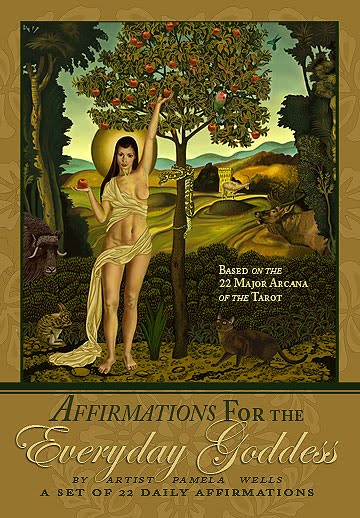
Opening the deck upon arrival proved to be a genuine treat. It is enclosed in its own well constructed, sturdy, lined box (yes, it is lined!) The cover art is exquisite and reminiscent of ancient religious art. The figure on the front is clearly Eve standing beside the Tree of Knowledge of Good and Evil. She holds one fruit in her hand and is almost greedily reaching up to pluck another from the tree. The implication here is she is hungry for knowledge and despite any warnings to the contrary, she wants all the wisdom she can hold. Interestingly, the snake, which Christian tradition holds as the vile tempter, is echoed in the gown that drapes her body, enveloping her body. Its position reminds me of the cadeceus and the Rod of Asclepius, both symbols that represent healing and medicine. The implication is that while there are responsibilities and consequences to acquiring wisdom and knowledge, the effect of it is healing and growth. The end papers that line the box are richly patterned as are the gold borders of the cards. The bottom section of the box is lined in paper that is decorated with stylized, calligraphed names of God from various spiritual traditions and practices. Opening the box feels a bit like stepping into sacred space.
The 22 cards themselves are the size of regular (large) tarot cards, and they are gloss coated, so at first use they are stuck together, but once separated they shuffle smoothly and don't stick together. The shiny surface is a bit much and detract, I think, from the richness of the art as the light reflects and glares impede the ability to view the art the way, I believe, it was intended. I think the coating is unnecessary since this is not intended as a "reading" deck and isn't likely to suffer the abuse of constant use. The art is detailed and exquisite, the colors rich and vibrant. Some of the goddesses appear to be of ancient origin while others seem more modern which gives the deck a timeless quality, allowing one to envision the goddesses as timeless themselves. The women featured on the cards, we are assured, are real women. They are all very beautiful but I don't have a problem with that because they're goddesses, after all. Personally, if I was a goddess and able to choose my material form, I'm pretty sure I would choose an aesthetically pleasing one. I do appreciate the diversity of skin tones and hair colors and textures represented in this deck.
Only two cards do not feature a goddess image, although the Sun is anthropomorphized with a feminine face. After all these years of associating the Sun with a masculine energy, it is refreshing to see it personified as feminine. The nurturing gaze on the face of the Sun suddenly brings to mind the Empress and her creative, prolific energy. Of course! They are obviously connected! The other goddess-less card is The Tower. The tower itself does not appear to be in the process of being destroyed as much as it is being revealed by the "all-seeing eye" above it. The absence of the physical presence of a goddess is poignant because in times of extreme personal loss and devastation it can seem as if the Divine has in fact abandoned us or, worse, is the malevolent force behind the destruction. Therefore, the absence of a physical representation of the goddess on this card is particularly significant.

Each card includes an affirmation printed unobtrusively on the bottom border. I am not personally a fan of "extra stuff" printed on cards, like keywords, affirmations, etc., so I like that one can use these cards without being forced to use the affirmation if one does not desire. So even though this deck is clearly intended as an Affirmation Deck, it does not overly impose that practice on the user. The affirmations themselves are intelligent and based solidly on a clear understanding of the accepted Major Arcana card meanings. They are positive, yet realistic, and don't feel "forced" when spoken aloud.
The affirmations would be enough in themselves but the artist has also authored a companion book that guides one through an intelligent practice of using affirmations in one's spiritual life. The book -- I refuse to call it a "booklet" despite its diminutive size -- is a worthy introduction to archetypes, the use of affirmations, and non-dual awareness. Dual awareness is what keeps us entrenched in dichotomies, such as masculine/feminine and other either/or ways of categorizing people and things. It is an effort I can deeply appreciate given my strong feminist beliefs. At first it may seem hypocritical to promote non-dual awareness with a deck that is clearly all feminine all the time. Yet this deck is clearly promoting non-dual awareness by imaging women in roles that are traditionally male dominated. One of the most striking cards in the entire deck is the Emperor. A beautiful ebony-skinned goddess with natural hair stands squarely facing the viewer. She holds a scepter, a symbol of power and authority, in one hand and in the crook of her other arm rests an eagle, an ancient symbol representing a noble nature, strength and aristocracy. A lion stands by her, also representing power, courage, authority and royalty. She stares forthrightly out of the card and one would be hard-pressed to deny her inner strength and determination. There is no doubt she IS the Emperor. No question. Imaging the persona of the Emperor as a woman assists in creating that non-dual awareness that allows us to see both men and women as equally suited for roles.
The book is a very helpful guide through each card as well, including as it does quotations appropriate for the meanings of each card and self-exploratory exercises one can do, or not, with each card. I love the flexibility of this deck which allows Major Arcana tarot readings, meditative exercises, and affirmation practice. One can use it as one chooses. And the art is gorgeous. You won't get tired of looking at these images. They're rife with hidden details and symbolism. This is most definitely a deck that would take a long time to uncover all the mysteries both in a tarot sense and in a spiritual sense.
Very well done, Pamela. Well done.
Sunday, March 21, 2010
Tool of the Devil or the Divine
 A "Chick Tract" was shoved into my door yesterday. I rolled my eyes and showed it to Mike. "What is that?" he asked.
 "A Chick Tract, " I said. He looked at me quizzically.
"What is that?" he asked again.
"It's a Christian proselytizing cartoon that usually attempts to scare one into church. I hate them because they're really dumb and if one thinks fear is the basis for anything resembling faith, they are sorely mistaken. Plus, they're insulting. I dunno, these things have always bothered me, even when I was a fundamentalist Christian. I've always thought they were wrong." Mike took a look at the cartoon. It featured a guy in a car talking to a preacher saying, "Listen Preacher! I've got lots of time before accepting Christ as my Saviour, I'm gonna have good time first!" The second frame shows the car wrecked on the side of the highway with the warning: "Death Strikes Without Warning." Whatever. It irked me. I know I should just let little irritations like this go, and I do eventually, but I feel a need to spout a bit about it first.
Lately, several of my friends have felt the need to chide me in some way for my current faith status or what they perceive as my lack thereof. I've had people ask me what has happened to me, don't I love God anymore? I've had others tell me to contact them when I want back in the light. Still another said she felt "so sorry" for me because my children self-identify as "agnostic." Most of the comments are related in some way to my tarot practice. I am told the cards have power but not the right kind of power. It's clear these folks believe I'm dabbling in the dangerous and need to change my ways. What is also clear to me is that they attribute a whole lot more influence and power to these cardboard images than I do. I don't think they are the only ones to do that. Not only fundamentalist Christians think these cards are more powerful than they really are. Some tarot practitioners do, too.
While my friends comments may be well intentioned, they are in fact, ignorant on many levels. For one, they are not privy to my spiritual beliefs, my ongoing relationship with the Divine, nor my thoughts on the subject. They make assumptions based on very superficial observations. They also display ignorance about tarot. Though they disappoint me on the first, I don't blame them for the latter. There is a lot of myth and mystery surrounding tarot both in the religious and secular realms. A lot of authority is granted these cards than is truly warranted. They are but a tool and their use depends on the one in whose hands they lie.
For me, they are a tool first and foremost of strengthening my intuition. Secondly, they are a divination tool. My reading style does not invoke deity but relies instead on tapping into a shared consciousness of all human beings. I'm not even sure I believe in a universal unconscious, but I don't really know what else to call it. I do believe in energy and connectivity of such, so I know that we are all connected to one another and to the planet and even into the universe. I don't think we know what to do with all of that energy but I know it exists. So when I divine with the cards, I believe I am connecting subconsciously into that network via my intuitive process. But sometimes, particularly when I am reading for myself, I am simply connecting to my own subconscious and dredging up useful information there. Hence the title of my blog: 78 Notes To Self. These cards help my self exploration and also remind me of things I already know but have forgotten.
 The way I use the cards is in no way the only way or the proper way or the recommended way. Others incorporate the cards in their religious faith, in spell work, in ritual, in communing with deity they worship or work with. Candles, too, are used in many religions. Lighting a candle while saying a prayer or casting a spell is common. They are but a tool, an expression of one's faith. Candles, likewise, can be used in completely non-religious ways to light a room, scent a room, warm a dinner table. Tarot cards can be used in such ways as well. They can be used in religious and non-religious ways, it depends on who is using them.
Perhaps the cards make my friends nervous because they've been told they are tools of the devil or some variation of that. They seem to believe that some kind of power is naturally inherent in the cards themselves or that because they have been used for religious purposes that don't align with their own, they are natural "gateways" or "stepping stones" toward demonic or other dealings with entities not sanctioned by their God. To me, that belief seems immature and foolish. It would be like saying candles, too, because of their use in non-Christian ritual, are inherently evil, or because Wiccans use athames, all knives are tainted. It's as if they think the cards are inhabited by spiritual beings just waiting for some hapless dummy like myself to open the gates to hell.
Christians will often point to the story of Saul who consulted a medium and was corrected by God for doing so as reason enough to condemn divination. And yet, in order to decide who would serve tables, Jesus' apostles drew straws to see who got the short end of the stick, believing that it was God who controlled the choice. Besides, Christians like to intuit all the time only they call it relying on the Holy Spirit. Honestly, I have no quarrel with those who have concluded for themselves that tarot cards represent too much of a temptation and would personally steer clear of them, but their own dear Apostle Paul made it clear that no item in and of itself is clean or unclean and one should have no fear of spiritual contamination by their use. He only cautioned that we should bear with the weaknesses of others who aren't as confident in their faith and feel they must abstain. So I'm finding it difficult not to roll my eyes, but it is I that needs to chill. I wouldn't expect my Christian friends to participate in a tarot reading but it still irks me when they express that I'm dabbling in darkness because of it.

Tarot cards are a tool. How you use them depends entirely on how you use them, to what purpose, to what end. I wouldn't recommend ascribing any more authority to them than to any other useful item. It would be like saying my pen has a mind of its own and what I write is not sourced from my own mind but from some other divine source. My writing may be inspired by the divine or it may not, but it certainly comes from me. The same is true for tarot reading. The cards are the tool through which a reader can express intuition and wisdom, divinely inspired or not.
Thursday, March 18, 2010
Intuition and Making Shit Up

I don't do as well with pictures as I do with words. I graduated early from picture books to novels because words always told a better tale for me. Picture books frustrated me for their lack of detail and dialogue. While I love fine art for the beauty and capturing a moment, they are for me like snapshots, frozen timeframe. A still picture doesn't provoke much in me but questions. Little did I know then that those questions were precisely the place to start listening.
 Take, for example, the 5 of Cups. The image is sad, no doubt. The shrouded figure, the sloped shoulders and bowed head all denote palpable regret and grief. Even the Thoth shows five empty cups labeled "Disappointment." While I understood the card's meaning -- loss but with something remaining, inheritance but not as one had expected -- and the image makes that obvious, I wanted to know more. What happened that made the cups spill? Did the figure knock them over himself, or did someone else do it? What was in the cups that would provoke such intense sadness? Were the contents of the three downed cups more important than the upright two? Why? And why is everyone so quick to point out those standing cups and not incline themselves to empathize with the grieving? Does the card make us that uncomfortable? Is the grief so tangible that we want to so quickly move towards looking on the bright side? As I began reading for others, these questions became crucial in my understanding the unattributed meanings of each card. By "unattributed" I am speaking of the meanings that are gleaned in each individual reading that is specific to that reading and not the general meaning that is always (or most of the time) true of the card itself.
So I would look at the card and these questions would arise. I sit for a moment with the questions and if nothing comes to my mind in answer, I might ask the querant these same questions. What happened to cause the sadness you now feel? Why was this loss so significant to you? You're having a hard time looking past it, right? You try to let go and move on, but it's just so difficult. Having a hard time finding your way "home" are you? These wonderful cards provoke questions more than give answers and these questions are key to finding our own answers within ourselves. Use these unbidden, curious questions to tap into the answers your intuition can relay. Don't be hesitant to ask your querant, also, because interaction makes for a much better reading experience. I have learned so much and been so enriched by the stories my clients tell of their experiences and struggles. They have answered questions I didn't know I had until I read for them. I learn a little more about these tarot cards each time I read for someone because the questions the cards provoke in me are specific to their situation and so are a bit different each time.
One tarot exercise I found early on has you lay out three cards and tell a story with the cards, beginning, middle, and end. I couldn't do it. Like picture books lacked a certain flow for me, so did the cards. It's a good exercise, and I can do it better today than I could then -- my imaginative and intuitive muscles are stronger now -- it just didn't do much then but frustrate me. It frustrated me in part because I was trying to fit the ascribed meaning to the cards in a flow of a story instead of just looking at the images and imagining the connections between them. But the other part was just that I wasn't very good at telling a story beyond the very simple and I wasn't satisfied with that. I wanted more, much more, as I had seen and heard other tarotists read the cards, and my simplistic tales lacked so much that I just said fuggetaboutit and moved on.

If, like me, you find yourself in a similar block, move to the questions. Look at the images and ask yourself about them. Find out what happened to create this snapshot. Make up shit. That's good reading right there! Pull it right out of your hind parts! Seriously! Don't be afraid to play, to make shit up, to fantasize and wonder, to spin yarns and knot them, unravel them again and find out through it all what this card is telling you. It's great practice and they don't call them exercises for nothing. This sort of thing strengthens your intuitive abilities and allows them to roam around unchecked, like children playing in an open field. It's good for children and it's good for your intuition.
Another reason this type of exercise is great is because there is no "right" or "wrong" interpretation. There's no second guessing yourself to check if you got it right or if you're accurate or not. It's just a story. That's all. And when you realize that all our lives are just a story, that each situation a querant comes to you with is just a story, then you become a better storyteller even if you never could tell one before.
I now recognize when my intuition is kicking in. It's when my rational mind in my left brain chides the fanciful right side of my brain, "Now you're just making shit up." Whenever I hear that I know I've hit on something. That party pooper, my left brain, was the bane of my readings for a while. I would listen to it and not to the other side that apparently knew what it was talking about. Enough feedback from clients told me to freaking LISTEN to that storyteller part of me, particularly when the rational side of me protested, because that rational side is a bit of a control freak and doesn't like uppity right brain interference even when correct. Other tarot friends encouraged me, "Stop second guessing! What's your immediate interpretation? NOW! What do you see?" Don't give yourself time to "interpret," go with that first impression. The more time you give your left brain, the more control it will take and the less intuitive your reading will be. I'll never understand readers who say they stew over a reading for days. WTF? I can't give my logical left brain that much time or it will totally fuck things up. So make shit up, I say! You'll be astounded at how very right that shit is.
Tuesday, December 29, 2009
I Hereby Resolve....


I've had that perpetual grocery list for many years. I remember when my oldest was in high school and his girlfriend Jessica once surprised me by writing her desired item on the list. She wasn't even at the house when I saw it and it made me laugh out loud. There, nestled between bread, milk, cheese, and laundry detergent was her request for a pony. Since then, my kids have randomly written their wishes on my grocery list and it's still amusing to see the unlikely items they'd like me to pick up at the grocery store. There's a second clue about making viable New Year Resolutions: make them realistic. While there may come a day when Super Walmart carries ponies, that day is not today, at least not in my town, so I would have to limit my list to that which I can reasonably assume would be sold there. So I need to make my intentions realistic and achievable.

Beyond the shopping list approach, I don't usually have to concern myself too much with the "how's" of grocery shopping. Not so with my other goals in life. If I want to lose weight, for example, I need to break that goal down into smaller achievable goals that I can reach on a daily basis. Drink more water. How much more? Write it down. Eat fewer meals out. How few? One night a week? A month? Exercise more. How much more? Walk daily. When? How far? Write it all down.
If you're having trouble sorting out in your mind exactly what goal you want to make your priority, tarot can lend a hand. Ask the deck to choose a goal for you and then draw a card. Once you interpret the goal, draw more cards to show three things you can do to reach that goal. Draw cards again to show the pros and cons of each path to the goal. Tarot is a fantastic tool for brainstorming and for getting to the unsurfaced subconscious desires. The thing with manifesting anything in your life is that you have to really want it. I mean really, really want it. Because if you really don't give a crap then it's not going to happen because you just won't find the motivation to move it along. For example, I've been saying I want a new car, but I'm nowhere near that goal. I realized today that what I really want is a new laptop to replace the one with the motherboard that fritzed out after 18 months or a way to get that one fixed. Now THAT I want. Because sharing one computer between me and my boyfriend is, well, inconvenient. And we can't play World of Warcraft together and that just sucks. I've researched prices and specs on new laptops and have even decided on one I'd like to buy when I can. I've researched and priced replacement motherboards for the old one and found them to be about 1/3 the cost of a new computer, but with labor will likely make repair the old one unreasonable. I've looked into selling my old laptop for spare parts. I have put time and energy into the new laptop desire but virtually nada into the new car desire. So pay attention to what you focus on and where you spend your energy and you may realize that what you think you want isn't what you truly want after all. Get behind what you really want not what you think you want.

Let's make 2010 a year in which we indeed follow our bliss, but better yet...find the way there.
Thursday, December 10, 2009
Are You Psychic?

I've been asked to perform some pretty amazing feats with these tarot cards. I've been asked if I can feel someone's energy through the cards, if someone will meet their soulmate, if someone will win the lottery, and if the cards can diagnose a medical problem. These are valid questions but they are more appropriate for a psychic reader, a doctor, or another professional than a tarot reader. Then again, I've heard of and have done some pretty amazing psychic readings with these 78 pictures. Basically, it comes down to what process is in operation in the reader. Is the reader using a psychic ability or intuition or a combination of the two?
I stand by what I said here in that I believe that a Tarot Reading involves applying basic historical meaning of the cards with intuition. It does not have to involve any psychic abilities whatsoever. Tarot reading is a skill that anyone can learn and while it can be used with psychic abilities, it does not have to be. Amazingly, the combination of archetypal images thrown in a random spread and interpreted via knowledge, understanding, and intuition can yield a most amazing, chilling, and goosebump-raising reading. Here you'll hear me mutter something about a "universal consciousness" and "the common human experience" and "somehow we're all connected" amid coughs and generous shrugs of the shoulders indicating I really don't know how it works so precisely, but it does. And it does so without a iota of psychic woo-woo attached.
I'm all for woo-woo. I love it, in fact. When I have experienced it either in myself or in another person it's crazy and spooky and makes me smile really big. I love it when things are said that could not have been said except that the person received that bit of info extra-sensorially. I feel just like those guys on Ghosthunters when the lights on the meter go off and they have no explanation for it. Willies galore! But psychic abilities vary widely from person to person, just as any other talent or gift. While I believe everyone has psychic abilities, not everyone is psychic. I can sing just like anyone can, but I can't sing well and even with training I won't be able to sing professionally. I think that's how psychic abilities work, too.
Basically, there are three major types of psychic abilities: clairvoyance, clairaudience, and clairsentience. Clairvoyance is the ability to see images, scenes, visual impressions in one's mind's eye that are extrasensory messages about another person. Clairaudience is hearing things spoken, listening to guides, spirits, or departed ones. Clairsentience is feeling, smelling, tasting or otherwise physical sensations that communicate extrasensory messages. One or any combination of these abilities can be exercised in any psychic reading, depending on, of course, the particular bent of the reader. However, none of these abilities are of much use without intuition that filters the messages and allows the reader to make sense of them, to interpret them, and deliver them in a relevant manner. While a tarot reader may possess and use any of these abilities, she relies heavily upon intuition to guide her through the reading, to discern between meanings, images, messages and in choosing which of the sensory and extrasensory input to apply to this reading for this person right now.
I have experienced some of all three types of psychic input but none of them to any great strength, usually. During any given reading I will often hear words or phrases that will explain the specific meaning of a card for someone and my intuition must apply that to the reading/situation in question. That makes me somewhat clairaudient, but I am not a medium or channel. I sometimes see pictures, with or without accompanying words, and I can just sense what they mean, but I think that's my intuition kicking in. Rarely have I smelled or tasted or had a physical sensation apart from empathic feelings. The hardest part of it all for me has been to trust that this input is not my own imagination. Working with tarot has certainly helped me in developing these abilities but I do not claim to be psychic. I am simply using these abilities as I can to enhance readings that I do. I have done many readings without the use of these abilities, relying purely on intellect, knowledge, and intuition and the readings are no less accurate or insightful.
A psychic may use tarot cards, or not, but relies primarily on extrasensory input combined with intuition. A tarot reader relies primarily on knowledge of the cards and intellect combined with intuition and possibly, though not necessarily, some extrasensory input, depending on the person. So, are tarot readers psychic? It depends on the reader. He may have well developed psychic abilities or he may not, it's highly individual, but psychic abilities do not determine the skill of a tarot reader.
As a client, how can one know whether one's tarot reader is psychic? Certainly you can't really know anything about a reader's abilities unless you've splurged for a reading. Even then, you really don't know how the reader obtained the information she relays to you. Intuition is eerily accurate and doesn't require messages from "spirit" to access. To be very honest, I don't know how it works. Maybe it's all "messages from spirit" and we think it comes from our own heads or gut feelings. I don't know. I do know that I have delivered readings that contained information there is no way my conscious or subconscious mind could have known. At other times, the cards just read like a story and it only takes figuring out the conjunctions between the cards that allow the story to be told. Maybe there's something to Jung's theory of a collective unconscious that we all share and are able to tap into, the connective threads between us accessed by those of us willing to trust and listen. Jung described the collective unconscious as the 'inherited potentialities of human imagination. It is the all controlling deposit of ancestral experiences from untold millions of years, the echo of prehistoric world events to which each century adds an infinitesimal small amount of variation and differentiation. These primordial images are the most ancient, universal, and deep thoughts of mankind.'
Our minds are amazing computers. Nothing is ever lost, it is stored and categorized and accessible at any time. It cross references all words, images and experiences we have experienced in our lifetime. Most of this activity is done below our conscious surface. This lends credence to the experienced reader, someone who has a number of years and readings beneath their belt. Her mind will naturally compare and reference the various combinations and placements of cards and with analytical reasoning she herself may not even be aware of, come forth with some amazing understanding. I lean towards a combination of theories. While the idea of a collective unconscious intrigues me, and I think it is valid given what we know about how all energy and matter is interconnected, I also give credit to the human brain to sort and sift and analyze the data presented. Together, the end result may be what we call "intuition" or even "psychic" phenomena.
But wait -- that all makes sense when you're talking about past or even present events, but how are tarot readers, psychics and intuitives able to predict the future? It hasn't happened yet, so it can't be stored in the collective unconscious, it's not able to be retrieved from the mind's database, so how in the heck do some of these people tell us precisely how something will play out? Once again, I think its a matter of both tapping into the collective and the individual consciousness. Human beings have not changed significantly in thousands of years. We really do respond and react in pretty predictable patterns. Oh sure, there's always a time we get caught off guard and surprised with some uncharacteristic move on someone's part, but if one were to place all of human interaction and history into a huge computer, I bet that machine could predict the next thousand years of our actions. Ok, that's only part of it. How did that psychic know about the washer breaking down or the windfall of money that was to come your way? Honestly? I don't know. Therein lies the mystery and the fascination with getting a reading. We stop thinking, "How do they do that?" and start thinking, "When will this happen?" Now you are a co-conspirator.
I truly do believe in the ability we have to draw unto ourselves the things and experiences we focus on. Some call this the Law of Attraction. I don't know if it's a law as such but it sure seems to happen. So when one receives a reading and is given a prediction, even if it isn't something grand, it plants a seed in your mind and even if you consciously forget about it, your steel trap of a brain hasn't. Am I suggesting the Power of Suggestion? Maybe a little. But it's not that simple. I see things all working together and one's own power of attracting to oneself that which one expects to happen is quite a powerful force, especially when combined with other energies in play.
So, am I psychic? Yes...and no. It depends how you think of psychic and it depends what you demand from someone who promotes their psychic abilities. Personally, I don't think we can demand any predetermined product from psychic or tarot people. They provide a service, but the results aren't dependent upon them alone. They are but an element in the grand scheme of things. As the motto I've claimed as my own says, "The cards may be in my hands, but your destiny is in yours."
“We are a psychic process which we do not control, or only partly direct. Consequently, we cannot have any final judgment about ourselves or our lives.”
--Carl Gustav Jung
Wednesday, November 11, 2009
I'm On A Boat!
“A ship is safe in harbor, but that's not what ships are for.” ~William Shedd
Sometimes when I'm listening to my iPod I can't help but hear a tarot card shout out through a song. The other morning this song came on my random shuffle and all I could think about was the Three of Wands.
WARNING: Probably NSFW, liberal use of the f-bomb will ensue if you choose to view this video
Are you laughing? I hope so. I was. Hard. That song is from The Lonely Island's debut comedy album "INCREDIBAD"(C) Universal Republic. The Lonely Island is Andy Samberg, Akiva Schaffer & Jorma Taccone. I love it because it's contagious and perfectly captures the excitement of something simple. To me, the 3 of Wands means a lot of things, but one of its meanings is having one's ship come in. The most basic meaning of the idiom is that something very good has happened to you. Most often it is used in terms of financial wealth, but in tarot the suit for this ship's homecoming is not pentacles but fiery, passionate wands. It's that playful, passionate energy that I see in that video.

Other similarities to the card have to do with the number. In the beginning of the video, the prize is a boat ride for three. Three is a pretty low number, but it's a first completion or achievement. How exciting to get to the point in one's endeavor when you can sit for a moment and just enjoy what life has brought to you. Make you want to jump up and down and shout, "I'm on a BOAT! Look at me! I'm on a BOAT!" It's a card of adventure, strength, commerce, and of approaching life with a "Let's Go!" attitude. The ship symbol is commonly seen in rock carvings as far back as 5000 BCE. It can be found on funeral stones, in graves, and was believed to be one of the vehicles to reach the afterlife. You've probably heard of the mythological Charon who ferries dead folks over the River Styx on what? A boat. Boats have long been the most prolific symbol of good luck next to the dragon in China. Boats take you places, bring things to us, allow us to cross an otherwise unnavigable ocean in order to expand our horizons.
The image of the ship or boat is featured in other RWS tarot cards as well. The 2 of Pentacles shows ships on rough waters behind the dancing figure. The 6 of Swords is all about a boat crossing water. There is a ship in the distance behind Death. The King of Cups shows a ship in the water beyond him as well. Don't "miss the boat" in the cards because if you do, you miss out on some key symbolism in the reading. Boats offer safe passage over water -- the element in tarot that represents emotions and the deep psyche. They allow us to be in the water without being overwhelmed by it. From a safe distance we can plumb the depths of our own emotions and the emotions of others and the situation, allowing objectivity while still being involved.
In dream interpretation boats are usually indicative of something going on emotionally, depending on the condition of the water beneath the boat. Various words and phrases seem to come up time and time again when discussing boats or travel by boat. Words such as "involved", "carried along", "emotionally excited", "having a good time"," current" and "waves". Boat dreams are often linked to emotional excitement. When we become excited by a project, a book, or something currently happening in our lives, boats may feature prominently in our dreams. It makes sense. Boats carry us, push us farther, propel us, inspire our imagination. Wands do the same thing. They inspire, propel, activate and recharge us. Sometimes getting carried away is the only way to get there.
I guess that's what I really like about that video. Silliness aside, it provokes a sense of wide-eyed excitement over something relatively commonplace. Being on a boat is something not everyone in the world experiences and yet this is about more than just the boat ride itself, but about finally achieving something, reaching a small but significant pinnacle in one's life, seeing one's reward and reveling in it.
Sometimes when I'm listening to my iPod I can't help but hear a tarot card shout out through a song. The other morning this song came on my random shuffle and all I could think about was the Three of Wands.
WARNING: Probably NSFW, liberal use of the f-bomb will ensue if you choose to view this video
Are you laughing? I hope so. I was. Hard. That song is from The Lonely Island's debut comedy album "INCREDIBAD"(C) Universal Republic. The Lonely Island is Andy Samberg, Akiva Schaffer & Jorma Taccone. I love it because it's contagious and perfectly captures the excitement of something simple. To me, the 3 of Wands means a lot of things, but one of its meanings is having one's ship come in. The most basic meaning of the idiom is that something very good has happened to you. Most often it is used in terms of financial wealth, but in tarot the suit for this ship's homecoming is not pentacles but fiery, passionate wands. It's that playful, passionate energy that I see in that video.

The image of the ship or boat is featured in other RWS tarot cards as well. The 2 of Pentacles shows ships on rough waters behind the dancing figure. The 6 of Swords is all about a boat crossing water. There is a ship in the distance behind Death. The King of Cups shows a ship in the water beyond him as well. Don't "miss the boat" in the cards because if you do, you miss out on some key symbolism in the reading. Boats offer safe passage over water -- the element in tarot that represents emotions and the deep psyche. They allow us to be in the water without being overwhelmed by it. From a safe distance we can plumb the depths of our own emotions and the emotions of others and the situation, allowing objectivity while still being involved.
In dream interpretation boats are usually indicative of something going on emotionally, depending on the condition of the water beneath the boat. Various words and phrases seem to come up time and time again when discussing boats or travel by boat. Words such as "involved", "carried along", "emotionally excited", "having a good time"," current" and "waves". Boat dreams are often linked to emotional excitement. When we become excited by a project, a book, or something currently happening in our lives, boats may feature prominently in our dreams. It makes sense. Boats carry us, push us farther, propel us, inspire our imagination. Wands do the same thing. They inspire, propel, activate and recharge us. Sometimes getting carried away is the only way to get there.
I guess that's what I really like about that video. Silliness aside, it provokes a sense of wide-eyed excitement over something relatively commonplace. Being on a boat is something not everyone in the world experiences and yet this is about more than just the boat ride itself, but about finally achieving something, reaching a small but significant pinnacle in one's life, seeing one's reward and reveling in it.
Saturday, September 26, 2009
The Advice Position
 Reading tarot professionally, advice becomes a commodity that is sought after while utilizing the tarot cards as a tool. In fact, many tarot spreads have at least one position that is specifically designated for "Advice." Tarot cards are, after all, used primarily as an advisory tool. Even when one is seeking "insight" from the cards it is usually so that insight can be used in the course of making choices and decisions in our lives. Of course, the reader can't help but throw his or her two cents in, too. Even if we don't mean to, we really cannot separate our own life experiences and accumulated wisdom from how we interpret the cards. Although a good reader will consciously be aware of this and try to draw that fine line between her own advice and what the cards are saying, we can too easily fall into the place where we are drawing primarily from our own advice storehouse and lapse into personal opining rather than tarot reading.
This isn't necessarily a bad thing and I certainly wouldn't say we should try to dissociate ourselves from our left-brain functioning when we read. It's that side of our brains that can find the links and patterns between what happened in the past and connect them to the present and the future possibilities. This is essential for communicating what the cards are projecting. We also need some tangible frame of reference for that communication and if we don't have our own experiences, knowledge and wisdom to pull from, we wouldn't be able to empathize or effectively share what we are seeing. So while I think it's perfectly okay to bring one's own personal advice into a reading, be careful. I've done many readings where I've seen the cards recommend exactly the opposite to what I would have advised. I might entirely disagree with the cards and yet it is my responsibility as a tarot reader neither to twist the meaning of the card to better align with my own advice nor to replace the reading with my own recommendations. I've sometimes felt the need to disclaim at these times that while I wouldn't personally recommend this course of action, the cards clearly seem to be pointing in that direction.
My clients understand they take the advice of the tarot reading at their own risk. We are each responsible for the choices and decisions we make in our own lives. We can't convincingly point a finger of blame at anyone or anything that "forced" us to choose one way over another when it was we ourselves who acted in accordance to what we believed, at the time, to be the best choice. Certainly we are influenced in our decisions, but honestly, most people will, in the end, follow their own inklings, urgings, passions, and way of thinking. We are most likely to go in the direction our emotions lead, even if our minds are telling us something different. Persuasive speakers, salespeople, and motivational coaches know this and if you look back on the major decisions you've made in your life, you will likely find a strong emotional component to the choice made. This is why unsolicited advice is so rarely received well. The recipient is not emotionally open or prepared to accept the advice given, even if it's good or well-intentioned. Unsolicited advice is most often perceived as criticism which is a really good reason not to give it. You're wasting your breath and time and you risk alienating the person you are trying to help.
Of course, tarot readings are a form of solicited advice, but that comes with a different set of responsibilities. When someone asks for advice, one needs to be respectful of the other's willingness to be vulnerable. When asking for advice, people open themselves up a bit and I consider that, in itself, a gift. It's not carte blanche for your ego to take over and climb the podium and pontificate endlessly on and on about what you know and have experienced. They have not suddenly elevated you to Master Guru of their life or even of the situation at hand. Offering honor and respect for the seeker is essential to giving any advice, and in the case of the tarot reader, that respect is extended to the cards and the art of tarot reading as well.
While empathy is crucial to giving meaningful advice, it can also be a motivation for giving unsolicited advice and should be kept in check. By all means empathize with others, but if that empathy is so strongly felt that you can't help but instruct them on their situation, realize that your empathy just trumped your respect for them and that's bad because your empathy just crossed the line from being other-centered into being self-centered. When that happens it's because you need relief from the anxiety of feeling their emotions. That anxiety can cause you to stop empathizing entirely and once that happens, you're no longer thinking or feeling for them but for yourself. Notice when that anxiety starts and you'll be able to pull back and gain perspective more and more frequently.

I had an unpleasant experience last week in which a family member decided she needed to voice her unsolicited opinion regarding my parenting. In the process I was called everything from selfish and irresponsible to manipulative and a drama queen. This person's motivation, she said, was coming from a strong desire to see my children cared for properly. She's worked with children in various ways all her adult life and I understand she has a passion for seeing to the welfare of kids. Her advice, though well intentioned, was entirely inappropriate given that it was not sought. Not only that, but she neglected to ask the simplest of questions that would have given her much more context in which to give the advice, since she clearly felt the need to express her opinion on the matter. She made the common mistake of assuming her secondhand information was correct simply because it came from other trusted family members and she also presumed upon her relationship with me believing it gave her an undisputed platform from which to speak into my life. As a result, much of her advice was irrelevant because she had not "done her homework" by asking questions and thus she was not informed about the history of the situation, so her advice was redundant and useless. What she intended as helpful was instead insulting and invasive.
Unsolicited advice is always risky, but if it's going to be given, at least please frame your advice in question form. Instead of saying, "You need to do this" say, "Have you tried this?" That way, you're not assuming the person hasn't given consideration to the options you are suggesting. Had this person simply asked me and my children's father what we had already tried, what we were already doing concerning a certain situation with our kids, she would not have come across so unbearably arrogant. When receiving unsolicited advice, our knee-jerk reaction is defensive because it feels like criticism. However, if we try and view the person giving it as, at best, concerned and well-intentioned, we can diffuse the defensiveness. In this case, even my understanding that her intent was good, her lack of communication skills and attitude of superiority created a wall of animosity rather than understanding and acceptance. Instead of building bridges, her "advice" attacked and, as a result, erected walls between us. Now, unless she can approach this issue differently in the future, she has lost any opportunity she may have had to influence. Her potentially valuable expertise and advice is no longer welcome on this subject because she was so disrespectful. In short she pissed me the hell off and it's going to be a cold day in hell before I discuss anything remotely personal with her.
Communication skills are something one can learn and hone. Some of us are naturals and others have to work on it, but it's not something you can't improve. Having poor communication skills is not an excuse when one routinely unintentionally offends others. You don't need a broad vocabulary and you don't need perfect grammar. You need only to show respect for the person to whom you are speaking and things should go relatively well. Put your ego in its place and seat the other person in a place of honor for the moment. Ask questions, and not condescendingly either, as if you already know the answers. Even when you've been asked for advice, tread lightly with humility and give only enough to satisfy the seeker. If they want more, they'll ask.
While I could take on full responsibility for the conflict and berate myself for not being more understanding, I don't think that's right, either. I don't make a very good martyr, it makes me grumpy. When unsolicited advice feels like a sledgehammer, it's perfectly fine to tell that person to stop. If they don't stop, that reveals they probably aren't looking to help you but instead, their need to "advise" is coming from some other motivation, probably ego-driven. That's their problem, not yours. As a tarot reader, check yourself when you discuss your readings with your querants so that you're not investing your own ego into the reading. Allow them to take it or leave it, think what they will about it. It's not about you, it's not about your finely-honed intuitive skills, it's not even about what the cards mean and say. It's always, always about the one seeking the answers.
Subscribe to:
Posts
(
Atom
)


