Saturday, November 03, 2018
Home Sweet Home

The ache for home lives in all of us, the safe place where we can go as we are and not be questioned.”— Maya Angelou
I did it! I found a home! It's beautiful and cozy and sweet and happy and it's just the sort of house I imagined for myself. It was built by the seller's grandfather in the 40's. He owned a sawmill that made doors. So he used his "extras" from unclaimed door orders in his own house. No two doors/door-frames are the same size. He used red oak for the floor throughout the house, even in the kitchen. The baseboards and moldings are generous with deep windowsills, stained to match the floors. I have a vestibule (!) with windowed doors. The house has a rather unremarkable exterior, but inside it's an adorable cottage with bright yellow kitchen cabinets that line the length of the large kitchen. We moved in June and couldn't be happier with our new home. At last, I am home.
 | |
| 1JJ Swiss Tarot Created by
Stuart Kaplan Tarot Deck - 78 Cards - AGM-Urania 1970 |
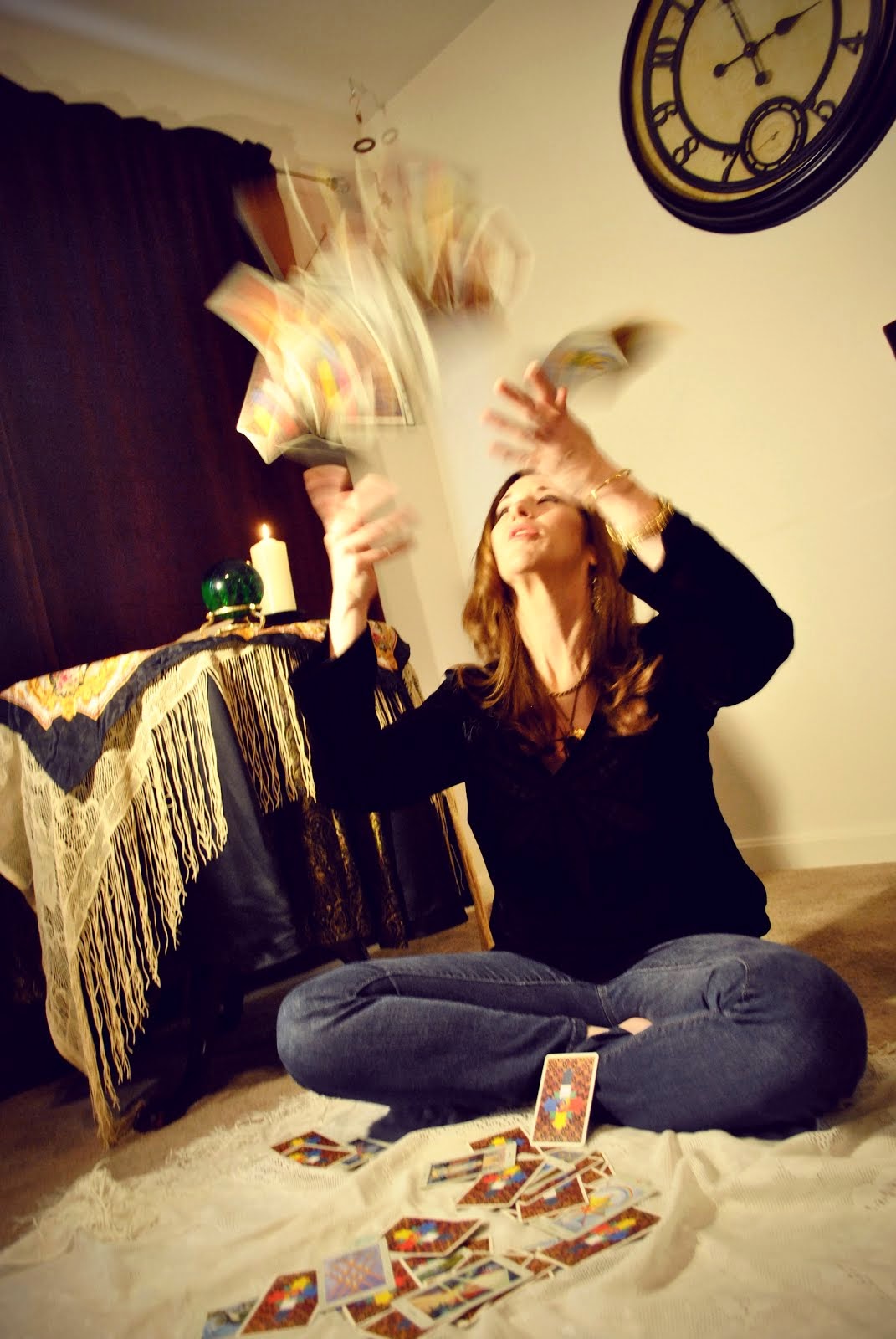
The "Congrats! You did it" card in tarot is The World. As I wrote in "The Spiral World" the World card is about those times on our journey when we overcome obstacles, complete an objective successfully and feel joy, freedom and a sense of accomplishment. But with every accomplishment is a new beginning, a new level, a new set of challenges to face. As a homeowner, I am responsible for repairs, improvements, maintenance, insurance, trash pickup, and all that comes with having a home of one's own. There's a learning experience almost weekly here but I'm welcoming even the hard stuff.
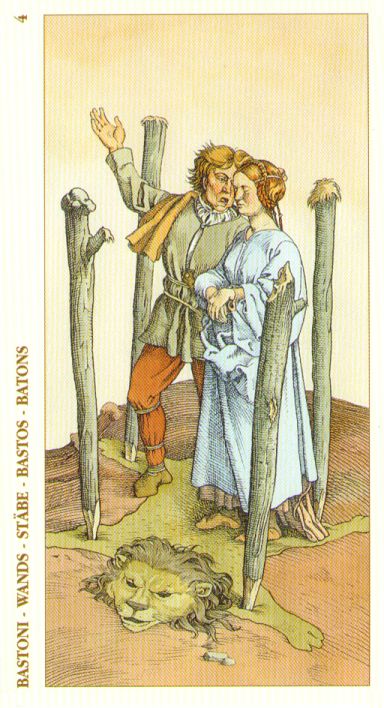 |
| Tarot of Dürer Created by Giacinto Gaudenzi Published by Lo Scarabeo |
It begins as this 4 of Wands from the Tarot of Durer, a dream on a foundation. The woman's expression in this card is hilarious. She's all "Yeah, yeah, whatever. We've got four poles and a lion skin rug. This is not a house. Let me close my eyes to try and imagine because this ain't it." It reminds me of the many houses we toured and tried to envision as our own but which were inadequate and in need of work beyond our means.
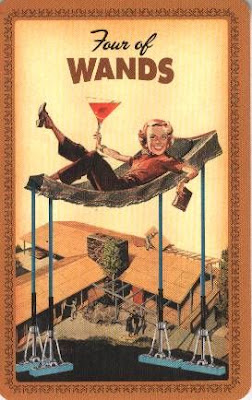 |
| Housewives Tarot Created by Paul Kepple Tarot Deck - 78 Cards - Quirk Books |
It ends in 4 of Wands moments like this one from The Housewives Tarot. Moments of bliss like the housewarming party when my family brought laughter and love and blessed my home with appreciation and most of all, their presence. Friends hanging out on the back porch into the night, lit only by a garden torch and the glow of cigarettes. Crockpot buffets, friends sitting at the kitchen table creating their own culinary delights to share, all of us smooshed together on the living room sofa and loveseat. Hauling the extra chairs in from the kitchen so we can all be together in one room. Scooting past laughing people in my kitchen to reach the refrigerator to get someone a beer. It is nothing short of delightful.

Also delightful are the quiet starry skies I find myself drinking in while sitting on my back porch by myself. How starved I had been for outside space while living our apartment life! We didn't have even a balcony there. I'm dotted with mosquito bites but I am undeterred from watching the fireflies dance and rise from the grass in my back yard. As the evenings chill I am to be found wrapped in a quilt on the porch enjoying the outside until inevitably the cold forces me back inside.

When Habitat for Humanity -- a non-profit that builds homes for people and families in need of a decent and affordable home -- asked Habitat homeowners "What does home mean to you?" the most often repeated word I noticed among the answers was "stability." Fours in tarot mean exactly that. The 4 of Wands stability is unique because of the fire element in the Wands suit. Fire, by nature, must be continuously fed to produce heat, light, energy. Likewise, the stability of a home must be continuously nourished with the ongoing process of homekeeping -- everything from maintenance and repairs, decorating and landscaping to entertaining and making memories with friends and family.
Wands symbolize the energetic force behind creativity and bringing things dreamed into being. Our homes are rich with personal investment and expression. One might think a house should be represented by the suit of Pentacles, made of earthly substance such as wood and stone. But houses are more than that. They shelter us and speak of our identity. They offer warmth and safety, but also frustration and grief. They serve as a place where we are safe to pursue and express our creativity, devote our energies, and nurture the soul as well as the body. How very Wands-like.
I'll close this with a song that kept me going through the long and arduous search. Enjoy.
Home
Machine Gun Kelly, X Ambassadors, Bebe Rexha
Atlantic Records
from Bright the Album
Friday, March 30, 2018
A Necessary Revival
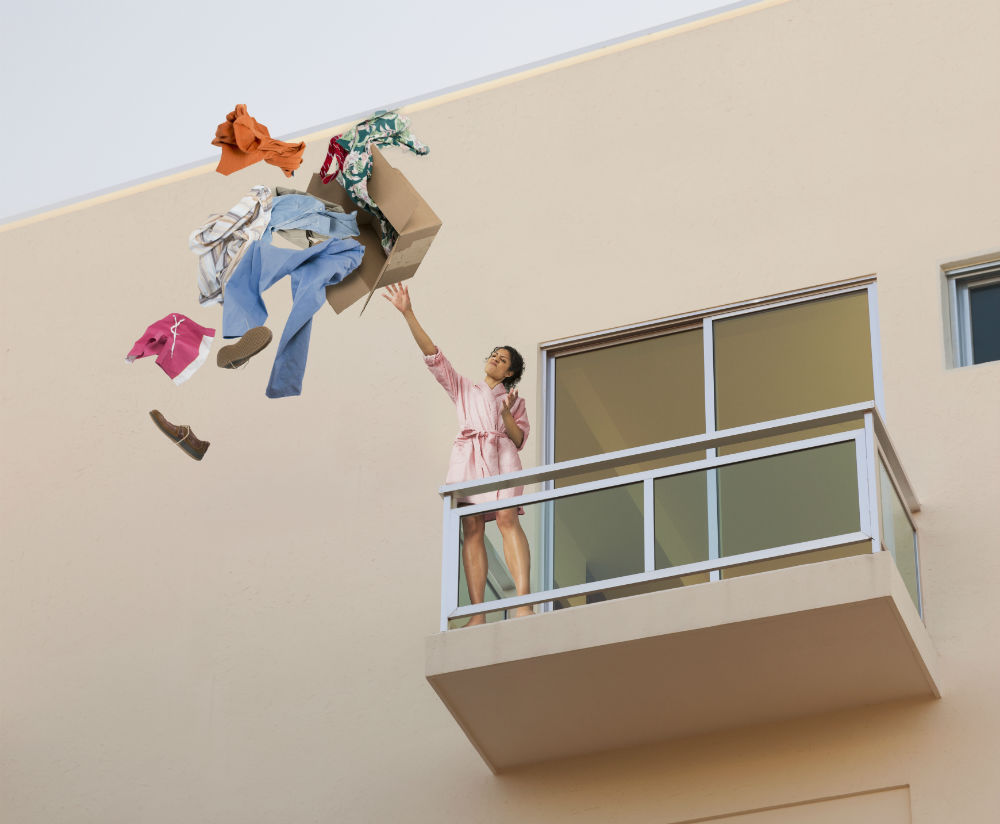
I've been tossing stuff in the apartment complex dumpster more than usual lately. See, I'm in the process of house hunting and I'd rather not take anything with us to the new house that we don't need or want anymore. While the search for a proper and affordable home is taking much longer than I anticipated, it has granted me enough time to de-clutter and reorganize the pantry, the bathroom cabinets, the walk-in closet, my dresser drawers, and the laundry closet. So far. There's always more. The process has been at times difficult, not because I cling to my stuff but because I realized in mid-purge that I haven't truly claimed this space in which I have been living for the last ten years.
Subconsciously, I viewed this apartment as temporary and didn't invest myself or care as much for it as I had when I lived in my own home. Not that anyone else could tell. No one who has visited me here would think that the place wasn't "mine." It, like every other space I've ever lived in, reflects my personality and very much looks like home. When I left my old life to make a new one, I naturally brought my stuff with me -- my furniture, my art, my books. I realize now that many of those things symbolically tied me to my old life and to the old me. Some items never quite fit right in this new space and always reminded me where they used to be, the spaces they were meant to fill, spaces that were no longer mine.
I have a nagging sense that one of the reasons it has taken so long to find a new home is that I had yet to completely let go of my old one. I haven't lived there in ten years, but I've missed it so much. My ex-husband Steve and I had the good fortune to customize the home as it was built, and I was able to choose so much about the space in which we lived and raised our children. Our children are grown now. Only one still lives at home, but he is in college and is looking toward a near future independence. Steve remarried last year. That's probably significant, but not as significant as the fact that because he did I am no longer welcome in the home I built. His new wife is "uncomfortable" with me visiting. Despite ten years of a close, co-parenting friendship shared with my ex-husband, and despite that I am happily ensconced in a solid and committed relationship with Mike, despite that I still have belongings stored in that home, I am persona non grata in his new life. For that, I am hurt. I have a very compelling and irrational desire to scoop up all of my stuff out of that house, including the wallpaper, the floors, the jacuzzi tub, the stained glass window at the stair landing, and my son -- who would not be scooped -- and close the door to that house forever. I want to raze it to the ground. I don't want any pieces of me left there, but there is no helping that. I played a huge part in creating and maintaining that house, that home. I blessed it with my self and now I must truly let it go. It's time. And it's hard.
It's rather like shedding a skin, a kind of arduous renewal. Like the Judgement card in tarot. There's nothing left in the past but ghosts, fond memories, and regret. Now, I am replacing the art on my walls with new perspective. I've tossed books in the dumpster, yes I did. (Don't judge me! I needed to do it.) I'm heeding the internal call to rise up and leave my old self in the grave. Meanwhile, I bought new pillows for the sofa and a new quilt for the bed. The outer is giving voice to the inner, one that speaks of fresh starts even as I stay, for now, in the same space. Feeling accomplished as I admire the organized pantry, the clean (empty!) spaces in my closets, and feeling lighter each time I toss another bag or box into the dumpster, I am moving ever so steadily out of the past me and into the future me.
This is precisely the sort of experience the Judgement card is referencing. In the Druid Craft tarot the artists renamed it "Rebirth" which places the focus more on the result of the process whereas "Judgement" places the focus on the process itself.
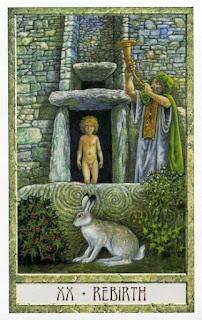 |
| Druid Craft Tarot |
judg·ment
ˈjəjmənt
noun
noun: judgement
1.
the ability to make considered decisions or come to sensible conclusions.
Judgement is discernment and choosing. As I sift through my home spaces, I must discern the current value of the thing in my hand. Things that once held value but are no longer useful to me are removed, tossed, or donated to others who may find value in them. It requires objectivity and wisdom. The Judgement card is also about completing a major life cycle and is a time when one frees oneself from the past and its longstanding thought-patterns and behaviors that are no longer serving you and are, in fact, dragging you down, robbing you of energy and preventing progress, just like those clothes that don't fit are silently judging you and hogging up space in the closet. Ultimately, you are your own judge and jury and your own higher calling, so there really is no outside source judging you. It's all you, baby. You're in control of the process and the pace. Unlike Death, which is also a kind of metamorphosis, Judgement isn't thrust upon you by chance. Judgement is a choice made consciously and with intent. I have taken it slowly, one small space at a time, and I have broken up the process with choosing art and other decorative things that bring me pleasure. It's hard work digging out of a grave, so the breaks are necessary and restorative.
 |
| The Illuminated Tarot |
Friday, November 10, 2017
Sex, Lies and the Three of Swords
Look, I'm not a generally hopeful person. I am a realist, practical and grounded, most of the time. It's not hard for me to lose hope, I do it all the time. I am rarely disappointed because my expectations are low. I take life at face value and see things and people for what they are, not what I hoped they would be. This time, though, I've reached a level of hopelessness that I haven't felt in a very long time. I have spent many months in a state of "What is the point?"
I don't have an existential answer to that.
But what is happening now, across the country, in full view of everyone, is tempting me to hope. It is at least a Three of Swords if not a Tower. I don't feel it's a Tower, really, but a Three of Swords, definitely. Harsh truth, blindfolds removed, facing what is true and real. Men and women are publicly speaking out against those who have sexually harassed, assaulted, and harmed them and --here's the best part-- we are LISTENING. Well, many of us are.
 |
| Robin Wood Tarot |
So many women, especially, are feeling triggered. #MeToo. Who knew so many of us have various shades of PTSD just from living our lives in this very bent society that treats us like morsels for male entertainment. Personally, I'm freaking out internally on a daily basis hearing about men creeping on underage girls. My first marriage was to a man who, among other abusive crimes, persistently preyed on adolescent girls, including me at 17 when he was 32. He was arrested on sexual assault of teenage girls several times during our brief marriage and I don't know how many times since. My second husband, a man in his fifties, just married a young Russian woman he groomed at 18 on the internet and then persuaded to come to the US to visit him when she was 19. She's now 23, only 2 years older than our youngest child -- who, by the way, is a young woman herself and has been struggling with the creepy implications of her father in a romantic relationship with someone she considers her peer. A lifelong friend of Mike's has recently been charged with possession of child pornography. He had spent five years in jail for "messing around," he said, with a "seventeen year-old," he said, when he was twenty. He spent ten years in therapy following his release. Although he had to register as a sex offender, he swore he never had The Problem for what he was convicted but said he used the therapy to help himself become a better person. It was all bullshit. We subsequently learned he had actually been convicted for having sex with a girl "13 or younger." The cache of child pornography was discovered by another good friend, his roommate, who went to the police because it was that bad. And of course there is Donald Trump, Harvey Weinstein, Kevin Spacey, Louis CK, and Roy Moore, and...all of the men on this list. I expect the list to continue to grow.
Truth revealed. Three of Swords. Old wounds and betrayals resurface. Three of Swords.
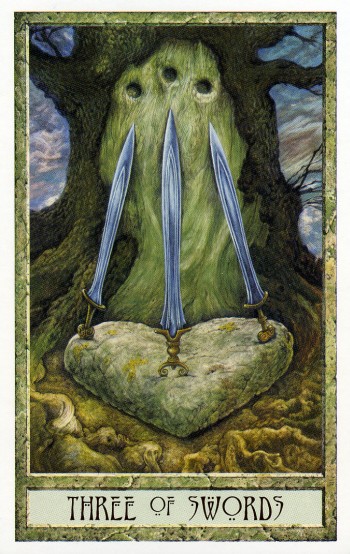 |
| The Druidcraft Tarot |
Not all men? Three of Swords says "Bet me." Because if "good men" are surprised, shocked, and dismayed at what they are witnessing now, they haven't been listening to women. If they haven't been listening, they were dismissive, complicit, and participated in the culture that allowed it. Too harsh? No -- that's real truth. Three of Swords.
What is the point? Truth, if told, needs time to journey from our ears and our minds to our hearts and our character. Being quiet. Listening from the inside. Four of Swords. Healing. Integration. Peace. We'll get there, if we listen, accept the truth, and listen some more.
 |
| The Druidcraft Tarot |
Monday, May 08, 2017
Hello Again

Hello...Testing...1,2,3. I have finally gotten around to uploading ye olde podcasts from ages ago and they have now gone live on Google Play Music and are almost live on iTunes. They are also over at PodOmatic. The Series on the Aces, The Tarot Court and other miscellaneous podcasts are now up and I'll be adding more until I exhaust my collection. Then I'll start recording new ones.
About time, right?


Sunday, February 12, 2017
The Spiral World
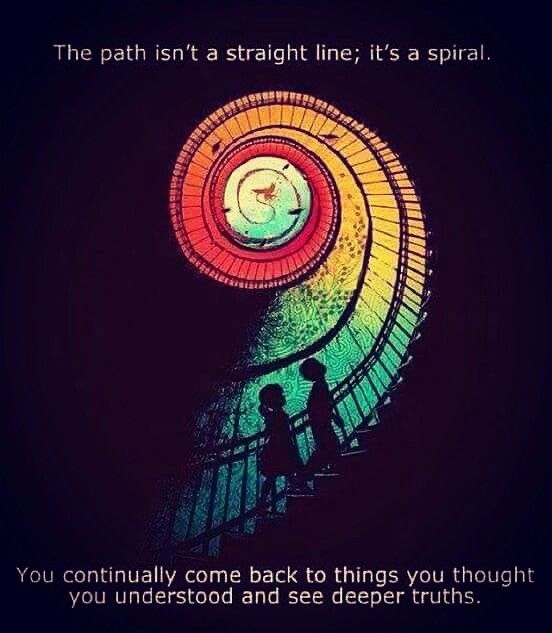
“Life is a
journey up a spiral staircase; as we grow older we cover the ground we have covered before, only higher up; as we look down the
winding stair below us we measure our progress by the number of places
where we were but no longer are. The journey is both repetitious and
progressive; we go both round and upward.”
―William Butler Yeats
―William Butler Yeats
I love metaphors to a fault. I know when I've traveled too far into metaphor land when my children snap back, "OK, Mom, ok, I get it, I get it." It's like when you've walked along a beach for so long that because the scenery still looks the same you have no idea how far you've gone. Enough with the metaphors. I can never get enough. Tarot, like metaphor, is illustrative language that tells a story and paints a literal picture in order to communicate a vital truth. I love tarot and I love metaphor, so yeah, not going to stop with the metaphors.
I have often heard the metaphor of an onion used to describe an internal process, be it of healing, maturity, or self-discovery. The idea of the onion metaphor is that we continually peel away layers of self to get to the core. The onion metaphor, however, did not line up with what I actually experienced on my personal trek through life. I found that when I overcame a particular personal obstacle or had a breakthrough that allowed me to move on, at some point later I would revisit the same issue. I thought that layer of the onion had been removed. Then a friend of mine shared that she thinks the path is more of a spiral. As we travel the spiral we certainly do revisit the same issues time and again but at a different level. Now that's a picture I can relate to because it mirrors what I have experienced in a more precise way than the onion metaphor.
From the golden ratio and the Fibonacci sequence, the spiral is a constant pattern in the universe. This is a widely observed phenomenon, though scientists have not figured out the "why." Maybe that's better left to philosophers, but the pattern is evident in everything in nature, art, biology, and The Universe itself.


The World card is about those times on our journey when we overcome obstacles, complete an objective successfully and feel joy, freedom and a sense of accomplishment. The wreath that encircles the dancer reminds us of these cycles and that we are never really finished. If you've ever played a video game with "levels" you'll know what I mean when I say this is the "Leveled Up" card. Completing a level is an accomplishment worthy of dancing in celebration, but as any gamer knows the next level will undoubtedly be more challenging and many of the same obstacles you met in the previous level will be presented again but will be more difficult to overcome. However, all along your journey through the levels of the game you have picked up tools and skills and armor to help you in the succeeding levels. In some games, you've also picked up allies who will help you as well.
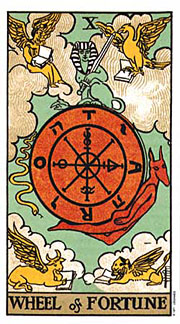
Wait, these cycles, aren't they what The Wheel of Fortune is about? Yes, but different cycles. The Wheel is most definitely about cycles but they are the typical rotations of life's whims and follies. In other words, fate. While our actions do certainly shape our destinies, we are never free from those events that occur outside of our control that impact our lives. The World, on the other hand, focuses more on how the individual has responded to those and other experiences in order to achieve the successful completion of a goal. The similarities between the two cards doesn't stop there. They each have heavenly beings in each of the four corners. They can be attributed to Christian symbolism of the four evangelists whose books are canonized in the reformed New Testament: Matthew -- a man; Mark -- a lion; Luke -- an ox, and John -- an eagle. These four Evangelists are also represented by the four fixed astrological signs: Leo, Taurus, Aquarius and Scorpio. In The Wheel's imagery they are each busily writing in books whereas in The World they are celebrating the success of the figure in the center. This conveys the message that the Divine was in the seemingly arbitrary events and that heaven was rooting for you all along.
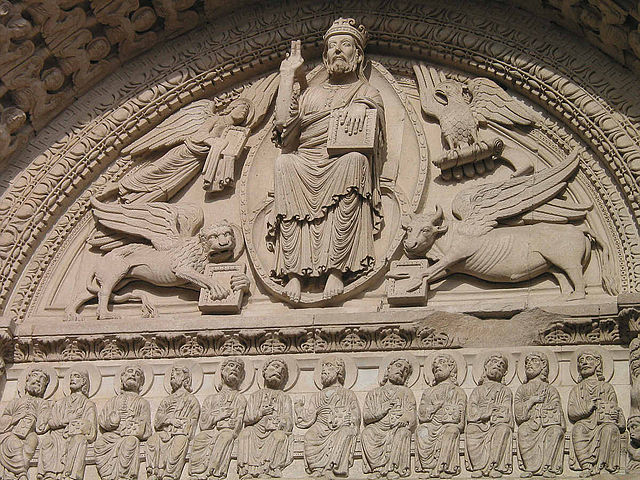 | |
| By Rolf Süssbrich - Own work, CC BY-SA 3.0, https://commons.wikimedia.org/w/index.php?curid=2567511 The four winged creatures that symbolise the Four Evangelists surround Christ in Majesty on the Romanesque tympanum of the Church of St. Trophime in Arles, France. |

Yet another symbol in The World card can be found at the very beginning of the Major Arcana within The Magician. The Magician holds a wand. The figure in The World holds two. This wand is distinct from the suit of Wands in the Minor Arcana. On the table before the Magician, that wand is lying along with symbols of the other suits. So the wand in his right hand with his left hand pointing downward is to symbolize his connection to the Divine and the power to bring forth the adage, "As above, so below." He is, in Waite's tarot, an adept who, unlike the charlatans of previous tarot magicians, seeks to express the Divine within as direct manifestation in his life on earth. The wands in the hands of the woman in The World card are not directly engaged in a concerted effort. She's barely grasping them and they are balanced equally. She's mastered something in her Divine nature and the manifestation is complete. Bravo!
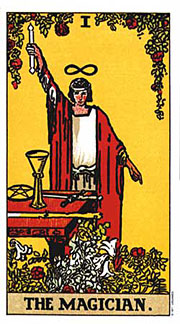
Resting on that laurel wreath is transitory because the next turn of the spiral is right after her last spin on the dance floor. She will find herself back at one, as a Magician, attempting to manifest yet another aspect of the Divine into her earthly existence. No doubt she will go over the same ground previously trod but with a new perspective gained from her last level.
In readings, some situations are readily seen as World events. Graduations, new parenthood, a promotion, an award, etc. I've seen The World show up when someone has been struggling to overcome a broken heart and is a very encouraging indication they are ready, finally, to move on. I've seen it say, "You're above this, don't stoop to their level." and "No need to go through that again, don't reinvent the wheel" (note reference to The Wheel). To a lesser extent this card can be associated with travel, not just a road trip, but more like the kind of travel that requires a passport or visa. However, more often it is a celebratory message that says "Go you!" The question remains, "What's next?"

Saturday, November 19, 2016
Me And My Shadow
“You spoke your words as though you denied the very existence of the
shadows or of evil. Think, now: where would your good be if there were
no evil and what would the world look like without shadow?”
― Mikhail Bulgakov, The Master and Margarita
― Mikhail Bulgakov, The Master and Margarita
It has been a hard year or so. That saying that goes, "Bad things come in three's" is a load of shit. Bad things come in two's, three's, four's, five's and so on. In the last year these are the things:
- The car died.
- The laptop died.
- My father died.
- My sister died.
- America died.
That last one was a wry joke my daughter made that still makes me laugh. Tori called me a few days after the election and upon hearing the depressed tone of my voice asked, "What's wrong, Mama?"
Sighing heavily I answered, "It's just hard to be positive right now. I know I'm depressed but I also know it's with good reason given this difficult year. I mean, my sister just died."
"And then America died," she quipped, and I burst into laughter. Thank goodness for dark humor right now.
The world seems a rather dark place at the moment. Putin and Assad are bombing children and kittens in Aleppo. Our soldiers are still killing and being killed in Afghanistan. President Elect Donald Trump (!) is surrounding himself with dark minions. I've gained 20 pounds in the last year, probably due to stress. The rent went up. My salary didn't. Mike lost his job. Despite mine and my family's efforts to save her, my sister died from leukemia four weeks ago. I've every reason to be depressed, but I don't want to be. I never want to be. Depression is a liar, a cheat, and a thief and it's running that train through my daily life.
I have learned from previous treks through this valley that I cannot combat depression by shaming
it away. I can't deny it away. I can't smile it away. I also can't do
nothing. The shadow of depression will thrive unless I sit with it,
face it, and accept the reasons it is here. I must remember not to
listen to its lies, but understand why it tells them. Every day, I am
determined to move in the direction of health and wholeness, but determined in bringing my
shadow with me for the lessons it teaches me are valuable.
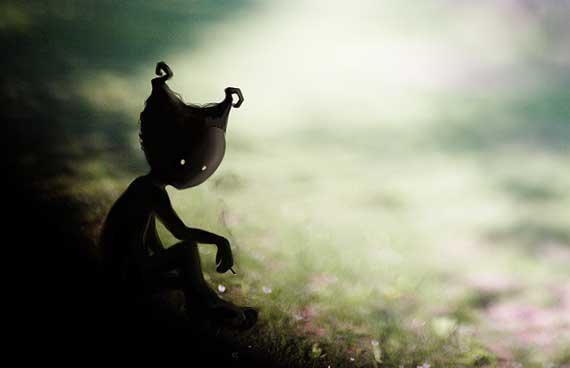
So I've been thinking this recent turn in cultural events is like getting the light switched off in a room and having to live with the shadows for a while. That isn't all bad. Just as individuals have a "shadow side" so do countries and governments. I'm not speaking politics here -- so this isn't me saying Democrats are light and Republicans are shadow, that would be nonsense. I am talking about the impulses that we'd rather not have or deal with in others: rage, jealousy, cravings, lust for power, despair and fear. These are the shadows that compel people to violence and petty meanness. These are the shadows we fear in ourselves and in others.
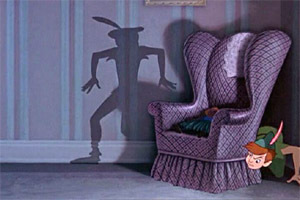
After all, one can’t leave his shadow lying about… and not miss it sooner or later, don’t you agree?
One of the most famous shadows in
American literature is Peter Pan's shadow. At one point in the story,
Peter Pan loses his shadow as it gets caught in the window at the
Darling's. He comes back to retrieve it and Wendy ends up sewing it
back on for him, for which he takes credit as his own accomplishment, a
rather shady thing to do. Separated, his shadow takes on an independent
life of its own and cannot be controlled by Peter. Most importantly,
Peter was not complete without it. Although Peter Pan is the eternal
child, his approach to his shadow is very mature. It's only as we grow
up and learn that certain actions and even feelings are not condoned in
our society do we attempt to dissociate ourselves from our shadow, thus
giving it more power and independence than had we accepted it and kept
ourselves whole.
Carl Jung said that anything of substance will cast a shadow. “How can I be substantial if I do not cast a shadow? I must have a dark side also if I am to be whole” We can't pretend these feelings and the actions based on them aren't real. We can't shush them away. Many in our society have tried through censure and shaming but that doesn't work.
 |
| Light & Shadow Tarot by Michael Goepferd |
On a cultural level we're seeing a lot of unrestrained shadows and I do think this may be because we've spent a tremendous amount of effort to deny their existence, a shadow-lash of sorts. I've heard white people who did not vote for Trump, post election, expressing that they were feeling on edge, frightened and ill at ease in their own communities. People of color, on the other hand, responded that this is how they have always felt. Confronting our own shadow now many are finally experiencing the reality that so many others have lived and we're learning that proclaiming oneself to be "color blind" is revealed to be the mechanic of denial that it is. "Safe spaces" are important, but in practice merely served to silence dissenting speech. We thought we could shush our shadows away.
To be clear, I am not speaking of individuals here -- not the guy with the Confederate flag on his truck chasing motorists of color, not those assaulting Muslim women, not the hurlers of racial and homophobic epithets, not even the ones sexually assaulting women a la Donald Trump in this post-election freedom of shadow expression euphoria. I am speaking of the impulse behind these acts, the parts of human personalities we try so hard to stuff away, ignore, deny, excuse, but never accept.
When we judge others so quickly and harshly, we're doing it. Blame is simply deflecting attention from the shadow. The parents whose child was killed by an alligator in Florida were met not with condolences, but attacks and shaming. Those who overdose on drugs are made fun of in videos. Black men shot by police are subject to a shaming post mortem. The unemployed are told to "get a job!" like that hadn't entered their minds before. We are such a weak and fearful society that cannot deal with shadows but this is precisely the environment in which shadows, separated, thrive.
Y'all need Jesus or group therapy or something.
Sunday, June 19, 2016
Is It Worth It?

When we find ourselves on a particular path that we've devoted a great deal of time and energy to, and the future being what it is, always uncertain, tarot can provide some valuable feedback that we can use to decide "is it worth it?" In fact, there is a specific tarot card for just this dilemma, the 7 of Pentacles:
 | ||
| Cosmic Tarot by Norbert LoscheUS Games 1986 |
Other cards in a reading can give important feedback for us to use when making this decision. The reading itself cannot and should not make your decision for you. Only you can do that. In reading for someone in this situation, even if the other cards show some unpleasant experiences, I always communicate that sometimes we have to get to that really tough place before we know for sure what to do. Or the cards may indicate a struggle to come before a success. So we have to be careful not to jump to conclusions based on seemingly "negative" cards surrounding this dilemma. For example, we might see this sequence:
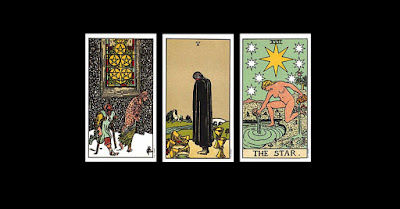 |
| Original Rider Waite Smith |
It appears there may be a tangible setback and a time of material change and struggle, missed opportunities for success or assistance, leading to some disappointment, loss, and regret, but then followed by a period of recovery and healing with clear signs you are now on the way to your goal. In this case, I would say don't give up when the going gets tough. You will come through to the other side having learned important lessons and with a clearer vision of where you are going, even though you will not have reached your goal, you will see what you are supposed to do. This still doesn't say whether the person will ultimately choose to continue or abandon the current project, but it lays out the likely progression which leads to knowing what to do.

In other readings there may be a very clear message to dramatically change direction. For example we might see something like this:
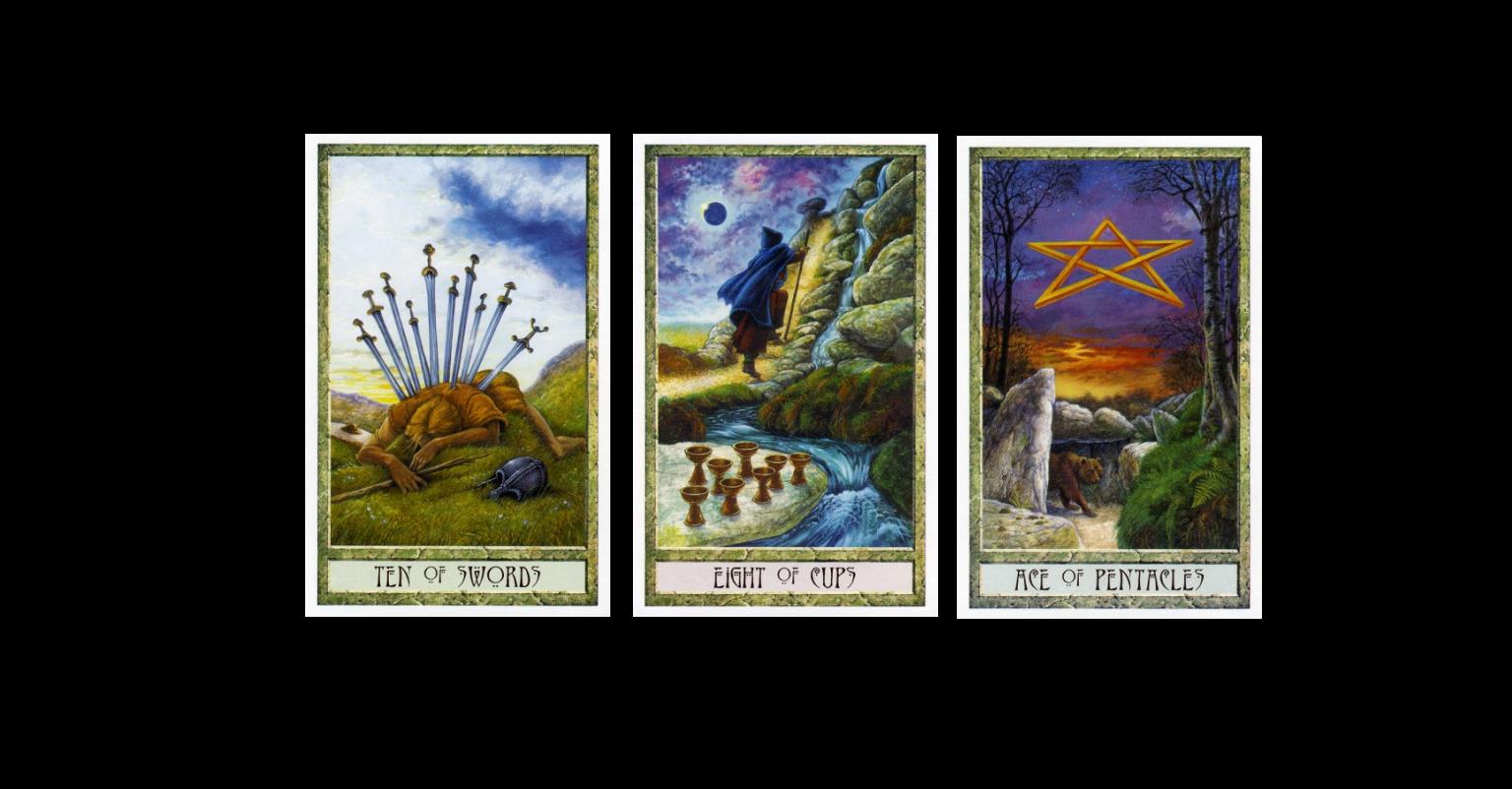 |
| DruidCraft Tarot © 2004 by Philip and Stephanie Carr- |
The 10 of Swords tells us it's done, there's no more that can be accomplished in the way you have been approaching things. The 8 of Cups shows an abandoning of a way of being that has become emotionally draining, unsatisfying, or stale. The Ace of Pentacles shows a new opportunity that has much more promise. So in this scenario I would urge my client to consider other options and to critically evaluate their current situation for signs that letting go and moving on would be the right choice for them.

This kind of objective feedback is extraordinarily helpful to one in the middle of a quandry over that assessment of whether something truly is worth seeing through or not. We're often given generic cheerleading advise to keep pushing, never give up, anything that's worth doing is worth giving your all, but sometimes that advice may not work for the specific situation you're dealing with. We also have to take into consideration our own patterns. Do we tend to start things and not finish, or only go halfway and give up? Or do we have a history of holding on to something long past its expiry date? Maybe it's time to change that.
Sunday, May 15, 2016
Hypervigilance Masquerading as Intuition

When we're ready to deal with some aspect of ourselves it often bubbles up just to the edges of our consciousness and we start seeing signs and clues for it everywhere. Like connect-the-dot puzzles, those clues lead us to confront, research, and deal with an issue that has been holding us back or hurting us in some way. The symptom of hypervigilance is my connect-the-dot puzzle right now. Specifically, as it relates to intuition. The other day I heard someone on the radio mention one of the symptoms of hypervigilance, which in itself is usually a symptom of PTSD, Post Traumatic Stress Disorder. This was just one of many "dots" that have presented lately. I have been in PTSD recovery for most of my adult life following an extremely abusive marriage in my early twenties. I have been somewhat hypervigilant all my life, probably stemming from childhood abuse.

When I escaped from the abusive asshole husband, I moved back in with my mom for a while. My brother was eighteen or nineteen and still living at home. One evening as my brother and I were talking in the living room we simultaneously noticed we were both nervously and repeatedly glancing out the front window during our conversation. We realized that we were mentally "on alert" for our mother's return from work. During our childhood our mother's mood upon arriving home from work tired and "hangry" was often very bad. We tried to secure her good favor by scurrying around, cleaning up, and whichever one of us was assigned dinner duty had to make sure it was well in process before she walked in the door. We sometimes sat nervously waiting for the car to pull into the driveway. Trying to work out from the way the car was driven, the way she opened and shut the door, what kind of mood she was in. Would this be an evening of calm or anger? At the time my brother and I noticed our behavior in the living room that day we were adults and had nothing to fear from the return of our mother. We awkwardly laughed at ourselves, aren't we being silly? Hypervigilance is subtle.
The negative emotional effects of my childhood were not severe. Like everyone, I had imperfect parents but my childhood experiences did not cause my PTSD. My mother was raised by an emotionally abusive mother and grandmother and alcoholic father who himself suffered from extreme combat PTSD. She married at nineteen and had four children. My parents divorced when the oldest child was nine and the youngest was two. My father was not involved in the child rearing except as financial support. Needless to say, my mother was emotionally ill-equipped to deal with it all and she made mistakes, some horrible. Still, she did her best and she did succeed in parenting better than her parents. Nevertheless, there were damages as there usually are, but I did not display the symptoms of PTSD proper until during and after my first marriage when I was faced with the perpetual threat of being seriously injured or killed by my intimate partner.

While many of my PTSD symptoms have diminished with therapy and the healing of time, I continue to be hypervigilant. I rarely experience flashbacks anymore. The more intense and obvious flashbacks are actually easier to manage after the initial freak-out. I can rationally understand that my current emotions are responding to a past situation and I ride it out, coping by focusing on the present reality. The smaller ones, however, fly under my radar and can trigger extreme hypervigilance that I don't immediately recognize as an inappropriate reaction. I think it's normal for me.
In a dictionary definition nutshell, hypervigilance is the condition of maintaining an abnormal awareness of environmental stimuli. It causes one's body and brain to perpetually maintain a heightened state of awareness which is part of the natural fight-or-flight response. What served as a necessary survival tool during the time of trauma continues on to become a part of one's everyday existence, seamlessly woven into every waking moment, every interaction.
On the plus side, it makes one very observant, keenly so. When it comes to "reading people" and scoping situations out, hypervigilance is like a sixth sense. Those with hypervigilance know more about what is going on than most people ever will. They pick up on others' moods and stresses, hone in on details most people miss, and spot the smallest change in their environments. In practice, hypervigilance seems a lot like intuition because this constant scanning for threats becomes second nature. We don't try to do it, we don't think about it, we just do it. It feels like a gift from the trauma endured. In some situations, truly potentially dangerous ones, it is a gift, but it comes at a cost. The price is paid in depeleted mental and physical energy and it could cost your relationships with others.

I think intuition and hypervigilance can merge. It can be difficult to identify which is at work because they share similar "knowing" and results. The main difference is in the physical sensations that accompany them. Hypervigilance is tiring. Exhausting, actually. I often get a sick feeling in the pit of my stomach or a clenching in my throat, and I become restless and there is a strong sense of urgency. That is how I feel fear. By contrast, intuition feels effortless. I am calm and relaxed and my mind just "knows" something or I mentally "hear" a phrase in my head. Hypervigilance develops out of fear and relentlessly gathers external clues. Intuition develops by following one's internal cues rather than external. This is one reason I prefer providing email tarot readings over face-to-face. I can't unconsciously scan the client's facial expressions or body language via text. There is less involvement of my hypervigilance and I can trust that my intuition is coming to the fore. The feedback from my clients suggests that my intuition is quite strong without the hypervigilance in play.
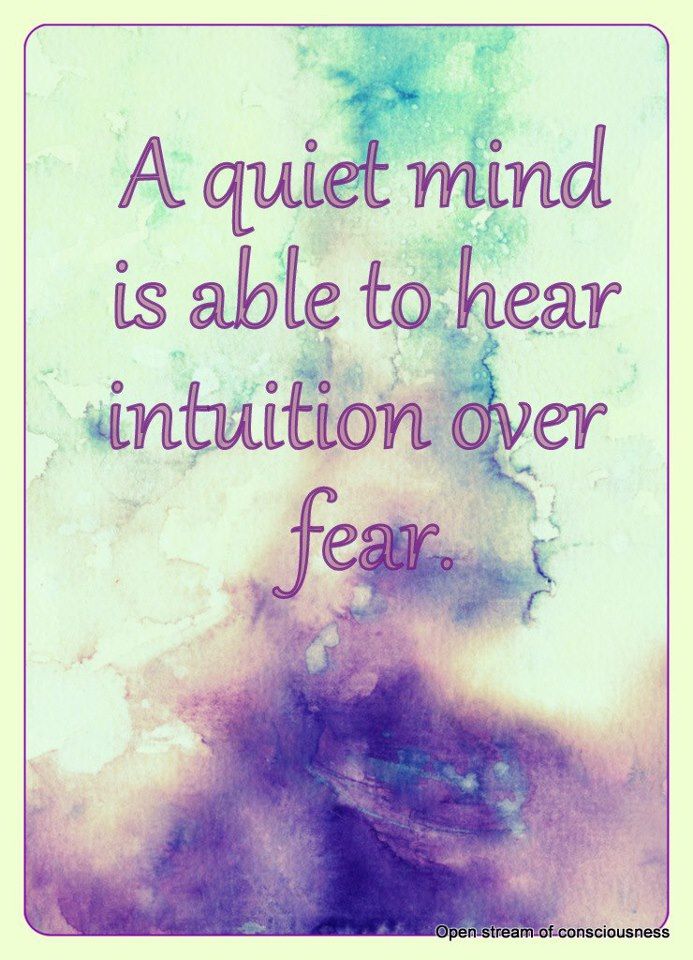
I suspect many people who have what they believe to be very strong intuition are also hypervigilant stemming from a past trauma. Identifying which is operating is key to reducing the cost of the hypervigilance -- stress. Stress, as we know, is incredibly unhealthy and damages the body and brain in measurable ways.

I'm partly loathe to give up hypervigilance as it has been my faithful superpower, but it has degraded my health and well being. I may never release it entirely but I plan to work to replace its function with my intuition. It is comforting to know that I also have developed keen intuition and can continue to strengthen that as I work to reduce the other. For now, I plan to take this wonderful advice given in this in-depth article, Searching for Bad News: The Circuitous Path of Obsessive Thinking by Dr. Heather Stone:
Live with ambiguity. Relax into knowing that, without hyper-vigilance, you have relatively complete and accurate information. The ambiguity that is in and around you is an unclear, imperfect, benign presence that can be trusted and accepted.
The Unknown that you fight so vehemently – that you fear, blame, rail against, and pray would become Real so that it could finally leave you alone – is often better than every known thing you have ever wanted to control. Let me put it another way: every good thing in your life that surprised you was previously unknown to you. You didn’t anticipate or create the people who showed up and loved you. You didn’t manage or direct the gifts that you were given, either literally or metaphorically. Live with the Unknown, because the stuff that will make you happy in life will be the stuff that you can’t control.
Saturday, January 30, 2016
It's Not About You

"Be careful not to practice your righteousness in front of others to be
seen by them. If you do, you will have no reward from your Father in
heaven."
-- Jesus, Matthew 6:1
When we are doing something that is intended to help someone else the most important thing to remember is that it's not about you. If you respond to that statement, "Well, of course it isn't, silly, I know that." I'm telling you it's harder than you think. Our ego is strong. And smart. And cunning. And it will sneak in self-congratulatory shit when you're not looking.
I read a really thoughtful article the other day on the dilemma of "Good White People" in the fight against racism. The comment section was full of irony, full of "good white people" making it about themselves and then noticing they made it all about themselves and trying to figure out how not to do that. It's hard. The main idea is that no one should feel the need to be congratulated for being a decent human being. You just be one as a matter of course. There are ways to bring important things to the attention of others without also saying, "Look at what a great person I am!" Sometimes we do this with good intention, but it still reeks.
I saw this today: Spiritual Molestation in Chik-Fil-A which I feel really nailed how I have always felt about people doing this sort of thing in public. What made this worse was the underlying coercion of food under condition of prayer. We might say, "What's the big deal? Even if you don't believe, prayer never hurt anyone." True. But to say that one will only help IF the recipient will oblige you is not giving, it's a negotiation. This kind of negotiation is sometimes appropriate but when we are holding something as crucial to life as food as a bargaining tool, we need to be very careful. If the manager of this restaurant really wanted to help this guy he had several options, none of which included making a display of his own faith for others to applaud. He could have asked the guy to meet him around back and take out the trash in exchange for the meal. He might have been able to offer him a job if he showed up every day to take the trash out (and get fed). The manager could have prayed for him silently without drawing attention to himself. I understand God can hear silent prayers.
I also saw this today on why this woman stopped "being a Voluntourist," that is, stopped going on aid missions to third world countries and started coordinating aid efforts that didn't involve her actually being there. The part about the workers coming behind them and tearing down their shoddily laid bricks and relaying them properly (and safely) in the night so the volunteers wouldn't know really brought the point home that these programs are too often set up in a way to be more about the volunteers feeling good about themselves than about the people they are trying to help.
Those who read tarot for others have that "helping others" gene. We truly want to facilitate growth in others and support them in their struggles. That's often the foundational impulse behind what we do. Like any other helping profession it can attract narcissists who get off on various twists of gaining attention, power, and ego stroking, but most of us just want to help. However, even the genuinely motivated ones among us can fall into the "About Me" trap. When we focus on whether or not we did it right, had the right answer, or found the correct interpretation. When we worry too much about the feedback from our clients. When we promote ourselves as super intuitive or act like our readings aren't wrong, the client just isn't in a place to accept the truth. Stop it. It's not about you. Yes, you are the one the client is looking to, but you know better. It's not you, it's them. It's their issue, their struggle, their dilemma, their questions. You're helping only if you understand this and take yourself out of it. The dialogue is between themselves and their understanding of the cards you have done your best to translate for them. You are the interpreter. The conversation is not about you. This subtle but important shift in focus will make such a huge difference in the impact of your readings. By impact I don't mean "accuracy," although that will likely be perceived as such, but by the real and actual help provided by the reading.
All this stuff about helping in a certain way gave me such food for thought because I find myself in a situation now where the last thing I want to do is bring attention to myself for doing something "good" when really, I feel that it's the only human option. My sister was diagnosed with leukemia in 2014. Chemotherapy put her in remission for almost a year. Then she relapsed. The next step is a bone marrow stem cell transplant. Of her three siblings tested, I am the match. In all honesty, I wasn't thrilled with the news and felt like an asshole for not being thrilled. It's not like giving blood, it's a much bigger deal. And the hospital where this will be done is 1000 miles away. There will be missed work, FMLA paperwork, travel time and costs, hotel costs -- all of which our mother is generously financing because it's not covered by my sister's health insurance. Not to mention the procedure itself will require me to be injected with a drug originally meant for cancer patients that disrupts my own bone marrow and causing bone pain for several days and having to sit immobile for six hours or more to have the stem cells harvested. So yeah, it's not nothing. But it really IS nothing when compared to what my sister has endured and will have to endure as the recipient of the transplant. Cancer has turned her life and the lives of her husband and children totally upside down and inside out in ways I'm sure no one but they understand. She recently started a GoFundMe drive in an effort to defray the monster costs of all of this. In my attempts to get the word out to others to hopefully increase donations, I have mentioned my participation in this effort as her donor, but I have tried not to make it about me. Because it's not. Even though it is a little, ultimately it's not. And I know people are just being kind and supportive when they laud me for the act of donating, and I thank them genuinely, but I cringe a bit at the comments that I am "being an angel" or that I am "so awesome." Thank you, and I mean that, but no, I'm not. I don't really see any other option except to be a shitty human being that would deny her the best chance she has to live. And to be honest, I felt weird about posting the GoFundMe thing because I didn't want to bring attention to my part in this but it seemed the best way to get donations for my sister.
I've been taking a break from reading tarot for others until the transplant is over. Just because it's not about me doesn't erase me from the equation. I must still be aware of my own needs else I become useless to others. Making it not about you doesn't mean nothing is about you. You are about you and you need to take care of you. Always remember the flight attendant adage -- "Place your own oxygen mask on first before assisting others."
Sunday, November 01, 2015
Your Mind is Mission Control

Knowing what to expect and expecting to know are two very different things. Miles apart, in fact. No matter how well prepared one may be for a particular possible outcome, when it happens it still comes with all its attending emotional baggage and camps out with you for however long it wishes. Therefore, knowing via tarot that the guy you've been seeing is likely seeing someone else on the side doesn't help the heartbreak or anger. We also can't expect tarot to provide all the solutions. It does help with many things -- a kind of psychic weather prediction or roadmap, a projection into what is probable and likely -- but not definitive. And it can't make your decisions for you. It can be quite informational but what you do with that information, how you choose to form your thoughts about that information will make all the difference in the actual outcome of any given situation.
Getting a reading on a situation is great for exploring. Possibilities, options, directions. A reading can reveal our own attitudes, intentions, and confirm our own intuition, but in the end how we choose to think about the information is what will impact our own outcome no matter what the external outcome of the situation turns out to be. Keeping tabs on your ex may be interesting and satisfying to that part of you that can't seem to let go -- out of love or vengeance, no matter -- but if the reading shows they are happily going about their lives, shouldn't you do the same? We can go back to the reader a month later and ask what the ex has been up to OR we could choose to think differently about the information and use it to release ourselves to our own lives. Going back to the reader is satisfying on some level, but it's a futile action, keeping watch on others (outside our control) or situations (outside our control). We become mere observers in our own lives rather than actively creating and participating.
Many readers will refuse to read on the same topic/person/situation on these grounds. They believe more readings won't help, it amounts to spying, and/or the repetitive readings may enable someone in a kind of tarot dependence. I don't really subscribe to all of that and I will read on the same topic/person/situation multiple times for a client because They Aren't Done Yet. When they are done, they will stop. When they are able to choose their thoughts more effectively, they will stop. Some people require only one reading for this and others require multiple. Each person is at their own level or ability to control their thoughts about any given situation. The more emotionally triggered they are, the harder that is to accomplish.
So we get that we can't control outside events or other people. What if the problem is we cannot control our own thoughts? Marcus, dude, it's not that easy. It's really not easy but it is crucial to one's well being and happiness. I suck at meditation because I can't control my thoughts. They scatter like a herd of cats being chased by a herd of puppies. Then I learned this ---

Some situations will never feel okay. One may never feel "at peace" with a particular outcome. But one can accept it and move on. It's a choice, a conscious decision. We make mistakes. We fuck up. Bad things happen that are our fault, but if we allow guilt, regret, or fear of making the same mistake again to control our choices and decisions going forward, we will simply have different regrets to obsess on later. I think regret is an inevitable constant in life, so we just have to learn not to let it control us.
When we experience something we feel feelings about it. Most of us believe those feelings are what inform our thoughts about the experience -- and they can. However, feelings actually reside in the brain and how we think results in feelings not the other way around. How we perceive an event or experience is a kind of thinking and feelings are a kind of thinking. So the real process looks like this:

Ever wonder why, no matter how many times you tell yourself you will not do something, no matter how many thoughts of inspiration, encouragement and willpower you think you end up doing that thing you specifically told yourself not to do? That's because our actions come from our feelings. BUT -- our feelings come from our thoughts. Sometimes it takes a while for our feelings to catch up to our new or different thought process, but we will finally see our actions in alignment with our thoughts if we force ourselves into the rather uncomfortable process of re-directing of our thoughts. Thinking about things a different way than we are used to, seeing it from a completely different angle. Eventually we will feel differently about the situation and once that happens, actions happen in accordance to the thoughts. But it can take a while. You know, like this:

Subscribe to:
Posts
(
Atom
)