
I was struck by something Roswila said over on her blog, Roswila's Tarot Gallery & Journal , that it has really got me thinking about how different people learn tarot differently. She said:
"Tarot cards are like people. We get to know them more or less well, but never completely. And like people, they change over time and with experience of them. This is not to say we can't really know a card. Anymore than one would say one doesn't really know one's best friend or mate or lover. Simply that with these cards we form, as with people, many-faceted, living, changing relationships."
Now, how true and insightful is that? While there are many basic, how-to manuals on tarot reading and classes you can take, and while I'm not devaluing those at all, I have to say they just never worked so well for me. Mind you, I have entire shelf devoted to tarot books and they've all helped me understand various facets of tarot, but how I came to know tarot was simply by developing a relationship with the cards themselves. I say "simply" but it really isn't all that simple. Just like any good relationship it takes time and effort and listening. It takes remembering the details and asking questions. It takes devotion and interaction on a daily basis.
A relationship? With bits of cardboard and ink? While you wonder a bit about my sanity, let me explain. If I can. A book about tarot will give you a range of pretty standard meanings of the cards. Each author has their own, developed through their own relationship with their decks, so the meanings will vary some depending on who is giving them. I have many books that came with the decks themselves and these will usually tell you what the deck designers intended to mean, what they hoped to convey through the images on their cards. Of course art is very subjective, so what you see in any given piece of art may be something entirely different from what the artist intended. A friend of mine, a photographer, has said that this is one of the exciting things about presenting her art to the public: to see the way her art speaks differently to different people, often saying things to them she'd never considered when she created it. That exchange becomes a conversation all its own and once a piece is released to the public, she no longer has control over that conversation and how it evolves. This can be frustrating sometimes, but more often it is fascinating to discover how different our perceptions are when we each gaze at the same exact thing. The same is true for tarot and which is why you will find so many varied meanings published for the same card. For a beginner, this can be frustrating. You want to know, which is it? Does this card mean this or that? Oy! So confusing!
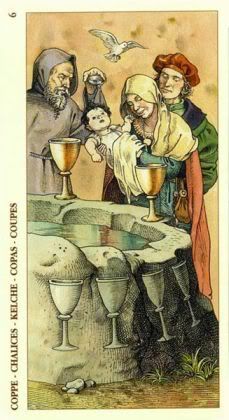
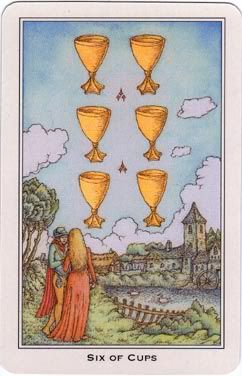
Add to that confusion the fact that different decks depict different images for each card. Sometimes the only common theme between two six of cups cards is the fact that they each have six cups on them. Take for example the Nigel Jackson six of cups here on the left and compare it with the Durer on the right. Utterly and completely different! The commonly understood meanings for this card have to do with nostalgia, blessing, a gift from someone in your past, an old friend or lover returning, things like that. We can kind of see those things in the Nigel Jackson image, possibly, and the baptism scene in the Durer highlights the blessing aspect, but really the scenes are so different that the reader must listen...yes, listen...to what the card itself is saying moreso than rely on those standard, generic meanings. Hear your own thoughts as you look at the image, feel what you feel and name what you feel. Notice colors and arrangements of people and objects. Ask yourself what they might be thinking and saying. Look for symbolic things, such as the dove over the baby in the Durer card and the sense of "home" you see in the town depicted in the Nigel Jackson. Let the cards tell you their story. Don't rush. Listen. And learn.
Each deck has its own stories, it's own set of symbolism, its own tarot dialect. It's best if, at first, a beginner chooses one deck and works with it until she learns the deck's language. Until there is reciprocal conversation going on between them. Certainly, you don't actually need more than one deck, but as your interest in tarot grows, so will your deck collection, more than likely. It's like adding more friends to your life, it just makes life more interesting. Different people have different things to say and so do different decks. In this way, too, you will come to understand and appreciate the different "personalities" of decks.
Is this just anthropomorphizing going on here? Well, maybe a little. But I will swear the Fey deck got so frustrated with me one night it all but revealed its arse to me and flipped me off. Now, you have to be quite antagonizing in order to get fey folk pissed off at you, but suffice it to say I was being quite insistent and repetitive and they had clearly given me an answer I didn't care to hear and I was, at that point, making myself a nuisance. There are those who swear the Thoth deck is scathingly blunt and will give negative readings just for sport. I have found that the Gilded doesn't mind lighthearted, playful questions but the Haindl always takes things far too seriously and just doesn't get the joke, preferring instead to find the deep, spiritual meaning in things.
What?!? It's true, I tell you, all true. Spend enough time with a tarot deck and you can talk like a crazy person, too.


You are hitting the nail squarely on its little head in every post, Sophia. Now you've got me wanting to begin a Tarot journal, since I tend to learn and process by writing about stuff. Talking too, yes, but few to really talk Tarot to are around me right now. I don't want to burn out my intuitive young daughter. ;)
ReplyDeleteJournaling your thoughts about tarot is often highly recommended. Me, I get grand ideas about journals, way too ambitious, and end up starting and not keeping up with them, or just being very haphazard. My suggestion would be to keep it simple and easy, no internal judge telling you how to do it, just free form. No systems. You'll be more likely to like doing it. Online is great, too, just like this one. :)
ReplyDeleteI hear ya. I've started and dropped too many blogs. What I've done is picked up an old blog that I let lapse and I'm turning it into my freeform Tarot musing blog. So the archaeomom8 one at LJ is for my daily stuff, work, archy stuff, family blahblah, etc., and the bloggger one will be mainly for working out Tarot. I'll sign in with that name and hopefully you can click and access it. If I fail I'll try again.
ReplyDeleteOh, Sophia, I am so ... honored? ... verklempt? ... that this wonderful article was in any way prompted by my quote. You cover the topic so well. And I can only agree with it all!
ReplyDeleteblessings,
Patricia (a/k/a Roswila)
Of course! Your analogy of one’s knowing the cards as ever-changing as in a human relationship was so perfectly applicable to how I have come to understand them and will, no doubt, continue to grow in understanding. I loved how you said we can never fully know them just as we cannot fully know another human being because as we change and grow so do our understandings of the cards. It really IS about “relationship” and “dialogue” with these funny scraps of paper.
ReplyDeleteYou're so right! my Hanson Roberts will tell me anything! but the Morgan Greer will only speak about mundane issues :)
ReplyDelete>the Haindl always takes things far too seriously
ReplyDeleteThat's true, that's true :-)
See? Now, I'm not the only crazy one who hears the cards talking, am I? They truly do seem to have their own "voices" and "personalities" once we get to know them, right? This is why I don't usually offer a choice of decks to my clients. I have come to understand the language in which each deck "speaks" to me and therefore I usually know which one will render the kinds of answers I need.
ReplyDeleteAnd :D LOL, flavio and aguaclara. I don't have the Hanson Roberts, but yes, the Morgan Greer does seem to stick to the day to day issues. And the Haindl? Like telling jokes to a monk on retreat. Great for spiritual and deep, personal readings, though.
Browsing, I just came across this older post w/commentage. When you all were first talking I only used between 1 and 3 decks and wondered if I would ever reach the point of being able to discriminate meanings using varying symbolism - without relying too much in "traditional" meanings.
ReplyDeleteNow I've ventured into many more of my collected beauties and see what you are saying. So true...It's beginning to come clear for me too. These days I'm much more likely to listen to the card and the deck than what I originally learned. I still consult books a lot but the intuition is kicking in more. :)
It's a whole new word that opens up when that happens. I remember how it began to start in whispers for me, but when the Vacchetta tarot started "talking" -- and this deck is not RWS based, so it had to tell me everything -- I was amazed when I could actually understand its language. So cool, kat! Isn't it cool?
ReplyDeleteLol, had to comment on this one. I've only had one deck, from the beginner's guide to tarot, but it does have moods when it wants. It especially likes to add one final shocker to the info as I'm shuffling the cards back in. Especially for relationship questions. Imagine the akwardness of explaining to your friend, in the back of science class, that her next boyfriend would have had a gay experience! And in the end her net boyfriend did have one, which kinda made my ears bleed when she told me, tmi...
ReplyDelete